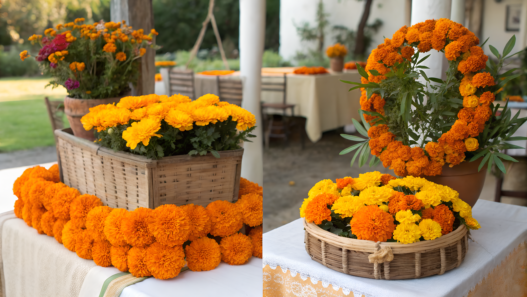
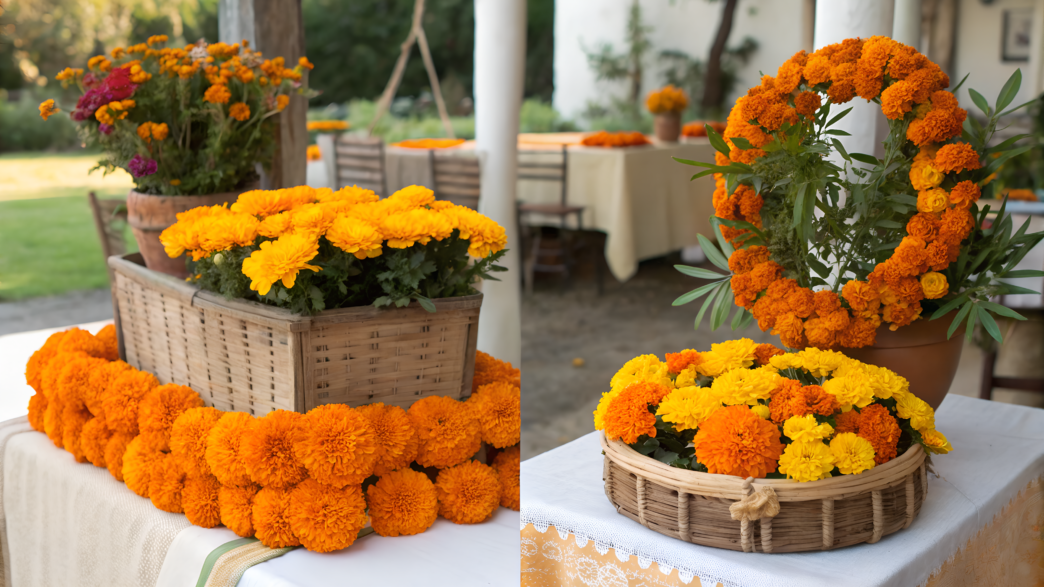
We’re all used to seeing marigolds in garden beds, along walkways, “for practical reasons.” But over time, you start to realize that marigolds can do so much more.
In this article, I tried to bring together 10 decorative marigold ideas for every season — from summer parties and weddings to calm, cozy fall decor. There’s no complicated floristry here, no overpriced solutions, and no decor just for the sake of decor. Only fresh flowers, simple techniques, and that balance between beauty and a feeling of home that we value so much at Rooted Revival.
None of this is theory. These are simply ways to use marigolds so they support the atmosphere instead of stealing all the attention.
1. Marigold Garlands for Festive Occasions
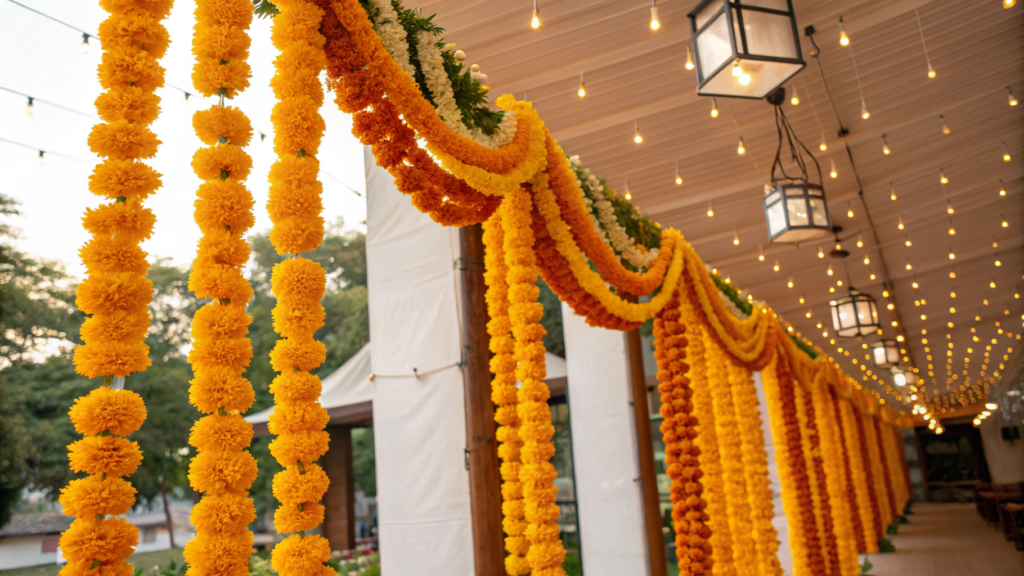
For a long time, marigolds were just the “workhorses” of the garden for me. Protection. Benefits. Smell. Pest control. Everything practical. Everything to the point.
One summer, I cut a big armful of fresh marigolds and set them on the table… and suddenly noticed that these flowers alone already felt like a celebration. No string lights. No balloons. Just living, warm, sun-colored blooms.
Why marigold garlands work so well
First of all, marigolds are sturdy. Their blooms don’t fall apart after an hour and don’t look tired by evening — even in the heat. Tested many times.
Second, the color. Yellow, orange, warm copper — these shades literally light up a space, especially against wood, linen, rough fabrics, and greenery.
And then there’s the scent. It’s not floral in the classic way. It’s herbal and alive. Outdoors, it feels especially right.
Where these garlands really shine
I use them most often for:
- summer and fall family gatherings
- backyard birthday parties
- harvest parties and fall gatherings
- casual, non-formal weddings (yes, we did this for friends)
- long tables under a canopy or pergola
They work indoors too, but outside is where they truly come alive.
You’ll need
- fresh marigolds (about 30–40 blooms for a 6–8 foot garland)
- strong cotton string or jute
- a large-eye needle
- scissors
How to Make a Marigold Garland
- Cut the flowers at the right time. Morning or late afternoon works best, when the sun isn’t too strong. The flowers are more hydrated then and hold their shape longer. Leave about 1–1.5 inches of stem so they’re easy to work with.
- Thread the needle through the base of each flower. Go through the base near the calyx, not through the petals. This keeps the bloom secure and helps it stay upright instead of drooping later.
- String the flowers close together, but don’t squeeze them. Let the blooms touch, but don’t press them tightly. Too much pressure makes the petals darken faster and look tired.
- Tie a small knot every 6–8 flowers. This step isn’t mandatory, but it really helps. The garland stays stable, especially if you’ll be moving it or hanging it outdoors.
- Use the garland right away or store it properly. If you’re making it ahead of time, wrap the finished garland in a damp cloth and place it in the fridge. It will keep well for 12–18 hours without losing its fresh look.
Small details that make a difference
- Alternate larger and smaller blooms
- Add small touches of greenery (a sprig of rosemary or bay leaf works beautifully)
- Use natural rope instead of synthetic cord
- Hang the garland slightly off-center, with a gentle drape
Once, we made marigold garlands for a long outdoor table — about 10–12 feet long. By evening, as the sun went down, the flowers practically glowed against the wood and old boards.
And it was very simple: we stepped into the garden. Looked around. And used what was already growing right there.
2. Table Centerpieces with Fresh Blooms
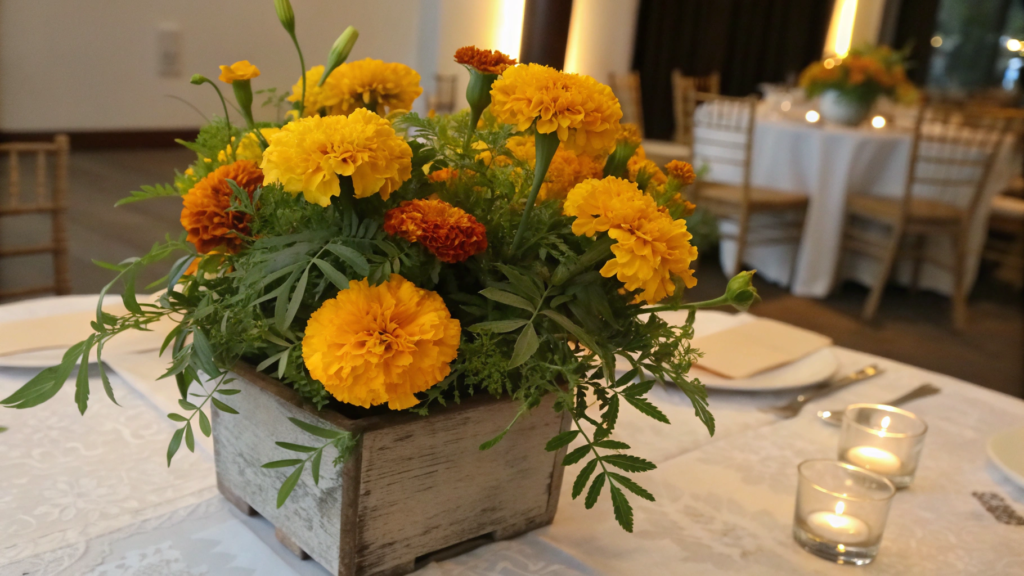
In a table centerpiece made with fresh marigolds, it’s important that everything looks natural, not like loud, attention-grabbing decor. I honestly can’t stand that. But when the flowers look like they’re there simply because they feel good there — that’s my kind of setup. When the table doesn’t look festive on purpose. Just alive.
This is my favorite option for:
- outdoor family dinners
- fall brunches
- small gatherings without a formal dress code
- long tables where you want warmth, but without visual overload
Why marigolds are perfect for table centerpieces
First, they don’t fall apart in arrangements, even without floral foam. The blooms are dense, and the stems hold their shape well.
Second, they look great at eye level, not just from above. That matters for a table where people are actually sitting and talking, not just taking photos of the food.
And one more thing: marigolds don’t look fragile. You’re not constantly worried if someone bumps the vase or kids run past the table.
Containers that work best
I’ve tried a lot of options, but I keep coming back to simple ones:
- glass jars with a volume of 16–32 oz (≈ 0.5–1 L)
- low vases about 4–6 inches tall (≈ 10–15 cm)
- plain ceramic mugs without patterns
- old milk bottles
If I want a clean, put-together look without hunting through thrift stores, I sometimes use Clear Glass Cylinder Vases Set — they’re versatile, transparent, and always look good.
How to put together a marigold table centerpiece
You’ll need:
- fresh marigolds (5–9 blooms per arrangement)
- a vase or jar
- clean water
- garden scissors or pruners
How to do it:
- Prep the flowers ahead of time. Cut the marigolds and let them sit in water for at least 30–60 minutes. This helps them hydrate and stay fresh longer, especially if the table will be outdoors.
- Trim the stems to match the height of the container. The flowers shouldn’t be too tall. Ideally, they should just rise slightly above the rim, without blocking people’s faces across the table.
- Start with an odd number of blooms. 5 or 7 always look more natural than 6 or 8. It’s a small detail, but the eye catches it immediately — even if you don’t consciously notice why.
- Leave some air between the flowers. Don’t pack the vase tightly. Let each bloom be visible. Marigolds shine because of their shape, not because of mass.
- Check the arrangement from table level. Sit down. Look at it from a guest’s perspective. If you feel like removing one flower — do it. That instinct is usually right.
Small touches that make the arrangement feel “richer”
- use one variety of marigold, but in different sizes
- add one subtle accent, like a sprig of herbs or greenery
- keep the table as simple as possible so the flowers can breathe
- use several small arrangements instead of one large centerpiece
One of the warmest tables we’ve ever had looked almost empty: wood, plates, bread… and a few low jars of marigolds. No tablecloths. No extra decorations. And somehow it felt so homey and inviting that everyone just wanted to sit a little longer.
3. Combining Marigolds with Candles
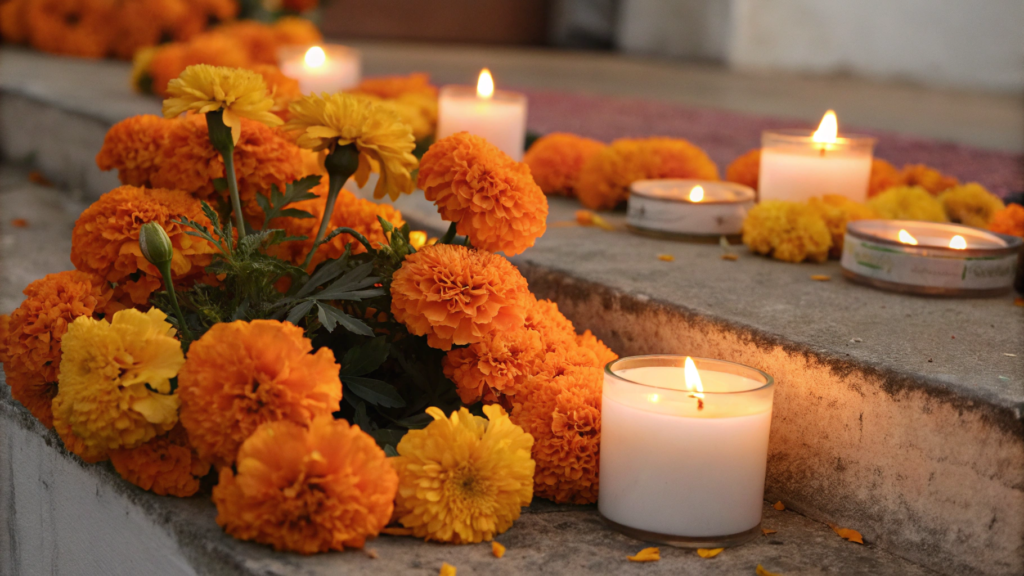
Marigolds start to look completely different when there’s real fire nearby. Not electric light. Not string lights. Actual candles.
I really love pairing marigolds and candles, but I always do it carefully. This is one of those combinations where it’s very easy to overdo it.
Why marigolds work so well with candles
First, the color. The orange and yellow tones of marigolds reflect warm candlelight instead of absorbing it. The flowers literally look like they’re glowing from the inside.
Second, the texture. Dense petals next to soft, living flame create contrast — and the table immediately stops looking flat.
Where this combination works best
I use it most often for:
- outdoor dinners
- fall celebrations
- casual, non-formal weddings
- harvest dinners
- evenings where light matters more than decor
If the event is during the day, candles aren’t needed. If it’s in the evening, marigolds without fire lose half of their effect.
The best types of candles to use
Here’s a clear list of my favorites:
- pillar candles about 4–6 inches tall (≈ 10–15 cm)
- tealights in glass holders
- candles in simple glass or metal holders
- outdoor lanterns with protective glass
I often use Unscented Ivory Pillar Candles — they give off an even, warm light and don’t interfere with the smell of food or flowers. Scented candles next to marigolds almost always create unnecessary noise — the smells start competing, and you can feel it.
You’ll need
- fresh marigolds
- candles (about 1 candle for every 12–18 inches of table length)
- candle holders or glass cups
- small containers for flowers
- water
How to Safely and Beautifully Combine Marigolds with Candles
- Decide who’s in charge first. If the table is long, let the candles set the structure, and use marigolds to fill the space between them. On a smaller table, it usually works better the other way around — flowers as the base, candles as accents.
- Place the candles first. This makes everything much easier. Fire immediately defines the layout, and flowers are far easier to fit into an existing structure than to arrange around later.
- Keep the flowers below the flame level. Marigolds shouldn’t reach upward. They work best when they sit at the base of the candle or slightly below, so the light falls softly onto the petals instead of fighting them.
- Leave air between the elements. Keep at least 3–4 inches between flowers and flame. This matters for both safety and visual balance. When everything is too close, the setup starts to feel tense.
- Always check the setup in the dark. Turn off the lights, light the candles, and sit with it for a minute. You’ll immediately see what feels unnecessary. Usually your hand reaches out to remove one element — and that instinct is almost always right.
There’s one trick I especially love: different candle heights in the same color, a bit of asymmetry, and empty space between objects. These pauses amplify the light more than any extra decor ever could.
A quick word about safety (this matters)
Marigolds look dense and “calm,” but they’re still dry petals next to open flame. I always treat this combination with attention.
Candles are best placed in glass or metal holders so the flame is protected from wind. Flowers should never hang over the fire — even if the distance feels safe. At least 3–4 inches between petals and flame is a rule I don’t break.
If there are children or pets around, I choose one larger candle instead of several small ones — it’s much easier to control. And candles are always the first thing to be blown out, before guests start leaving.
You want the evening to be remembered for the conversation and the light — not the smell of burnt petals.
4. DIY Marigold Wreath for Front Door
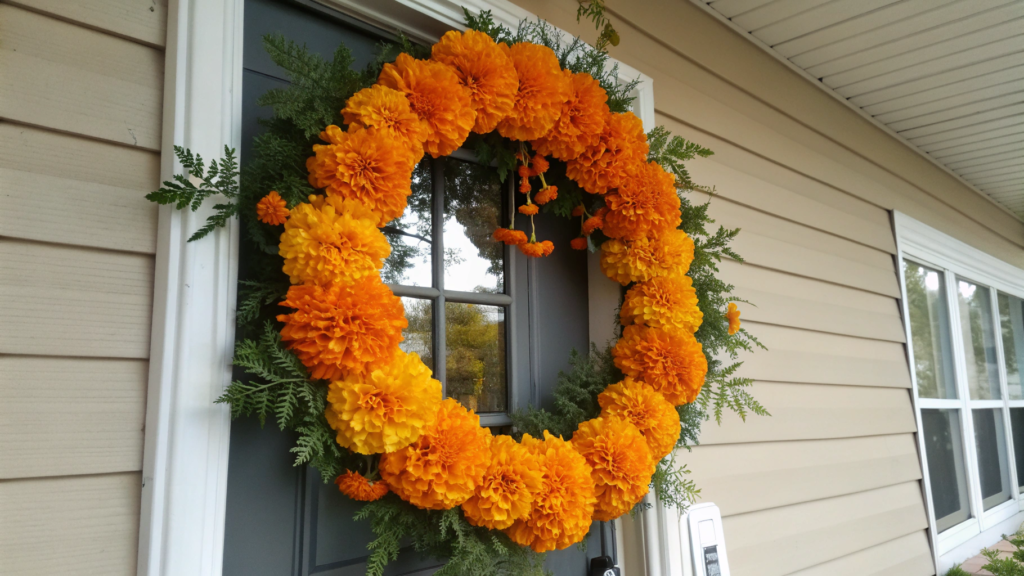
Unfortunately, marigold wreaths don’t last long. This is a temporary decoration that creates a feeling — right here, right now.
My first wreath wasn’t perfect. Not symmetrical. A bit too dense in places. But it was alive. And you could feel that immediately.
Why marigolds work better for wreaths than you might expect
Marigolds are sturdy. That matters. Their petals are dense, the color holds well even without water, and the blooms don’t fall apart after a couple of hours like many other garden flowers. And then there’s the color — warm, sunny, and very visible against wood, metal, or a neutral-colored door.
Even when the wreath starts to dry, it doesn’t turn sad or dull. It simply changes. The color shifts into deeper, more autumn tones, and that transition feels natural.
Where this kind of wreath works best
It really shines in late summer and fall, when you want to add warmth to your home without pumpkins, ribbons, or obvious seasonal symbols. I hang these wreaths on the front door, on garden gates, or on a wall under a covered porch. Sometimes even indoors, if the space allows and it’s not too warm.
It’s important to understand this upfront: this is decor for a few days. Usually 3–5 days on a door, a bit longer in shade or indoors. And you have to be okay with that.
What you’ll need
- fresh marigolds (about 40–60 blooms for a wreath 14–16 inches in diameter)
- a wreath base
- floral wire or thin jute
- pruning shears or garden scissors
- a hook or ribbon for hanging
I often use Grapevine Wreath Base — it looks natural and holds its shape well, even when the flowers aren’t placed perfectly.
How to make a marigold wreath
- Prep the flowers. Cut the marigolds and sort them by size. Larger blooms for the outer circle, smaller ones for filling in. This makes the process much calmer and saves a lot of nerves.
- Choose your direction. Before attaching the first flower, decide whether you’ll work clockwise or counterclockwise. This helps the wreath look intentional instead of chaotic.
- Attach flowers in small bundles. I usually group 2–3 flowers together and secure them with wire at the base of the stems. This adds volume and keeps the fastenings less visible.
- Work from the outside inward. Start with the outer ring, then fill in the center. If you do it the other way around, wreaths often end up uneven.
- Leave small gaps. Don’t try to cover everything completely. A few open spaces make the wreath feel alive and less “florist-made.”
- Hang it and step back. Put the wreath on the door and walk a few steps away. If you feel like removing one flower — remove it. That instinct is almost always right.
Small details that make a difference
- mix different shades of marigolds, not just one color
- add a little greenery, very sparingly
- avoid bright ribbons — they compete with the flowers
- remember that asymmetry works better than perfect balance
One of the wreaths I remember most lasted only four days. Then the flowers started to dry, and I took it apart and put everything into the compost. And somehow, that felt exactly right.
5. Floating Marigold Bowls
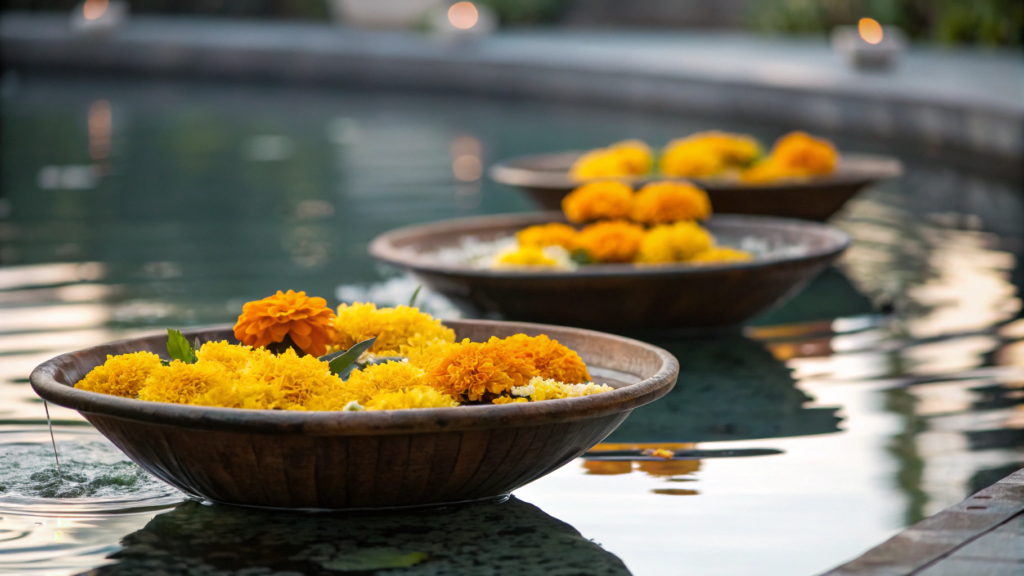
Floating marigolds mean no structure, no “built” shapes. Just water, flowers, and light. Simple, beautiful, and calming.
Why floating marigolds work so well
Water immediately takes away part of the visual noise. The flowers stop “standing” and begin to float in space, even when they’re literally resting on the surface. Marigolds are perfect for this: the blooms are dense, the shape is round, the petals hold together, don’t turn mushy, and don’t lose color after half an hour.
These arrangements don’t block the view. They stay low, don’t interrupt conversations, and don’t divide the table into sections. This really matters for long tables or evening gatherings where seeing faces is important.
Where and when these bowls work best
They work best in summer and early fall, during hot days or warm evenings. I use them for outdoor lunches, tables without tablecloths, and relaxed gatherings without a formal plan. They look great on wood surfaces, stone, concrete, and — unexpectedly — on old metal tables.
They also work indoors, but balance matters there. One bowl is enough, two at most.
What you’ll need for a floating arrangement
You don’t need much:
- a wide bowl or low dish
- clean water
- fresh marigolds (usually 5–9 blooms for a bowl 10–12 inches wide)
- candles, optional
How to make a floating marigold arrangement
- Choose the right container. The bowl should be wide and not too deep. Tall sides kill the effect, and very small bowls look random.
- Don’t fill the bowl to the top. Leave about 1–1.5 inches of space. This keeps water from spilling if someone bumps the table.
- Prep the flowers. Cut marigolds without stems or leave just about 0.5 inch. The flower should rest on the water, not stick up.
- Place the flowers one at a time. Don’t drop them all in at once. Watch how each bloom settles and how the spacing changes. This is a slow process — and that’s the point.
- Leave space between the flowers. The blooms shouldn’t touch. Water is part of the composition, not empty space.
- Add light if it’s evening. One small floating candle in the center or near the edge changes everything. Just one. More than that is too much.
Small details that make the arrangement work
- use marigolds of different sizes
- don’t mix too many shades in one bowl
- change the water if the arrangement lasts longer than one day
- place the bowl where there are reflections — near windows or fire
These arrangements don’t last long. Usually one day, sometimes two. But they don’t need to. It’s a moment, captured in color and water.
6. Using Marigolds in Wedding Décor
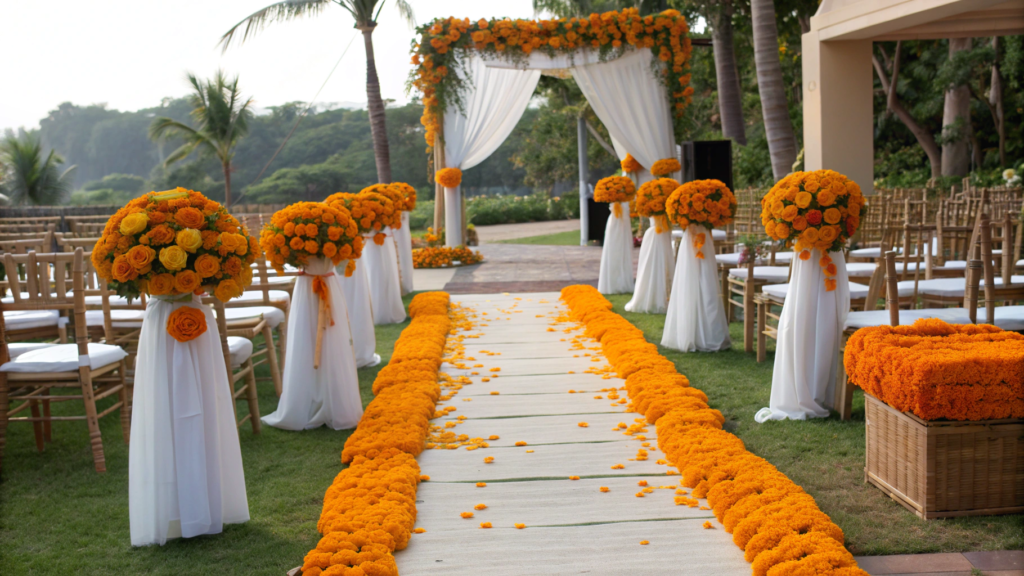
If you handle them carefully, marigolds in wedding décor can look unexpectedly elegant. Warm. Alive. And far from anything cookie-cutter.
While preparing a wedding for friends, I tried to stick closely to what they wanted: no roses, no “classic” arrangements. They wanted the day to feel real, not rented. We didn’t use marigolds everywhere — only in specific places — and that turned out to be the key.
Why marigolds actually belong at a wedding
First, the color. Marigolds offer rich shades, from soft yellow to deep orange. They work beautifully against wood, linen, ceramic, concrete, and greenery. They’re especially strong in late-summer and fall weddings.
Second, the shape. Round, dense blooms add volume without looking fragile or overly “floristy.” That matters when you’re creating an atmosphere, not just decorating a space.
Where marigolds work best in wedding décor
They feel most natural in table centerpieces, garlands for long farm tables, and small accents in the welcome area, near the seating chart, or at the drinks bar. Sometimes they work well in wreaths or small bouquets for bridesmaids.
I almost never use marigolds as the entire bridal bouquet. But they’re perfect as an accent — 2–3 blooms paired with greenery or neutral flowers work beautifully.
How to use marigolds without overwhelming the space
There’s one simple rule here: use less than you want to. Choose one role for marigolds and stick to it. Just the tables. Or only the ceremony area. Or a single pathway with arrangements. When they’re everywhere, the color starts to press in too hard.
Odd-numbered groupings work especially well: 3, 5, or 7 blooms per arrangement. And almost always, marigolds look better paired with greenery — eucalyptus, olive branches, fern, or bay.
How to build a simple wedding arrangement with marigolds
- Define the wedding style.Marigolds work best in outdoor, rustic, garden, farm, or boho settings. In an ultra-classic wedding, they tend to feel out of place.
- Choose a limited color palette.One marigold shade, or two neighboring tones, is enough. The calmer the background, the stronger the effect.
- Keep arrangements low.Flowers shouldn’t block the view. Marigolds look best at table level or just slightly above.
- Use greenery as a pause.Green elements give the eye a break and make the marigold color feel deeper and more grounded.
- Check everything in evening light.If candles are part of the plan, always look at the arrangements in low light. Marigolds change noticeably under warm lighting.
Small details that often make all the difference
- use different container heights, but keep the same style
- mix marigolds with neutral flowers
- leave open space between arrangements
- don’t be afraid of imperfection — it supports the atmosphere
At that wedding, marigolds appeared only on the tables and in the ceremony area. No arches. No overloaded arrangements. And in the end, guests didn’t remember the flowers themselves — they remembered the feeling of warmth and simplicity they created.
7. Marigold Arrangements for Outdoor Parties
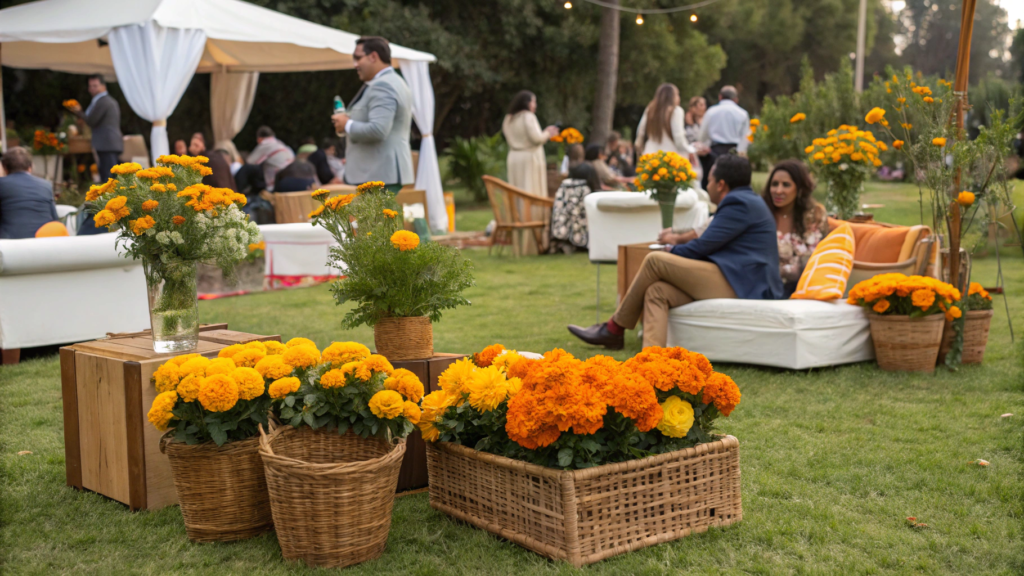
I especially love using marigolds for outdoor parties where there’s no strict script: people move around, switch seats, some stand with a plate, others sit on the edge of the table. In settings like this, complex décor starts to get in the way very quickly. Marigolds don’t. They work quietly in the background, creating a feeling of celebration rather than a staged setup.
Why marigolds are perfect for outdoor spaces
First, their resilience. Marigolds handle heat, wind, and temperature swings without any drama. They don’t slump after an hour and don’t need constant attention. That’s a huge advantage when a party lasts longer than planned.
Second, their color reads from a distance. Even small marigold arrangements stand out in a large space — whether it’s a yard, a garden, or a terrace.
And finally, they’re not afraid of imperfection. A slightly crooked jar or an unevenly cut stem only adds to the feeling of a lived-in, real space.
Which arrangement formats work best
For outdoor parties, I almost always choose low, stable arrangements. Small jars, ceramic bowls, metal buckets, old enamel dishes — anything that isn’t precious and won’t tip over from a light bump.
Groups of several small arrangements placed along a table work much better than one large centerpiece. The eye keeps moving, the space feels lighter, and the table doesn’t look overloaded.
If the party isn’t table-based and works more as a standing event, I use marigolds in zones — near drinks, on serving tables, or by the garden entrance.
What to use for outdoor arrangements
The key here is not to complicate things:
- simple containers with a low center of gravity
- fresh marigolds (5–7 blooms per arrangement)
- clean water
- pruning shears
How to assemble arrangements for an outdoor party
- Think about how people move. Flowers shouldn’t get in the way. Place them where hands won’t constantly reach — the center of the table, corners, or edges.
- Keep arrangements low. Ideally, flowers should sit at about 4–6 inches high. This keeps sightlines clear and prevents them from catching on clothing.
- Use an odd number of blooms. 3 or 5 looks more natural and less “arranged” than even-numbered groupings.
- Leave air. Don’t fill the container completely. Marigolds look best when there’s space between the blooms.
- Check stability. Before the party starts, gently nudge each container. If it wobbles, remove it or replace it.
Small touches that make outdoor décor better
- mix different marigold shades within one warm palette
- add greenery only as an accent, not as a base
- avoid glass where children are running around
- if the party goes into the evening, think about lighting near the flowers
One of our most successful parties had no “central décor” at all. Just a few jars of marigolds placed exactly where they were needed. People remembered the conversations, the food, the evening air — and honestly, what more do you need for a good atmosphere?
8. Pairing Marigolds with Seasonal Greens
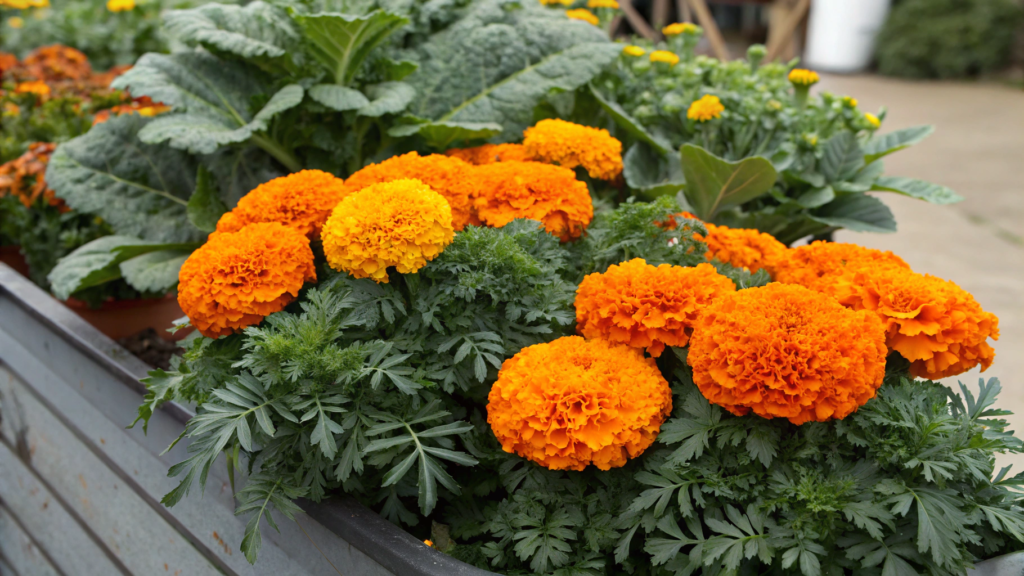
Marigolds on their own are very visually active. They have dense color, a rounded shape, and real visual weight. Greenery gives them room to breathe. It breaks things up, deepens the color, and makes the arrangement feel more thoughtful and layered.
Another important detail is texture contrast. Soft marigold petals next to matte, sometimes firmer greens look richer and more grounded than when marigolds are paired with other flowers.
Which seasonal greens work best
I almost always choose greenery that either grows here with us or is easy to find in season — that’s how arrangements look natural, not “put together on purpose.” Depending on the time of year, that usually means:
- Spring — young greens with soft leaves that don’t compete with color and add a sense of freshness
- Summer — herbs, especially aromatic and structured ones that hold their shape well and don’t wilt quickly
- Fall — denser, more saturated greens with deeper color and stronger texture
If we’re talking about specific options, marigolds pair especially well with:
- eucalyptus — creates a calm background and highlights warm tones
- olive branches — add structure and a bit of graphic interest
- rosemary — works both visually and in mood
- bay leaves — dense and dark, great for balancing bright color
- fern — softens the arrangement and adds depth
- ornamental grasses — bring movement and a clear seasonal feel
The main rule stays the same: greenery should be calmer than the flowers. If the greens start pulling attention away from the marigolds, the balance is off.
Where these combinations look best
Marigolds paired with greens work beautifully in table centerpieces, garlands, wreaths, wedding décor, and outdoor parties. They’re especially strong in long formats — farm tables, benches, wide windowsills. In these spaces, greenery helps stretch the composition and makes it feel less “spot-focused.”
How to build an arrangement with marigolds and greens
- Start with the greenery. Place or lay out the green elements first and set the direction and shape. This is the backbone of the arrangement, and it should feel calm.
- Add marigolds as accents. Not evenly, but in groups. Let the color appear in spots, not as one continuous line.
- Watch the proportions. A ratio of about 60 percent greenery and 40 percent flowers usually works well. Sometimes even fewer flowers look better.
- Different lengths help. Let the greenery extend past the edge of the container, while keeping marigolds closer to the center. This adds volume without chaos.
- Step back and look from a distance. Take a few steps away. If color is the first thing you notice — great. If greenery comes first, there’s probably too much of it.
Practical details that really help
- use one type of greenery, not several at once
- don’t strip stems to “perfect cleanliness” — natural looks better
- if greens wilt quickly, keep a spray bottle nearby
- for long arrangements, Floral Chicken Wire for Arrangements works well — it holds shape and looks more natural than foam
9. Creating Bright Marigold Bouquets

It’s impossible to make a sterile bouquet with marigolds. Even if you really try. They’ll still be a little bold, a little imperfect, sometimes too intense. And that’s exactly their strength. They don’t pretend to be delicate.
In single arrangements, marigolds often calm down — the container, the shape, the surroundings keep them in check. But in a bouquet, they move to the front. Color becomes the main character.
These bouquets look great in the kitchen, on the dining table, on an open porch, or on a serving table during a gathering. They’re not romantic. They’re about joy.
Which marigold bouquets work best
The best ones are simple, gathered-in-one-breath bouquets. No complicated shapes, no symmetry, no attempt at “proper floristry.” The simpler it is, the more alive it feels.
I almost always make bouquets either entirely from marigolds or add a very limited amount of greenery. If there’s too much green, the color loses its power. If there’s just a little — it highlights the richness instead.
Container choice really matters
For bright bouquets, I avoid decorative vases. They start competing with the color. What works best is:
- clear glass
- matte ceramic in neutral tones
- simple bottles
- metal containers without shine
How to put together a bright marigold bouquet
- Cut more flowers than you think you need. Marigolds like density. A medium-sized bouquet usually needs 12–18 blooms, sometimes more. Sparse marigold bouquets rarely look convincing.
- Cut stems at different lengths. Don’t even them out. Varying height makes the bouquet feel full and alive, not “lined up.”
- Start from the center. Take 2–3 of the strongest blooms and build the rest around them. This helps the bouquet hold its shape without forcing it.
- Add greenery sparingly. One or two sprigs is enough. Greenery here isn’t the base — it’s a pause between colors.
- Place the bouquet and step back. Look at it from a distance. If one flower grabs too much attention, remove it or turn it slightly. Marigolds like balance, even inside a bit of chaos.
Small tricks that strengthen the effect
- mix different marigold shades, but no more than three
- use blooms of different sizes in one bouquet
- don’t fill the vase all the way — marigolds hold better with 2–3 inches of water
- change the water daily if the bouquet stays indoors
Once, on a dull gray day, I placed a marigold bouquet in the kitchen, right next to the sink. And it genuinely changed the mood of the space. It didn’t decorate it — it brought it back to life.
10. Decorative Marigold Displays for Fall
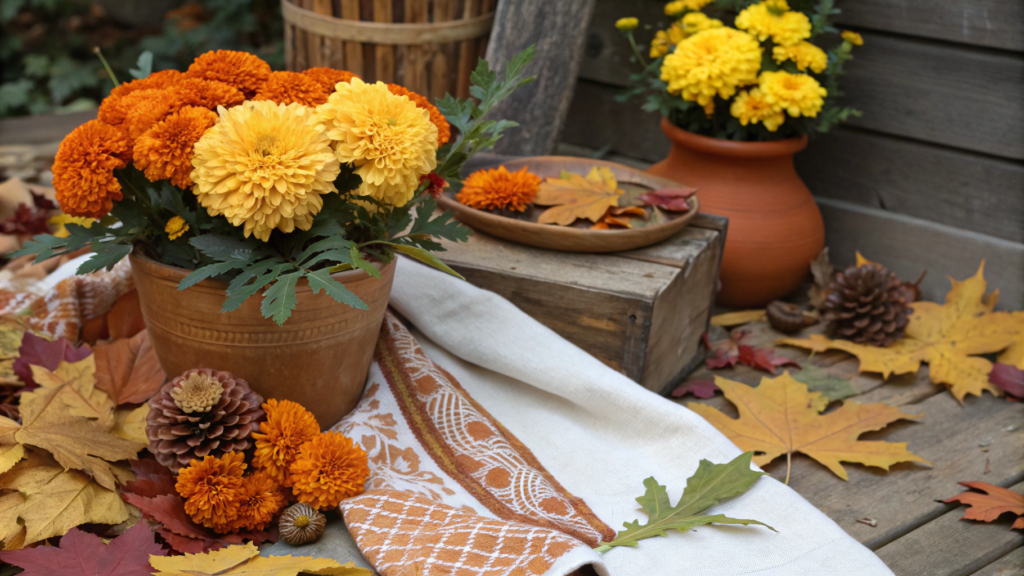
Marigolds work incredibly well with fall textures. Leaves, wood, clay, fabric — everything is already there. Marigolds aren’t the main character here. They’re an accent that pulls the whole composition together and makes it feel complete.
Why marigolds are especially good in fall
In fall, marigold color naturally echoes fallen leaves, dry grasses, tree bark, pumpkins, and ceramics. And unlike many fall flowers, they hold their shape for a long time, even as they begin to dry.
Marigolds also age beautifully. When the petals start to dry, the color deepens and becomes more matte. It doesn’t ruin the arrangement — it adds character.
Where fall marigold displays look best
They work best at the front entrance, on the porch, on tables under a covered area, on kitchen surfaces, and on open shelves. I often use them in places where the eye stops briefly but often — entryways, serving tables, windowsills.
In fall, grouped displays look especially good: several objects of different heights, connected by color and materials.
What to pair marigolds with in fall décor
Marigolds like company in fall. Just not any kind. They work best with:
- pumpkins and decorative gourds in neutral shades
- dried grasses and grain stalks
- branches with leaves, even partially dried ones
- ceramics, terracotta, clay
- wood, especially unfinished
If you add textiles, let it be linen or cotton, without patterns.
How to build a fall decorative display with marigolds
- Start with a base. Choose a tray, a wooden board, or a defined surface area. Fall décor looks better when it’s gathered into one zone.
- Add large elements first. Pumpkins, bowls, vases, lanterns — these set the scale and structure.
- Place marigolds as color anchors. Not evenly, but in spots. Let color appear where the composition needs warmth.
- Use different heights. Marigolds can sit in low bowls next to taller dried elements. This adds depth.
- Leave space. Fall décor doesn’t like crowding. Empty space is part of the composition.
Small details that make fall décor feel complete
- choose one marigold shade and work with it
- don’t be afraid of slightly dried petals — they add depth
- avoid glossy finishes and bright accessories
- combine fresh flowers with dried elements
Imagine this: an old wooden bench, a couple of pumpkins, and a bowl of marigolds that have already started to dry. Perfect. And nothing needs to be added.
Simple Marigolds
Marigolds are strange flowers. People either don’t notice them at all, or think they’re “too simple.” And then one day they place them on a table, hang them on a door, or float them in a bowl of water — and suddenly realize that simplicity can be expressive.
The same flower behaves differently in different homes, gardens, and hands. That’s why your experience matters more to me than a perfect result in a photo.
Tell me in the comments — do you use marigolds in your décor?
Where do you like them most: at home, in the garden, or during celebrations?
I genuinely love reading that. That’s exactly how new ideas are born.