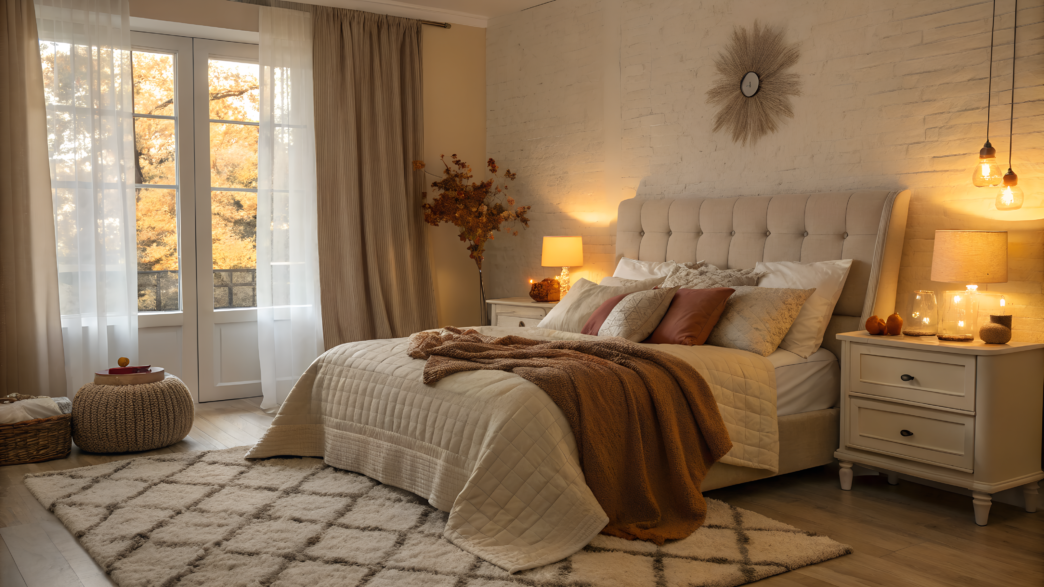
In fall, the light in the bedroom gets softer, the evenings get longer, and the bed slowly turns from just a piece of furniture into a place you want to stay. Not just to sleep, but to hide away, relax, and daydream.
I want to talk about 10 fall bedroom ideas that don’t require renovations, big budgets, or radical changes. There are no dramatic “before and afters” or showy decor in this article. Only things that truly work: warmth, light, textures, natural elements, and small techniques tested in real life, not just in pictures.
We’ll look at blankets, sheets, pillows, lighting, storage, and details that seem small on their own but together turn the bedroom into an autumn retreat you’ll want to come back to every evening.
1. Chunky Knit Blankets for Ultimate Coziness
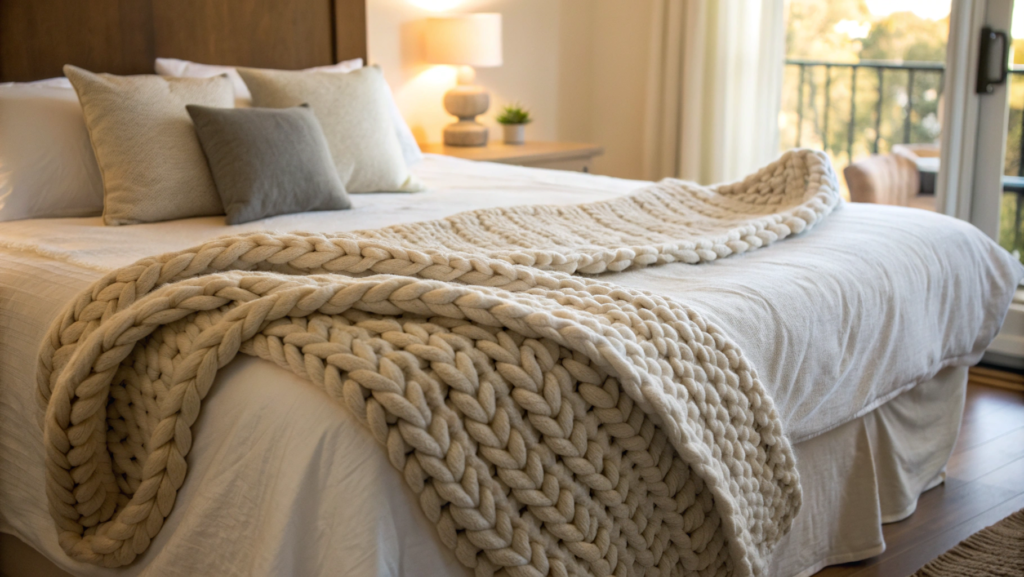
In fall, a chunky knit blanket feels like it’s meant to be in the bedroom. Picture this: in the evening, you throw something warm over your legs — and your body instantly understands it. Yes, cold days are coming. And there’s no point resisting.
Chunky knit blankets work on several levels at once. They provide physical warmth, add depth and texture to the bed, and create a sense of comfort and protection.
I’ve tried thin bedspreads, quilted throws, even old wool blankets. None of them felt right. Chunky knit wins every time because it doesn’t try to look neat. And that’s exactly its strength.
What matters with these blankets:
- Weight. Good options usually weigh between 8 and 12 lb (about 3.5–5.5 kg). This creates gentle pressure similar to a weighted blanket — the body relaxes faster, especially in the evening.
- Large stitches add visual warmth. Even cooler colors look softer and more inviting.
- Messiness is part of the design. You don’t need to fold this blanket perfectly. Just throw it over the bed, and it still looks good.
The sizes I use most often:
- 50×60 inches (≈127×152 cm) — if the blanket is more decorative
- 60×80 inches (≈152×203 cm) — if you actually want to wrap yourself up, not just have it “for looks”
Pure wool looks beautiful but requires care and often feels itchy. I’ve long switched to blends based on acrylic or chenille yarn — they hold their shape, don’t stretch out, and work well in real life, not only in photos.
Right now, we have a Bedsure Chunky Knit Blanket from Amazon in our bedroom — dense, heavy, with well-fixed loops.
How to use a chunky knit blanket
- Choose one blanket, not several.
Chunky knit is already a strong accent. One blanket works better than three smaller ones. - Decide on the placement.
The simplest and most reliable option is across the foot of the bed. Another option is to casually drape it over one corner so part of it hangs down. - Pick a color for the season, not trends.
In fall, rust, burnt orange, warm beige, oatmeal, and muted terracotta work best. These shades visually warm up the room even on gloomy days. - Don’t straighten the stitches.
Seriously. A bit of chaos makes the blanket feel alive. When it looks too perfect, it becomes decorative instead of real. - Use it every day.
A chunky knit blanket shouldn’t be “for special occasions.” The more you use it, the more naturally it becomes part of the bedroom.
Before putting the blanket on the bed, drape it over the back of a chair or a bench by the window for 10–15 minutes. Let it exist in the space first. Then move it onto the bed — the folds will look natural, the fabric relaxed, and the blanket will instantly feel like it’s been there forever, not placed “for decor.”
2. Seasonal Color Palettes with Deep Reds and Oranges
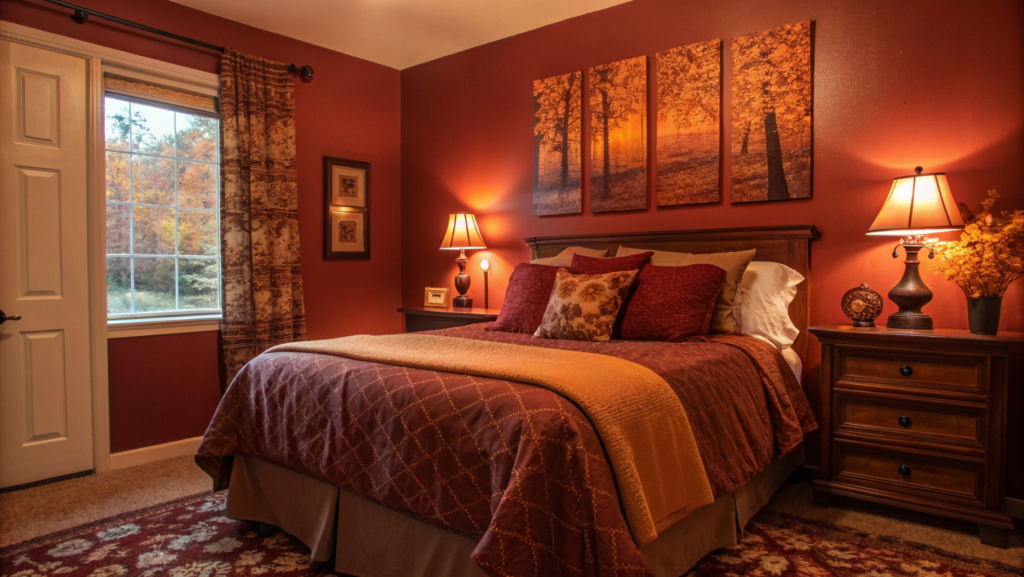
In fall, the feeling of a bedroom mostly depends on color shades. When they’re chosen well, the room feels warm even on a gloomy day. When they’re not — no blankets can save it.
Deep reds and warm oranges visually narrow the space, make it feel more intimate, and add that sense of a cozy retreat you crave on cold evenings.
When I first added deep rust red and muted burnt orange, the room suddenly stopped feeling like just a bedroom. It became a place where you actually want to stay.
Why these shades work so well in fall:
- Deep reds (burgundy, oxblood, brick) create a sense of depth and protection. They visually “pull” the space together.
- Warm oranges (terracotta, clay, burnt orange) add warmth without feeling bright or overwhelming.
- These colors work beautifully even in low light, especially in the evening with lamps and candles.
And yes — this matters: we’re not talking about bright red or pumpkin orange. Fall loves muted shades. Slightly dusty. Slightly faded.
How to build a fall color palette
- Start with one anchor color.
Don’t try to add everything at once. Choose one main shade — for example, deep brick red or warm terracotta. Let it appear in one large element: a bedspread, a decorative throw, pillows, or even the headboard. - Add a second shade in a smaller amount.
If your main color is red, let the second be orange — but quieter. Think pillowcases, a small bench at the foot of the bed, or wall decor. The second color shouldn’t compete; it should support the first. - Balance everything with a neutral base.
To keep the bedroom from feeling heavy, leave a neutral background: warm beige, cream, oatmeal, soft taupe. Bedding, walls, or curtains can stay light — they give the eyes space to rest. - Work with shades, not patterns.
In fall, solid fabrics or very calm textures work best. When the color is deep, patterns aren’t necessary. Let the tone and material do the work — linen, cotton, velvet, dense twill. - Check the palette in the evening, not during the day.
This is a crucial step many people skip. Look at the bedroom with the lights on — that’s how you’ll see it most of the fall. If the colors feel too dark or heavy, lighten the palette with one soft, light element.
Before buying anything new, grab a couple of pillowcases or a throw in the chosen shade and live with them for a few days. A color that looks great during the day can feel heavy at night. And one that seems quiet might turn out to be perfect under warm lamp light.
3. DIY Fall Garland Hanging Above the Bed
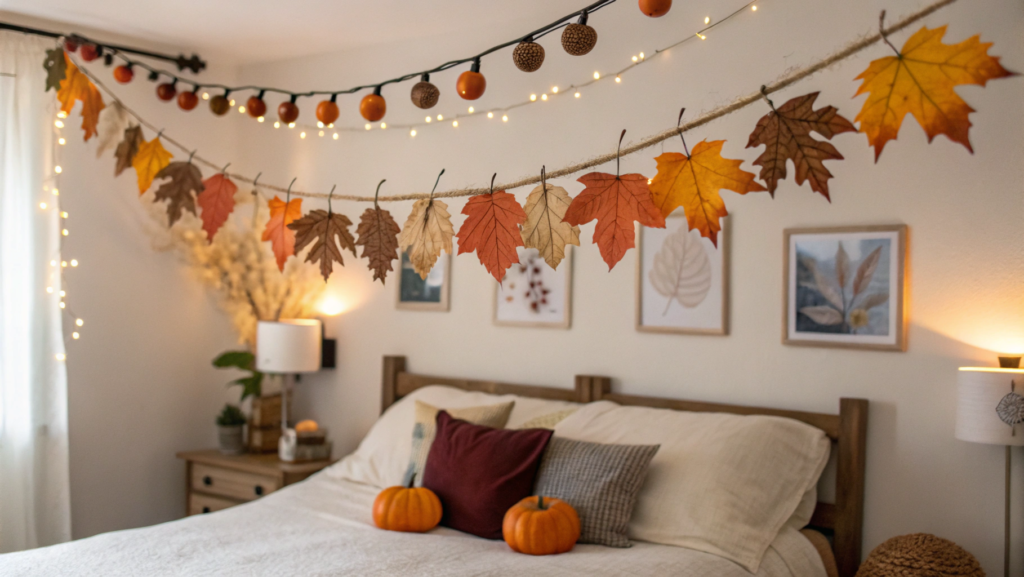
For a long time, I ignored the idea of a garland above the bed. It felt either too “festive” or overly decorative. But once I tried it, everything clicked. Especially in fall, when the walls suddenly start to feel empty and the ceiling feels too high.
A fall garland above the bed visually lowers the space, makes it warmer, and helps it feel more pulled together. And what really matters — you can change it every season without touching the furniture or textiles.
What I especially love about this approach:
- the garland adds depth without cluttering the space
- it works even in a small bedroom
- it’s easy to assemble from natural or faux elements
- it can be removed in five minutes without leaving marks
And yes — it doesn’t need to be complicated. In fall, things look best when they’re slightly imperfect. A bit uneven. A bit “however it turned out.”
How to make a fall garland
- Decide on the placement line in advance.
The best option is to hang the garland 8–12 inches (≈20–30 cm) above the headboard. Lower than that, and it starts to interfere visually; higher, and it gets lost. I usually mark the line with painter’s tape first and live with it for a few hours before attaching anything. - Choose the base, not the decor.
Start not with leaves or pinecones, but with the base:
- cotton cord
- jute rope
- a thin faux vine
- cotton cord
- The base sets the mood. Jute feels more rustic, cotton is calm and clean, and a vine looks soft and organic.
- Add elements unevenly.
This is the key moment. Don’t distribute the decor symmetrically. Let one side feel denser while the other stays almost empty. That’s what makes the garland feel alive instead of “measured with a ruler.” - Mix natural and artificial elements.
Real pinecones, branches, and dried leaves pair beautifully with high-quality faux pieces. The main rule — the artificial ones shouldn’t be shiny. - Attach it without damaging the walls.
For a bedroom, removable adhesive hooks rated for 2–3 lb (≈1–1.5 kg) work perfectly. The garland shouldn’t be heavy. If it’s pulling down, you’ve added too much decor. - Leave some breathing room.
Don’t cover the entire wall. Let the garland span about 60–70% of the bed’s width, not all of it. Empty space makes the composition calmer.
After hanging the garland, turn off the overhead light and switch on only the bedside lamps. If, in this light, the garland looks soft and almost blends into the space — you nailed it. If it grabs too much attention, remove a few elements.
4. Switching to Flannel Sheets for Warmth

In fall, sheets often start to feel cold all of a sudden. Not a big problem. But unpleasant. With flannel sheets, the difference is noticeable from the very first night. No exaggeration.
Why flannel works so well in fall:
- Flannel is cotton with a brushed surface that traps warm air right next to your body.
- It warms up almost instantly, unlike satin or percale.
- At a bedroom temperature of 60–65°F (≈15–18°C), flannel feels more comfortable than any other fabric.
- Good-quality flannel doesn’t feel stuffy if the night gets warmer.
How to switch to flannel sheets without mistakes or disappointment
- Pay attention to fabric weight.
Look for flannel with a density of at least 170–180 GSM. Lighter options lose their shape quickly and start looking worn after just a few washes. Dense flannel lasts for years and stays soft. - Choose 100% cotton.
Blends with polyester are cheaper, but they breathe worse and can build up static. Natural cotton behaves predictably and feels more comfortable, especially if you’re sensitive to temperature changes at night. - Start with one sheet, not a full set.
If you’re unsure, replace just the fitted sheet first. Direct contact with your body makes all the difference. Often, that alone is enough to feel the change. - Wash before first use.
Always. The first wash opens up the brushed fibers and makes the fabric noticeably softer. I wash in cold water and dry on low heat — this helps flannel keep its structure longer. - Match the color to your fall bedroom palette.
Flannel looks especially good in warm cream, muted plaid, soft rust, dusty clay. These shades visually enhance the feeling of warmth.
I use the Pointehaven Heavyweight Cotton Flannel Sheet Set — they’re dense, don’t pill, and stay soft even with regular use.
Make the bed with a flannel fitted sheet in the morning and leave it untouched all day. By evening, the fabric will “warm up” from the room air, and when you lie down, the difference is especially noticeable.
Sometimes it’s exactly these simple changes — switching sheets, updating textiles — that make a bedroom truly cozy. No renovation. No extra effort. Just because your body feels better.
5. Layering Pillows with Fall Patterns
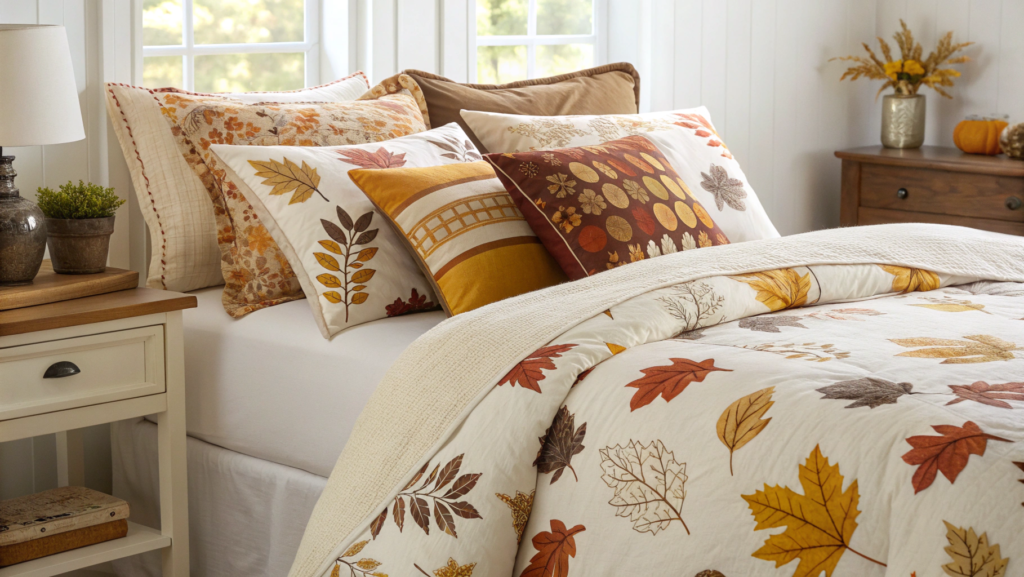
Pillows are part of a bedroom’s atmosphere. Overdo them — and the space starts to feel chaotic. Get it right — and the bed instantly looks more lived-in.
Layering pillows is about balance between color, texture, and scale.
How to layer pillows
- Start with a base you don’t change.
These are your regular sleeping pillows in neutral cases — cream, soft beige, warm white. They create a background and don’t take part in visual drama. Fall patterns work best when they rest on a calm foundation. - Add a second layer — textured but quiet.
Think linen, waffle-textured cotton, or soft tweed. The color should be warm but low-key: oatmeal, clay, muted taupe. This layer connects the base with the accents. - The third layer is for fall patterns.
Plaid, small florals, leaves, or geometric designs in shades of rust, deep red, burnt orange, olive. Two pillows are enough. More than that, and the pattern starts competing with itself. - Play with size, not quantity.
Instead of four identical pillows, use one 20×20 inches (≈50×50 cm) and one 14×24 inches (≈35×60 cm). Different scales make the arrangement feel relaxed and natural. - Watch texture as closely as color.
Fall favors heavier fabrics. Velvet, chenille, dense cotton, embroidery. Smooth synthetic pillowcases break the sense of warmth.
I often use covers like MIULEE Fall Decorative Pillow Covers — they have good fall tones and a matte texture without extra shine. And yes, I almost always buy covers instead of ready-made pillows — it’s easier to control firmness and height.
Before finalizing the setup, remove one pillow and look at the bed. If it still feels finished, you did it right. If not — put it back. This simple test saves both money and nerves.
6. Accent Chairs with Seasonal Throw Pillows

An accent chair in the bedroom is a bit underrated. Often it sits in the corner and is used at most to pile clothes on at night. And that’s a shame.
I love chairs because they don’t require big changes. You’re not replacing furniture, moving the bed. You’re just adding one pillow — and everything around it starts to look different.
How to style an accent chair in fall
- Decide what role the chair plays.
Will you actually sit in it, or is it mostly decorative? If the chair is used daily, the pillow should be firm and comfortable. If it’s more of a visual element, you can go for more textured or decorative options. - Choose one seasonal accent.
One pillow is enough for a chair. In rare cases — two, if they’re different sizes. More than that, and the chair starts competing with the bed for attention. - Pick a color that echoes the bed.
The pillow shouldn’t introduce a new color. It should repeat one of the shades already present in the bedroom — the same rust, deep red, or muted orange, just in a different material. - Focus on texture.
In fall, chairs look especially good with pillows made of velvet, wool, boucle, or dense cotton. Even a neutral color instantly feels warmer in these fabrics. - Add a throw, but don’t overload it.
If you want to enhance the effect, drape a light throw over the arm or the back. It shouldn’t be as bold as the pillow — let it act as a calm background.
Turn the pillow on the chair slightly at an angle instead of placing it straight in the center. A bit of asymmetry makes the chair look softer and more “alive,” as if it was just used.
7. Autumn Wreaths Hung Indoors
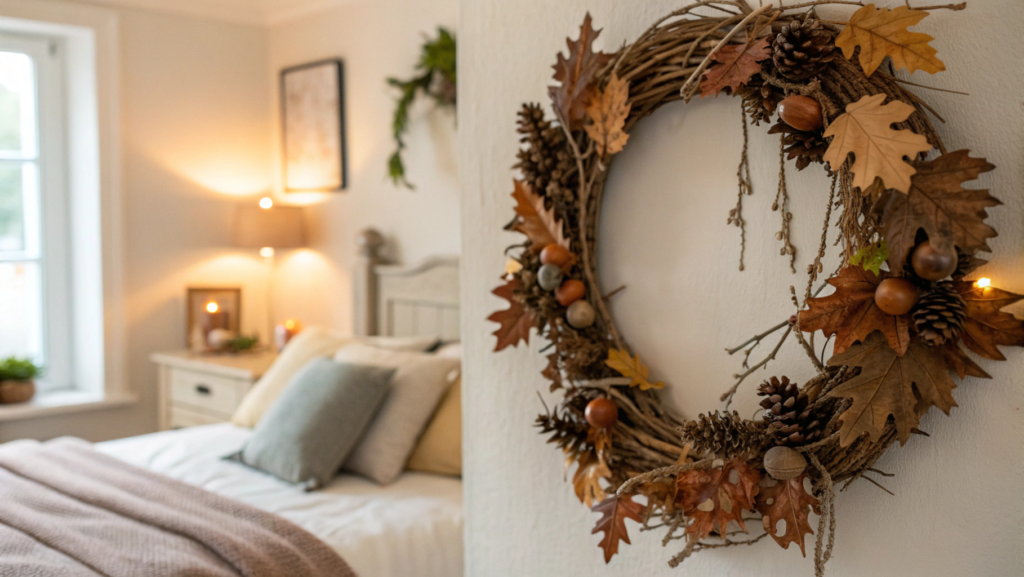
Many people immediately picture a front door, a porch, something “outdoor.” But indoor autumn wreaths work surprisingly well in fall. Especially in the bedroom.
I like using wreaths indoors because they don’t take up horizontal space. In fall, walls often feel empty — especially if you don’t want to hang artwork or completely change the decor.
And yes, a wreath in the bedroom quietly reminds us about the rhythm of seasons and, more broadly, about the cycle of life.
How to hang an autumn wreath in the bedroom so it feels right
- Choose a spot with visual “quiet” around it.
The best options are above the headboard, above a dresser, or on an empty wall near an accent chair. The wreath shouldn’t compete with other objects. If there are already shelves, mirrors, or busy textiles nearby, look for a different place. - Pick the right size.
For a bedroom, wreaths with a diameter of 18–24 inches (≈45–60 cm) work best. Smaller ones get lost on the wall, larger ones start to dominate. The wreath should be noticeable, but not heavy. - Stick to a muted palette.
In fall, muted rust, dusty orange, deep red, olive, warm brown work best. Bright colors get tiring quickly in a bedroom, especially in the evening. - Choose matte materials.
Avoid wreaths with glossy leaves, glitter, or an overly “plastic” look. Good faux wreaths look dry, almost dusty — and that’s a good thing. - Hang it without heavy hardware.
Use a thin hook or a removable adhesive hook rated for up to 2 lb (≈1 kg). The wreath should feel like it’s lightly floating on the wall, not rigidly fixed.
Try hanging the wreath slightly lower than feels logical at first. When the center of the wreath sits at eye level while seated, not standing, it starts to feel like part of the bedroom — not just decor on a wall.
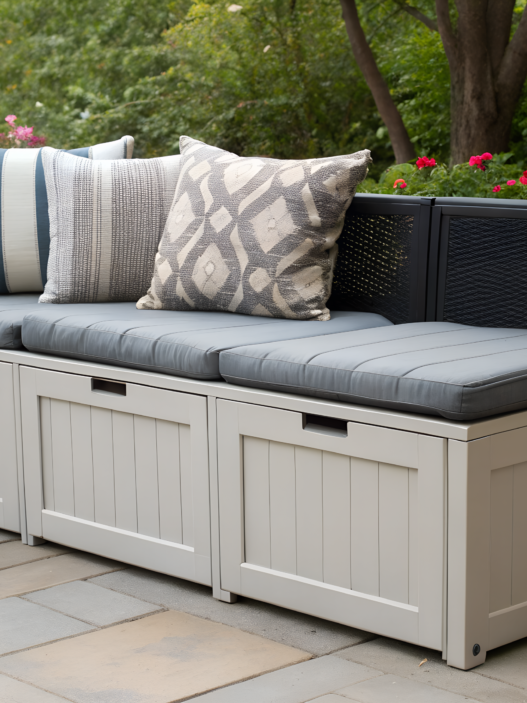
8. Vintage Trunks and Baskets for Storage and Charm
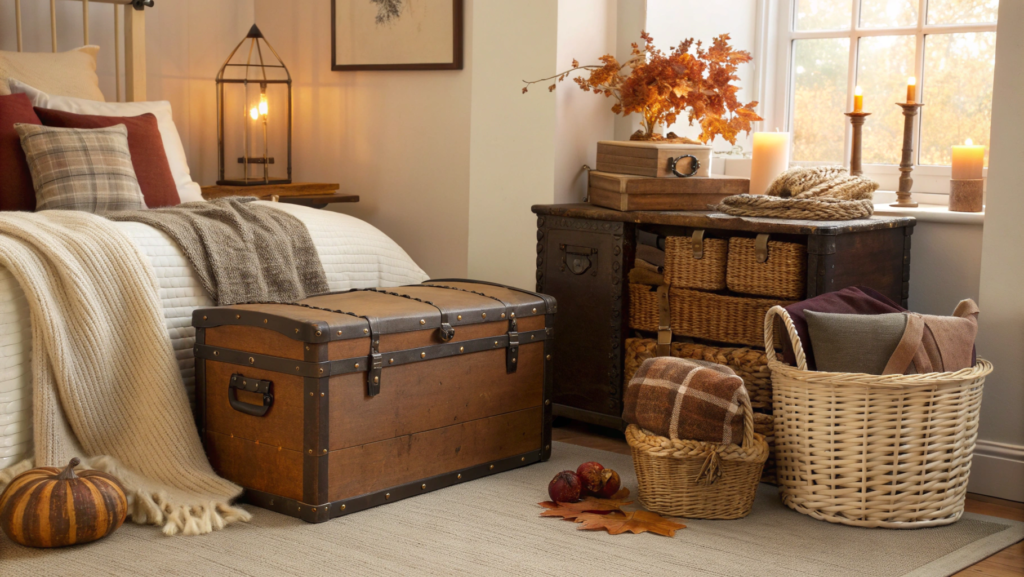
In fall, there are always more things in the bedroom. Throws, extra pillows, warm clothes you take off in the evening and put on again in the morning. And when there’s no thoughtful place for all of it, the room starts to feel cluttered very quickly — even if it’s beautiful.
That’s where vintage trunks and baskets solve a practical storage problem while adding real charm to the space. They feel like a natural part of the home.
How to use trunks and baskets in the bedroom
- Decide what you’ll store in them.
This matters. Soft baskets work well for throws and pillows. For seasonal clothing or extra bedding, a trunk with a lid makes more sense. When storage matches the contents, you actually end up using it. - Choose the size for the space, not the other way around.
At the foot of the bed, trunks 30–40 inches (≈76–100 cm) long and up to 18 inches (≈45 cm) high work best. For bedroom corners, baskets around 16–20 inches (≈40–50 cm) in diameter feel balanced. Oversized pieces visually weigh the room down. - Pick materials with texture.
In fall, these look especially good:
- woven baskets made from water hyacinth or rattan
- wooden trunks with visible grain
- fabric baskets made from dense cotton or jute
- woven baskets made from water hyacinth or rattan
- Use a trunk as a functional surface.
A trunk at the foot of the bed can be more than storage — it can also work as a bench or a spot for a tray with books. The key is a sturdy lid. - Don’t overload with decor.
One trunk or one basket is already an accent. Don’t stack too many items on top. In fall, the “less, but intentional” approach works especially well.
I often use options like the VASAGLE Storage Trunk — it has a comfortable height and supports up to 220 lb (≈100 kg), so you can sit on it without worry.
Place something lightly scented inside the trunk or basket — a small sachet of dried lavender, cinnamon, or cloves. Every time you open the lid, the bedroom quietly reminds you that it’s fall.
9. Soft Lighting with Amber Bulbs
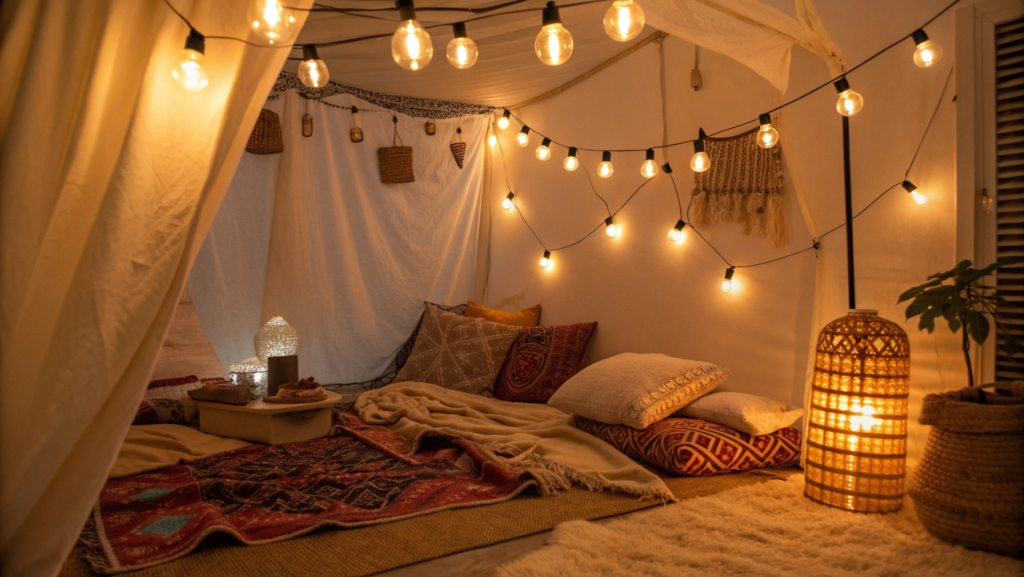
You can change textiles and add decor gradually, but if the light stays cold, that cozy feeling never really appears. Tested many times.
I noticed that after switching to warmer bulbs, we started turning off the main overhead light earlier. Simply because it stopped feeling harsh. The room became quieter — even visually.
How to set up soft fall lighting with amber bulbs
- Choose the right color temperature.
Look for bulbs in the 2200–2700K range. Lower than that feels too dark, higher and the light starts drifting cold again. This range creates a soft, honey-like glow that’s especially pleasant in the evening. - Use multiple light sources instead of one.
Three dim lights are better than one bright ceiling fixture. Bedside lamps, a small floor lamp, a table lamp on a dresser — together they add depth and dimension. - Pick bulbs with frosted or tinted glass.
Clear bulbs often create harsh glare. Amber glass bulbs diffuse the light and make it softer, especially when the lamp is at eye level. - Pay attention to wattage, not just color.
For a bedroom, 40–60 watts equivalent (≈6–9W LED) is usually enough. Brighter light becomes tiring, even if it’s warm. - Add a dimmer if possible.
Even a simple dimmable table lamp lets you change the mood of the room throughout the evening. I rarely use full brightness — something in between works better.
Swap just one bulb in the bedroom for an amber bulb and spend one evening with that light, changing nothing else. If you suddenly don’t feel like turning on the overhead light, you did it right.
10. Natural Elements like Pinecones and Branches in Decor

Every time I bring pinecones or branches into the bedroom, the space around me changes.
Natural elements work better than almost any decorative object. They don’t demand attention, but they create a quiet connection to the season. Especially in a bedroom, where you want less visual noise and more calm.
How to add natural elements to the bedroom
- Focus on shape, not quantity.
One expressive branch in a vase works better than a dozen small details. Look for branches with an interesting curve, asymmetry, or textured bark. - Use simple vessels.
For branches, ceramic, glass, or wooden vases 12–18 inches (≈30–45 cm) tall work best. The simpler the shape, the stronger the natural element looks. - Limit the palette.
Pinecones, dry branches, leaves — they’re already expressive. Don’t mix too many colors at once. Let browns, grays, and muted greens dominate. - Place elements where they can “breathe.”
The best spots are a dresser, bedside table, windowsill, or a corner near a chair. Avoid tight niches — nature needs air. - Prepare the elements before using them.
Pinecones should be dried and lightly cleaned with a brush if needed. Branches can be wiped with a damp cloth. It’s a small step, but it affects the overall feeling of neatness.
A small experiment for the bedroom
Try this: remove one decorative item — a frame, a candle, a vase — and replace it with one branch or a couple of pinecones. Look at the room in the evening under warm light. If the space feels calmer, you’re on the right track.
This technique often reveals how much we keep simply out of habit.
An autumn bedroom
An autumn bedroom is the feeling that the space adapts to you, not the other way around.
You can add just one element — warm lighting, flannel sheets, or a chunky knit blanket — and the room already starts to feel different. You can go further and bring everything together. Or you can stretch the process across the whole season, adding one detail at a time, watching yourself and the home adjust.
Try choosing one idea from this article and implementing it today or over the weekend. Not everything at once. Just one. Then live with it for a few days. You’ll feel what needs to come next. Write about it in the comments. I’d love to know what you liked the most.
And if you catch yourself thinking in the evening that you don’t want to leave the bedroom — that means it worked.