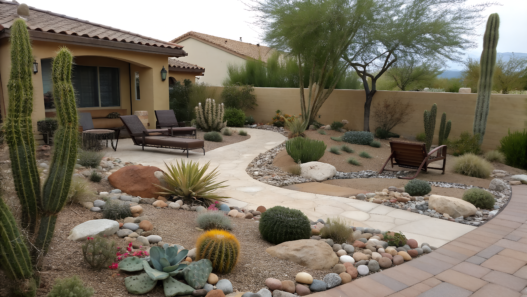
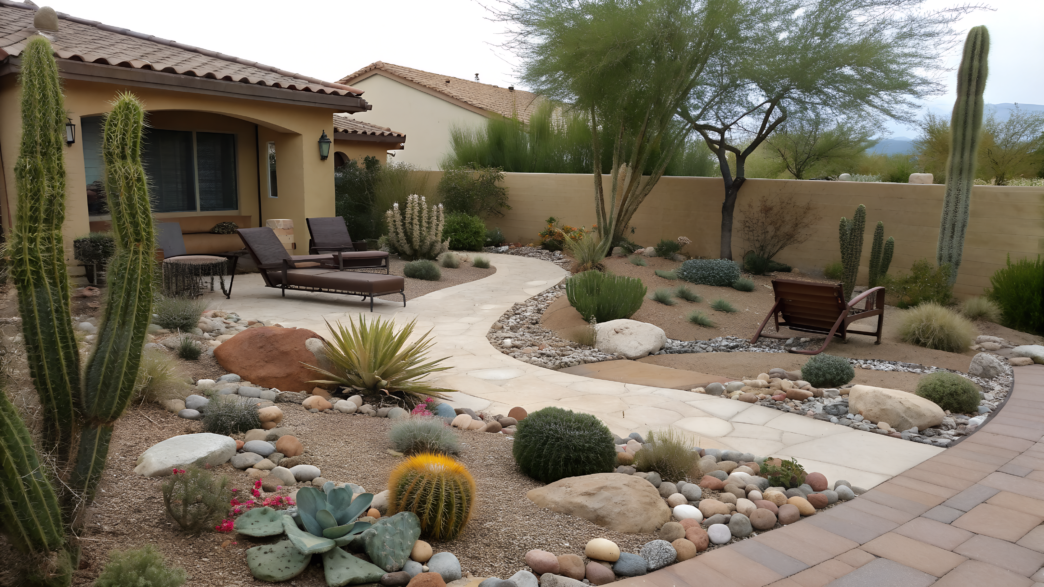
There’s a special kind of magic in desert aesthetics. Stones, cacti, textured shadows, warm tones — all of this creates an atmosphere of comfort without a drop of water or extra effort.
When Linda and I started working on our front yard, we realized we wanted to move away from the standard “grass–border–pathway” setup and find something that would actually fit our climate and please the eye every single day. That’s how this list was born. There are no templates or one-size-fits-all ideas here — only real concepts we either tried ourselves, saw at friends’ homes, or kept in mind for later.
Choose, combine, experiment. Sometimes even one well-placed plant next to a boulder can completely change how the space feels.
1. Southwestern Rock Garden with Cactus Accents
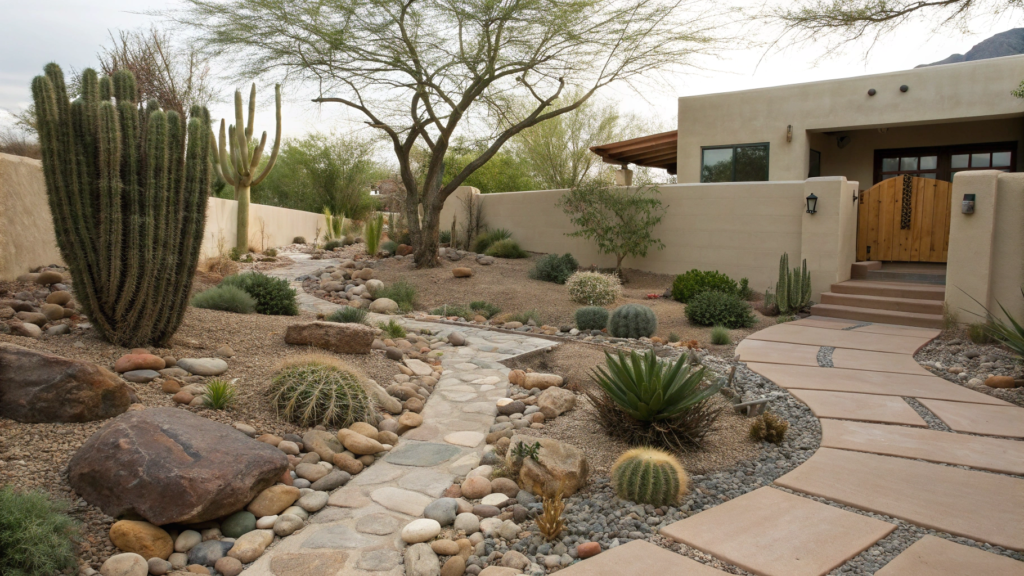
A Southwestern-style rock garden with cactus accents is not only aesthetic but also almost maintenance-free. This style fits perfectly in dry regions — especially in Southern California, Arizona, New Mexico, and Texas — where every drop of water matters.
We have a neighbor down the street who created exactly this kind of desert rock garden — and we just couldn’t help stopping to look at every detail. It looks like a movie frame from Breaking Bad: stones, cacti, gravel, everything very dry and very stylish. It inspired us to simplify our own landscape — but we ended up going in a different direction (I’ll talk about our lawn below).
What’s this idea about?
The point is to create a natural yet structured look using:
- Stones and gravel of different sizes (from 1″ to 6″ / 2.5–15 cm), imitating a desert landscape
- Columnar and round cacti — for example, saguaro (Carnegiea gigantea), barrel cactus, and golden torch
- Succulents and yucca for more texture
- Small pathways made of slate or polished stepping stones
You can add a couple of decorative elements — a clay bowl with sand, a vintage iron lantern, or even solar lights. The important thing is to keep the garden open and airy with plenty of space between the plants and stones.
Step-by-Step Plan:
- Mark the area. Use a garden hose or rope to outline the gentle curves of your future layout. Pay attention to sunny spots — cacti love bright light.
- Add gravel. Choose decorative gravel of medium size (¾–1½” / 2–4 cm). For contrast, you can mix warm terracotta with a lighter sand tone. Spread it in a 2–3″ (5–7 cm) layer and smooth it with a rake.
- Place the large boulders. Pick 3–5 big stones (around 18–24″ / 45–60 cm). Sink them into the ground by one-third so they look natural, as if they “grew” out of the soil.
- Add the cacti. Plant cacti in groups of 2–3, alternating heights. Golden Barrel, Prickly Pear, and columnar Trichocereus look great together. Leave 1–2 feet (30–60 cm) between plants for growth and airflow.
- Add accents. Place a couple of clay pots on their side, or set a decorative Southwestern-style sign. For evening comfort — here are solar lanterns from Amazon with warm light that handle heat and dust well.
This approach makes the design look realistic. Everything feels organic, as if your yard is truly part of the Sonoran Desert. And in the evening, when the solar lamps softly highlight the silhouettes of the cacti, your front yard turns into something like a cinematic scene straight from a western.
2. Minimalist Gravel Path with Agave
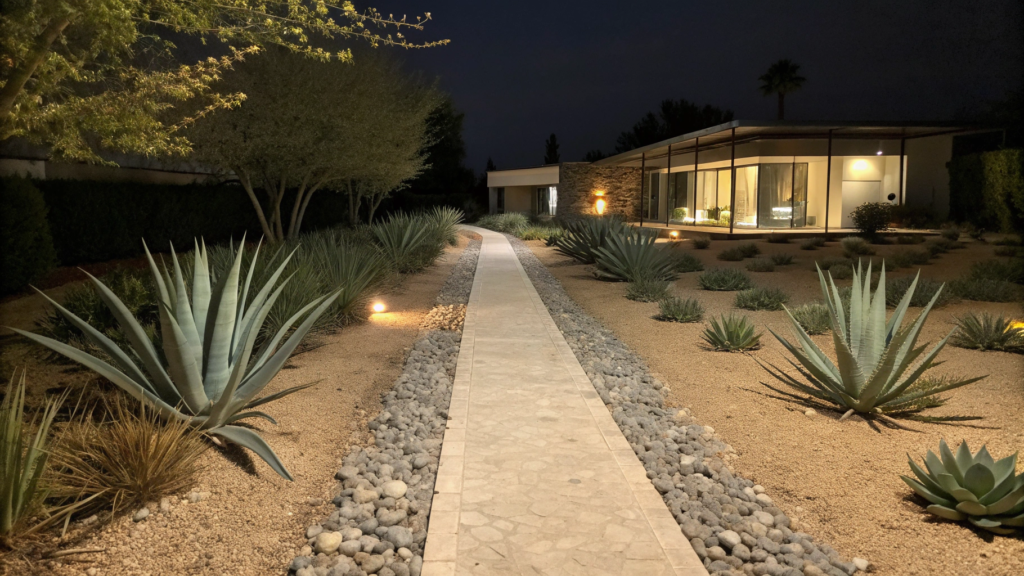
The idea of a minimalist gravel path with agave fits perfectly into dry front yards.
This concept works through contrast: the strict geometry of the path against the lively, slightly wild shape of agave. Everything is very simple, yet it looks incredibly interesting.
At first, we wanted to create this kind of path ourselves — we even bought a couple of Blue Glow plants at the nursery. But then we realized: for our yard with artificial turf, a different style would work better — the agaves didn’t fit the scale. So we gave the plants to friends, and they built the path next to their modern house. The agaves look like art pieces there — especially at night with lighting. Very striking, and maybe we’ll dedicate a corner to them later.
What’s this idea about?
At the center is a straight or zigzagging path made of light-colored fine gravel (¼” / ~6 mm), running from the entry to the door or along the entire yard. On its sides — agaves (for example, Blue Glow, Americana, or Parryi), evenly planted with 3–5 feet (90–150 cm) spacing.
This style works especially well for modern homes with clean architecture — it highlights the shape of the building without unnecessary elements.
Step-by-Step Plan:
- Mark the path. Use stakes and string to mark the outline. The path width should be 3–4 feet (90–120 cm), which is enough for comfortable walking.
- Prepare the base.Remove the top layer of soil to a depth of 4–5″ (10–13 cm). Lay down landscape fabric — it will stop weeds from growing.
- Add the gravel. Light gray or ivory gravel with a ¼” (6 mm) fraction works well. Add a 2–3″ (5–7 cm) layer, level it out, and lightly compact it.
- Plant the agaves. Choose the variety based on your climate. For example, Agave Blue Glow Live Plant Fully Rooted on Amazon — compact (up to 2 feet wide / 60 cm) with a vivid blue tone. Plant them on both sides of the path, either symmetrically or in a staggered pattern.
- Add accents. You can install low metal or concrete edging to emphasize the geometry. For evening effect — ground-level spotlights aimed upward at the agaves.
Tip. Agaves require very little water but love well-drained soil. In the first months after planting, water every 10–14 days. Later — depending on weather, sometimes once a month is enough.
A minimalist gravel path with agave is a way to highlight the style of the home and the character of the owner. Strict, elegant, and… no mowing required.
3. Desert Landscaping with Artificial Turf Mix
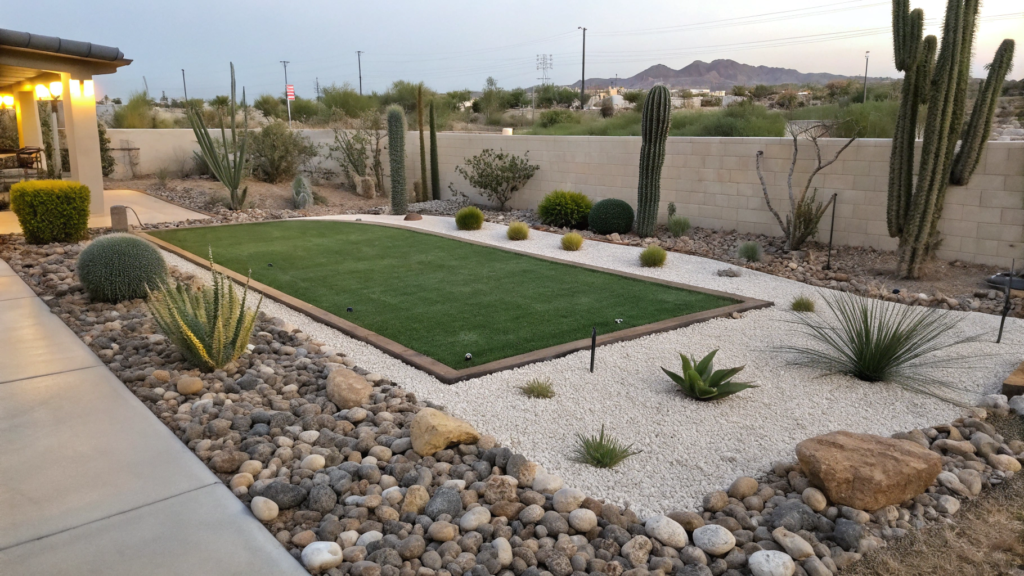
Combining artificial turf with desert landscaping elements is especially relevant in climates where heat isn’t a season — it’s a way of life.
This approach blends a clean green section (visually imitating a lawn) with succulents, cacti, decorative stones, and low-growing desert shrubs. A unique balance between natural dryness and neat, cultivated structure.
This is the idea Linda and I used at home. A turf rectangle framed with gravel and cacti along the edges — it turned into a real oasis without a drop of water or any hassle. Linda insisted on the lighting, and now in the evenings the yard looks like a small resort courtyard somewhere.
How does it look?
Picture this: in the center — a flat rectangle of “lawn,” but not real, artificial. Around it — a gravel strip, groups of cacti, single yuccas, and maybe a few boulders. Along the walkway — alternating patches of mulch and plants.
This design works especially well for smaller front yards where you need clear zoning. It suits both corner lots and standard rectangular yards in front of the house.
Step-by-Step Plan:
- Choose the shape of the turf. A rectangle is the simplest, but you can create an oval or even a wave. A flexible landscape border is best — it helps define the exact outline of the future “green spot.”
- Prepare the base. Remove the top layer of soil to a depth of about 4″ (10 cm), level the area. Add a layer of crushed stone (about 2″ / 5 cm), then a layer of sand. Compact it well. Be sure to use landscape fabric — it will stop weeds from growing.
- Lay the artificial turf. Roll out the turf so the fibers “face” the same direction. Trim it to shape and secure it with landscape spikes every 12–18″ (30–45 cm) around the perimeter. Brush it against the grain — this helps “lift” the surface.
- Add the gravel zones. Around the turf, leave a strip of decorative gravel 1–2 feet (30–60 cm) wide. This creates a buffer and adds texture. Gravel in wet sand or red granite tones works great.
- Plant desert plants. On the gravel, place small groups of Golden Barrel Cactus, Aloe Vera, yucca, or Red Yucca. You can add flowering succulents for interest. Between them, place 2–3 flat boulders — as if nature left them there. Use low-growing plants so they don’t block the view of the turf.
- Highlight the elements. Install low solar-powered spotlights to illuminate the plants at night. Or add garden figurines in a subtle Mexican style — restrained but with character.
Why this works:
- Artificial turf always looks “fresh” — even after a hot summer or dusty winter
- Gravel and stones create an excellent drainage zone — no puddles at the entrance
- Minimal maintenance: no watering, no trimming; just sweep it every couple of weeks
- A great solution for homes with kids or pets: the turf works perfectly as a play area
This design makes the yard structured, tidy, and very warm in feel. It’s not just a “fake green patch,” as some might think, but a smart compromise between style and practicality. Even in the desert, you can create the feeling of a garden — just in a new, modern interpretation.
4. Desert Courtyard Style with Clay Pots
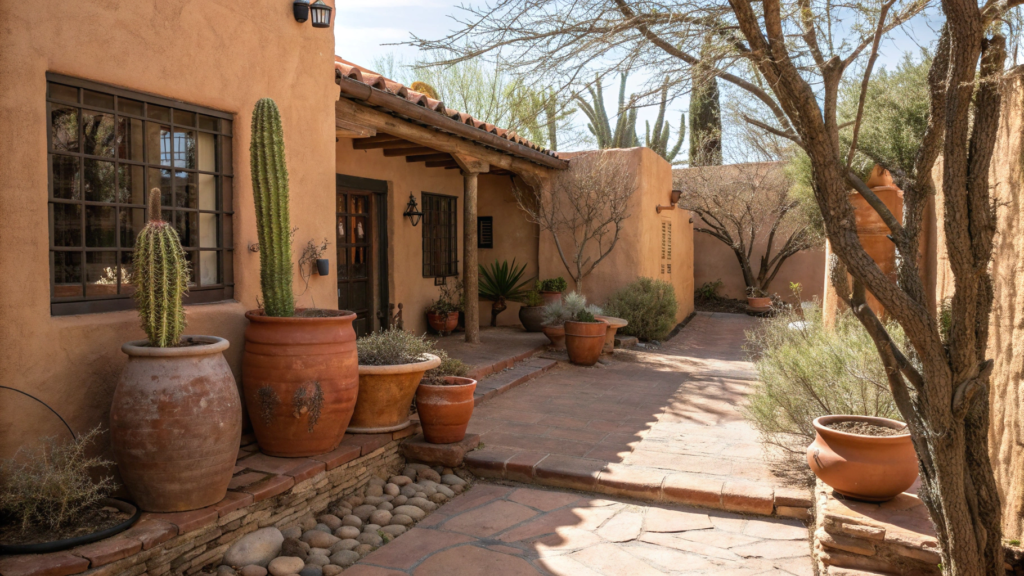
Warm terracotta, faded clay pots, succulents, a few cacti, and a tiny courtyard filled with sun and shadow — this style works especially well at the entrance to the house or along the facade.
The idea is to create a space that looks like a patio in Tucson or Albuquerque. Not a lawn and not a “garden,” but a courtyard — with textures, ceramics, and air.
Key elements:
- Clay pots of different sizes — you can use classic terracotta pots from 8 to 20 inches tall. They’re planted with agaves, echeverias, colorful kalanchoes, and trailing sedums.
- A sand or gravel base — beige, light brown, or slightly pink.
- Wooden benches or chairs, possibly wrought iron accents (like candle holders or an arch).
- Mulch and crushed stone decor to tie everything together.
Step-by-Step Plan:
- Define the “courtyard” zone. It can be a corner of the yard, a strip along the facade, or even a central bed. Make sure it gets at least 4–6 hours of sunlight per day.
- Prepare the base. Clear everything out, level the area, lay geotextile, and add a layer of gravel or fine crushed stone (2–3″ / 5–7 cm). This becomes your clean “canvas.”
- Arrange the clay pots. Choose sets of clay planters (Classic Home and Garden Terracotta Clay Planter Set) with gradually increasing sizes. Place them in groups of 2–3 at different heights — you can even use wooden or brick stands. One tall pot acts as a visual anchor.
- Plant the greenery. Mix green and flowering varieties: Agave Parryi, Echeveria, Kalanchoe thyrsiflora (with those striking red edges). Don’t forget good drainage inside the pots — terracotta holds moisture, but it’s safer to prepare the base properly.
- Add furniture or accents. A small table, a wrought iron chair, an old wooden box — all of this creates a sense of “life.” You can even hang a decorative bell or a clay tile on the fence.
This idea inspired Linda and me a lot when we were in Santa Fe a couple of years ago. Almost every courtyard there has clay pots, tree shade, and a kind of incredible calm. We haven’t set it up at home yet, but we’ve already collected some pots (some from a flea market). We’re thinking of creating a small courtyard corner on the side of the house to sit there in the shade in summer with a cold drink. Linda already picked out the bench — now we just need to put everything together.
Tip from us. If you want the clay pots to avoid looking like they just came from the store, wipe them with a lime solution (or simply wet them and dust them with dry soil). After a day or two, they’ll get that “faded” look, as if they’ve been sitting in the sun for decades. We tried it — works great, especially on inexpensive pots from Amazon.
5. Front Yard with Boulder Clusters and Yucca
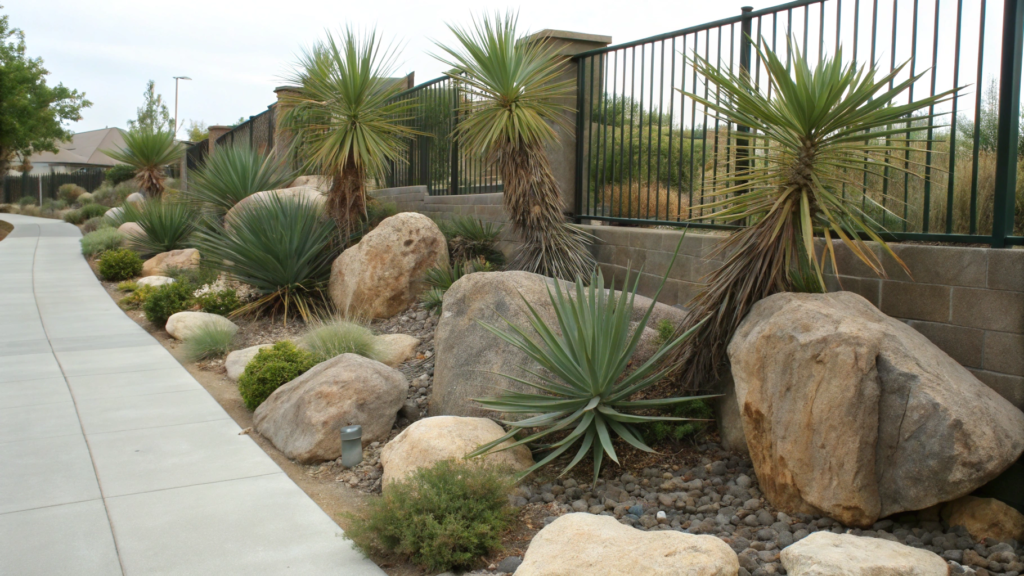
Compositions made of boulders and yucca combine visual heaviness (the stones) and graphic lightness (the yucca leaves). This works especially well at the front of the property, closer to the walkway or along the fence.
Yucca is a plant with character. Unlike cacti, it feels almost in motion: its leaves shoot out like rays, sometimes bending, and in the landscape it looks sculptural. And boulders bring foundation, stability, balance.
What it can look like:
- Large boulders (20–30″ / 50–75 cm), grouped in sets of 2–3, not overly symmetrical
- Between them — yuccas of different varieties: Filamentosa, Rostrata, or Spanish Dagger
- The soil is covered with gravel or stone mulch, sometimes with decorative sand added
Step-by-Step Plan:
- Mark the compositions. Use a hose or rope to outline the spots for the stone groups. Don’t make everything by the ruler — asymmetry works better here. Two or three clusters are ideal, spaced 4–6 feet (1.2–1.8 m) apart.
- Place the boulders. Choose stones of the same type but different sizes. Sink each about one-third into the ground so they look “settled” rather than placed on top. Weight ranges from 150 to 300 lb (68–136 kg), so be ready to get some help.
- Plant the yucca. Near each stone cluster, plant 1–2 yuccas at different distances. If you’re worried about sharp leaves, choose Yucca filamentosa, which has softer edges and handles frost well.
- Add background texture. The space between clusters can be filled with ½” (1–1.5 cm) gravel, decorative mulch, or ground cover — for example, blue pumice or even crushed tile for contrast.
- Accentuate the verticals. Along the walkway, you can plant 1–2 yucca rostrata — they have an almost perfect spherical form and look great against a wall or fence.
We saw this kind of composition at a private home on the way to Joshua Tree, and both Linda and I stopped and said: “Now this is cool.” The space felt like it was breathing. And it looked incredibly beautiful.
Tip. If you’re placing the boulders yourself, put old bricks between them while leveling. This helps keep the right tilt and saves your back from lifting each stone multiple times. Afterward, you can simply remove the brick and cover the gaps with soil or gravel.
6. Las Vegas Inspired Palm and Desert Rose Design
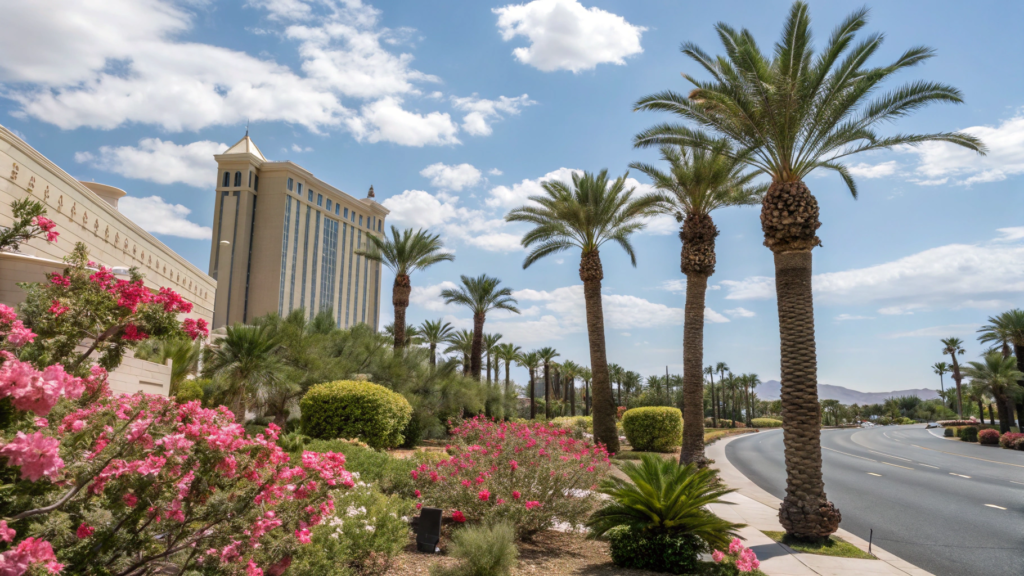
In this style everything is sharp, exotic, and a little bold. Here, palms act as the vertical focal points, while Desert Rose (Adenium) adds unexpected refinement — with its sculptural trunks and bright flowers.
The palms bring height, the Desert Rose adds texture, and together they look like an oasis in front of a luxury hotel somewhere in Summerlin or Henderson.
How it looks on the property:
- Short palms (for example, Mediterranean Fan Palm or Pygmy Date Palm) planted closer to the house
- Between them — gravel islands with 2–3 Desert Rose shrubs
- Up-lighting and golden-brown mulch enhance the “hotel” feeling
Step-by-Step Plan:
- Define the composition zone. This is usually the right or left section of the front yard, near the facade. The size ranges from 6×8 to 10×12 feet (1.8×2.4 m to 3×3.6 m) — a small scene, but with drama.
- Prepare the soil. Remove old grass or weeds, add drainage (sand, perlite), especially if you’re planting Desert Rose in the ground. These plants have delicate roots — moisture stagnation is harmful.
- Plant the palms. Pygmy Date Palm, up to 6 feet tall, is perfect — it doesn’t shade the yard and requires little care. Plant it in the “background,” closer to the wall.
- Place the Desert Rose. They can be grown in the ground (in warm climates) or in pots. Linda and I keep ours in containers — easy to bring inside before rain. One shrub is already a focal point. Set them on a gravel base framed with stone chips.
- Add lighting and details. Lighting under the palms and near the Desert Rose creates the effect of a resort evening. You can add glass mulch or decorative stones with a slight shimmer — subtle, but with character.
When Linda and I were in Vegas a couple of years ago, I said: “I want this — warm, bold, and not boring.” At home we’ve made a modest corner with one potted palm and a Desert Rose on gravel — looks great even on a small scale. And Linda, by the way, unexpectedly fell in love with the Desert Rose — for its thick trunk and delicate flowers.
Tip. If you’re planting Desert Rose in a container, choose clay pots with a wide base. Their root system is shallow and drainage is important. Water only after the soil is completely dry. And in winter — bring it indoors if temperatures drop below 50°F (10°C).
7. Arizona-Inspired Saguaro and Stone Combo

Saguaro — that epic cactus you see in every western movie and every postcard from Arizona. Powerful, vertical, slightly comical — and absolutely charismatic. If you add stones, sand, and minimal accents to it, you get a striking desert landscape.
This kind of front yard doesn’t require much space. The main thing is to let the air “move” between the plants and stones. Everything should feel a little rough, a little free. Like nature.
How it looks:
- One or two large Saguaros or their analogs (in most states it’s illegal to dig them up and transplant them, so people use fiberglass versions or substitutes like Cardon)
- Surrounding them — large boulders, sandy gravel, and small cacti or aloe
- The composition follows the principle of “one hero + texture around it”
Step-by-Step Plan:
- Choose the main focal point. The Saguaro must be the center of attention. Ideally, place it near the corner of the house, against a wall, to emphasize height. If you don’t have a real one, you can use an artificial version (Faux Saguaro Cactus Sculpture, Fiberglass Outdoor Decor 6ft) — they look very realistic.
- Prepare the base. Remove any grass, add sand or very fine gravel (¼” / ~6 mm). Choose colors like sandy, brownish-pink, or ashy gray. On top, add decorative mulch to create structure.
- Add the stones. Pick 3–4 large boulders (18–24″ / 45–60 cm) and place them diagonally from the cactus. One can be placed almost touching the base — like its natural “companion.”
- Secondary plants. Use low-growing cacti (Echinocactus, Ferocactus) or Agave Parryi. Place them sparingly, at different distances from the center — the empty spaces between them are important.
- Sand details. Sprinkle pathways with crushed sand or stone chips. You can create wavy lines with a rake, like in a Japanese garden — looks unexpected and interesting.
Tip. If you’re using an artificial Saguaro, be sure to secure it to a foundation or a weighted slab. Even a light wind can knock it over, and these structures can be fairly heavy.
8. Low-Maintenance Gravel Xeriscape

A gravel xeriscape works especially well in drought-prone areas (including California, Nevada, Arizona, and even South Texas) and is perfect for anyone tired of maintaining a lawn.
It looks minimalist but very refined: clean lines, pleasant textures, and groups of plants that “survive” even without your love.
What is it?
Xeriscape is a landscaping style focused on drought-tolerant plants, minimal watering, and mulched areas. In our case — a gravel surface (instead of soil or grass) and clusters of hardy plants.
Step-by-Step Plan:
- Define the zones. Divide the yard into functional zones: walkway, area in front of the porch, corner accents. Each zone can use a different gravel color or size to avoid monotony. For example, fine light gravel along the path, and larger, darker gravel closer to the house.
- Clear and level the area. Remove old grass and weeds (you can use a propane torch or herbicide if the area is overgrown). Level the soil and create a slight slope away from the house — 1–2 degrees for drainage.
- Lay geotextile. This is the foundation of a good xeriscape: it prevents weeds, stabilizes gravel, and keeps the layout in shape. Use dense landscape fabric (not the thin kind from hardware stores). Overlap the seams by 6″ (15 cm) and secure with U-shaped pins every 2 feet (60 cm).
- Add the gravel. The layer should be at least 2–3″ (5–7.5 cm), and for larger gravel up to 4″ (10 cm). Use one or two types — for example, light pea gravel (¼–⅜”) and black lava rock for accents. Spread by hand and level with a rake. Where you plan to place pots, make shallow depressions or set flat stones as a base.
- Place the plants. Use drought-resistant varieties: Agave, Yucca, Sedum, Lavender, Russian Sage. Plant in clusters but leave space — plants should “read” individually. Give each shrub 3–4 feet of free room (1–1.2 m). At the base you can add pumice to highlight the color.
- Add details. Small boulders, stepping concrete slabs, metal borders. Linda and I had an old copper basin — we turned it into a “dry fountain” with pumice and LED lighting. It looked strange, but beautiful — a tiny art piece.
- Watering and care. Install a drip system if the climate is extremely dry. But in most cases, mulch and occasional hand-watering are enough. Once a season — run a rake through, adjust the gravel, and… that’s it.
We created a xeriscape zone along the fence: clean gravel, a group of agaves, a couple of concrete slabs, and some low lights. It’s surprising how much it transformed the whole yard — and we didn’t water it once all summer.
Tip. To keep the gravel from shifting at the edges or washing out during rain, use a metal border (EasyFlex No-Dig Landscape Edging Kit, Metal Look). It’s barely visible, but it holds the shape perfectly, especially on slopes or along walkways.
9. Texas Front Yard with Mesquite and Pebbles

A front yard with mesquite and pebbles is a nod to ranch life, natural simplicity, and a bit of tamed wildness. There are no bright flowers or “English garden” touches — everything lives by its own rules, and that’s exactly the charm.
The star here is the Mesquite Tree. It has a wide canopy, narrow leaves, and a very distinctive trunk. Beneath it — pebbles, like the bed of a dried-up creek, mixed in places with rough gravel and low desert shrubs.
How this kind of yard looks:
- One or two mesquite trees (or similar varieties if mesquite isn’t available in your region)
- Under the tree — medium pebbles (1–2″ / 2.5–5 cm), with occasional patches of crushed stone, bark, or old brick
- A few plant clusters — for example, Texas Sage, Prickly Pear, Red Yucca
- Everything kept in a natural palette: gray-brown tones, a bit of dusty green, rust shades
Step-by-Step Plan:
- Choose a spot for the mesquite. Ideally away from the house — so it doesn’t shade the facade, but still gives shade to part of the yard. Mesquite can grow up to 30 feet tall (9 m), so plan accordingly. If planting a young tree, allocate a zone 8–10 feet (2.5–3 m) in diameter.
- Prepare the soil. Mesquite grows almost anywhere but prefers loose, well-drained soil. Remove the top layer of soil around the planting area (2–3″ / 5–7 cm), lay mulch or geotextile, and add pebbles on top.
- Add the pebbles. Use river pebbles or a mix of rounded stones and crushed gravel. Colors like gray, light brown, or dusty red work well. The layer should be at least 2″ (5 cm). Add a few large flat stones in places, as if they “pushed up” from the ground.
- Plant desert plants. Go for hardy local species: Red Yucca, Russian Sage, Texas Sage (Leucophyllum), cacti. Place them freely, without crowding. Around them — some bark or stone mulch for structure.
- Add ranch-style elements. You can use pieces of wood, old wagon wheels, vintage lanterns — anything that hints at “life on the land.”
- Set up the shade. Mesquite creates dappled shade, and it feels great to place a wooden bench under it. Even a simple two-board bench fits right in. This isn’t a lawn for games — it’s a place for quiet.
We saw this kind of layout at friends’ home in Austin — pebbles under the tree, a pair of cowboy boots used as planters, and Red Yucca on the sides. In the evening it looked like a scene from a Texas movie. Very atmospheric.
Tip. Mesquite tends to grow long, spreading roots. Don’t plant it closer than 6–8 feet (1.8–2.5 m) to walkways or the house. And trim the lower branches while the tree is young — that’s how you shape a beautiful silhouette with an umbrella-like top.
10. Color-Popped Succulent Border
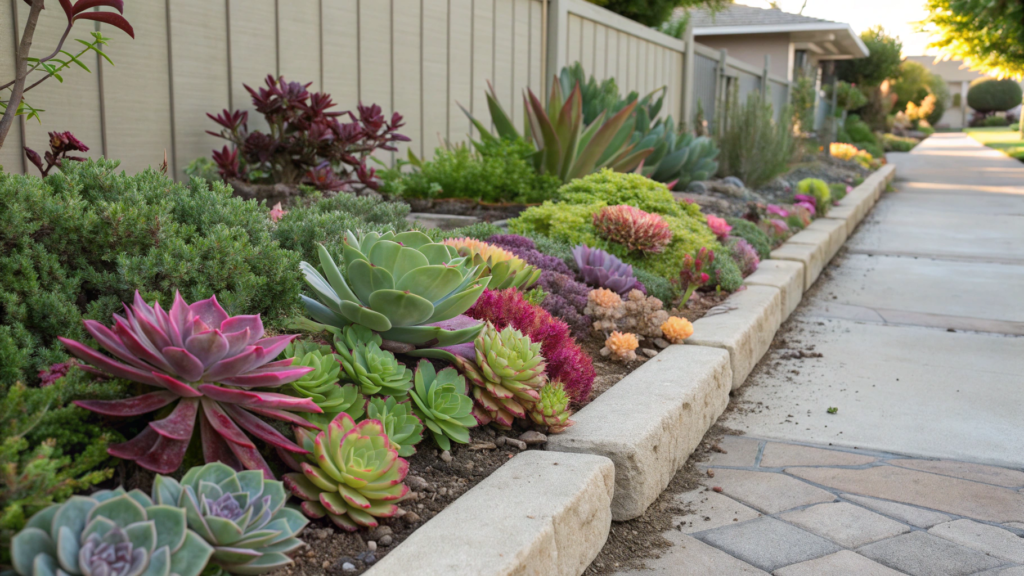
A color-popped succulent border is like a frame for a painting: it doesn’t take up much space, but it highlights everything else.
This kind of border can run along the walkway, outline a gravel bed, frame a planting area, or simply “hold” the edge of your xeriscape.
What makes this idea special:
- Succulents provide both shape and color: blue, purple, bright green, burgundy, even orange
- Some of them bloom — briefly, but impressively
- All are drought-tolerant and live “on autopilot,” without frequent watering
- They look neat, modern, and never appear neglected
Step-by-Step Plan:
- Choose the border line. This can be the edge of the walkway to the house, a line along the facade, or a frame around a gravel zone or flower bed. Width — 1–2 feet (30–60 cm), length depends on the layout. The key: the line should be clean, without abrupt curves, so the succulents form a unified picture.
- Prepare the soil. Remove the top layer of soil 4–6″ (10–15 cm) deep, add sand, pumice, or fine gravel for drainage. Succulents don’t like standing water. You can place landscape fabric on top to minimize weeds.
- Choose the plants. Suitable options:
- Sedum — carpet-like, often with lemon or red tones
- Echeveria — rosette-shaped, with blue-green or burgundy varieties
- Kalanchoe luciae (flapjack) — with bright red-green leaves
- Crassula — pearl-like leaves and compact shapes
- Aloe aristata — mini-agave look, often blooms
- Sedum — carpet-like, often with lemon or red tones
- Plant according to the layout. Combine tall and low varieties, tight but not crowded. A good pattern is alternating: bright — calm — variegated. Place each plant 6–10″ (15–25 cm) apart. At corners, use larger specimens to create visual “points.”
- Mulch and decorate. Around the plantings, add decorative pumice, fine gravel, or even glass mulch (if you like a glossy effect). This adds contrast and protects the soil from overheating.
Tip. To keep succulents from losing shape and color, avoid planting them in the shade. Even half a day of shade can make them stretched and pale. If the area is partially shaded — choose silver or blue varieties; they tolerate low light better.
The Desert Is Not Empty
A desert-style yard doesn’t look flashy, doesn’t require constant maintenance, and still gives a sense of a complete, intentional space. Everything is in its place: stones, gravel, the right plants. Everything feels calm.
No rush, no unnecessary fuss — just sun, shade, texture, and a little air between the details. It’s not just landscaping — it’s a mood. Sometimes Linda and I just step out barefoot onto the gravel at the end of the day, sit by the wall where the yucca stands, and simply rest after the daily noise.
I hope you’ll feel inspired to try something — not necessarily everything at once. Start with one accent, one plant, one line. And tell me in the comments how it turned out for you. And maybe that alone will set a new mood for your yard.