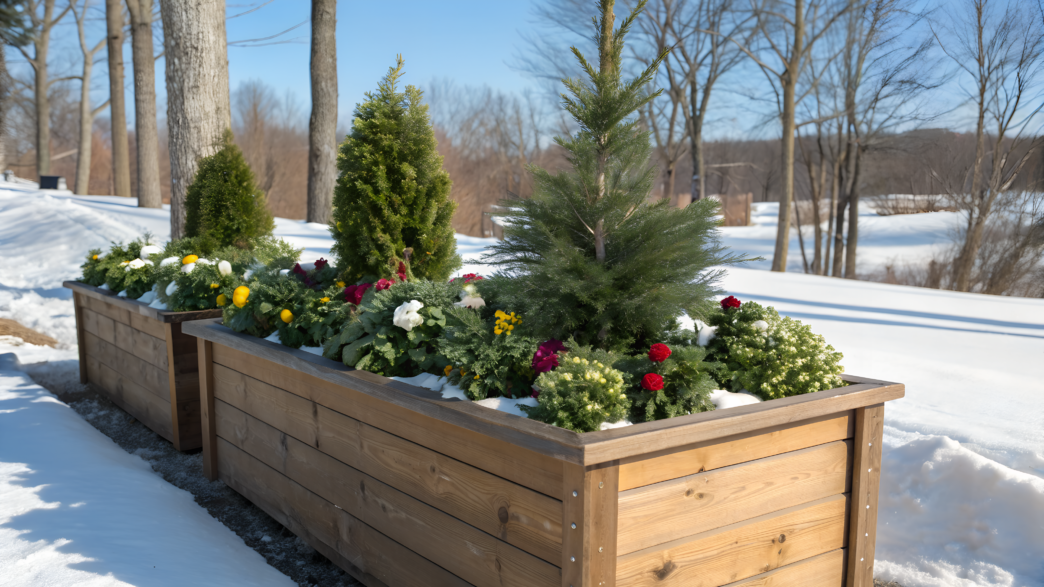
Winter planter boxes are a way to keep the space around your home looking pulled together and alive when the garden needs to go on pause. Cold, snow, and temperature swings aren’t going anywhere, but that visual feeling of neglect can absolutely be avoided.
In this article, I’ve put together 10 ideas we actually use ourselves — from frost-proof combinations and balcony solutions to boxes that handle snow and still look good even at the end of winter. There are no universal recipes “for everyone” here. Instead, you’ll find a logic shaped by real winters, real mistakes, and real re-dos. When you approach planter boxes thoughtfully, not as one-season decor, winter stops being a problem.
1. Top 10 Frost-Proof Planter Box Combinations
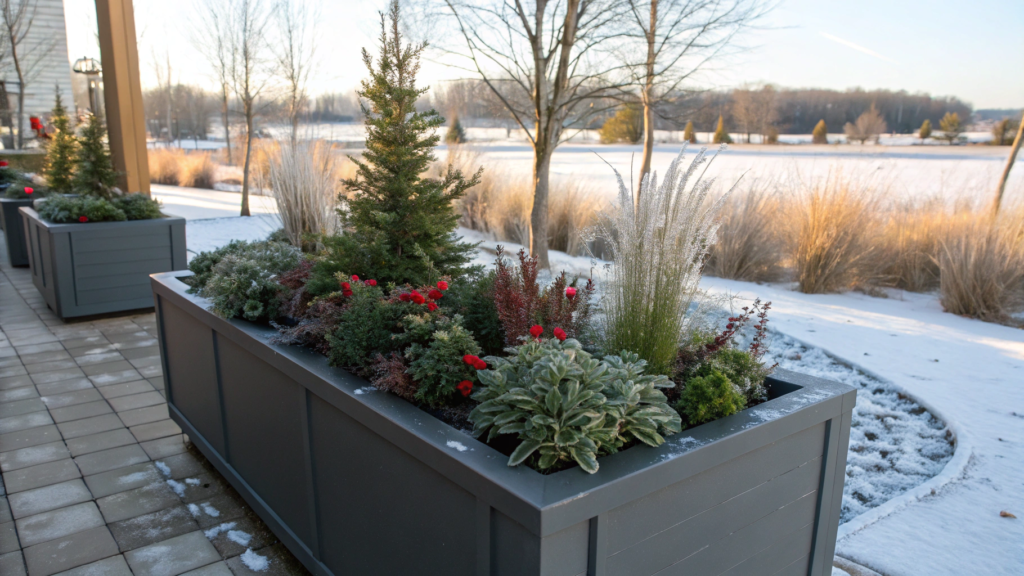
Outdoor winter planter box ideas create a sense of calm, and the boxes look structured, alive, and… confident. No drooping leaves.
Here are 10 proven combinations we use ourselves. They handle frost, snow, wind, and those exact temperature swings where it’s 40°F during the day and drops to 10°F at night (≈ +4°C and −12°C).
1. Dwarf spruce + ornamental cabbage + ivy
In this mix, the dwarf spruce provides structure. The cabbage adds color and density. The ivy spills over the edges and visually ties everything together.
- Planter box: minimum 36″ long × 16″ wide (≈ 90 × 40 cm)
- Depth: at least 14″ (≈ 35 cm)
- Why it stays stable in winter: spruce and ivy handle frost easily, and cabbage actually gets brighter after the first freezes
We place this combination near the front door. Even in February, when the garden looks as quiet as it gets, this box still looks solid and intentional.
2. Boxwood + heather + silver artemisia
If you’re after a clean, almost architectural look — this is it. Boxwood holds the shape. Heather adds soft color. Artemisia brings texture and a cool-toned contrast.
- Planter box: 30–36″ (≈ 75–90 cm)
- Weight (filled): about 80–100 lb (≈ 36–45 kg)
Tip from experience. Сhoose heather over erica — it handles temperature swings better
This option works especially well on clean, neutral front porches. It doesn’t demand attention but creates a strong sense of order and care.
3. Juniper + sedge + hellebore
This one is all about movement and contrast. Juniper provides evergreen volume. Sedge still shifts, even under snow. Hellebore sometimes blooms… and that’s always unexpected.
- USDA zones: 4–7
- Minimum planter depth: 16″ (≈ 40 cm)
- Fact — hellebores tolerate down to −10°F (≈ −23°C)
At times, this box feels like it has a life of its own. It changes week to week without ever looking messy, which is rare in winter.
4. False cypress + ivy + winter onion (ornamental allium)
A very resilient mix for open, windy locations.
- Overall height: up to 24–30″ (≈ 60–75 cm)
- Why it handles snow well: false cypress is flexible and doesn’t snap under weight
- Note — use a heavy container or add gravel to the bottom
We place these boxes closer to the road, where wind is constant. This combination keeps its shape even after heavy snowfall.
5. Dwarf pine + heuchera + ivy
In winter, heuchera leaves deepen in color, sometimes turning almost burgundy.
- Colors — burgundy, deep green, almost black
- Depth — 14–16″ (≈ 35–40 cm)
- Maintenance — almost none
If you want color without unnecessary risk, this is a safe choice. Especially for anyone who doesn’t plan to check planter boxes regularly in winter.
6. Thuja + ornamental cabbage + dry branches
Yes — branches. Birch or willow branches placed between plants add height and winter structure.
- Branch height: 36–48″ (≈ 90–120 cm)
- Why it works: visual balance and structural stability
- Tip. Branches shouldn’t touch the roots — they’re purely decorative
This approach really helps mid-winter, when you want structure more than greenery.
7. Boxwood + blue fescue + stones
This mix is built around minimalism that survives everything.
- Bonus — blue fescue keeps its color even under snow
- Addition — 1–2″ layer of decorative gravel (≈ 2.5–5 cm)
- Weight — the planter becomes heavier and more stable
This option is often chosen for balconies and small porches, where the composition needs to look clean from every angle.
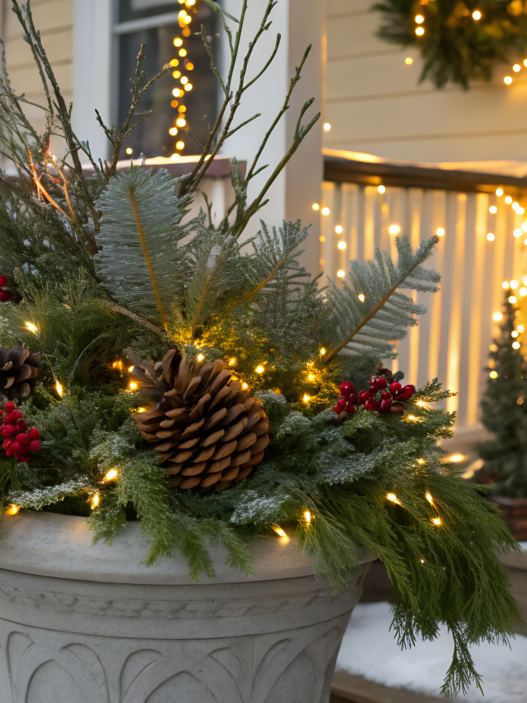
8. Spruce in the center + ivy around the edges + pinecones
Sometimes plants don’t need much “help.”
- Decor — pinecones, branches
- Why this works — everything looks natural, calm, and balanced — even in February
This planter blends into snowy landscapes without looking forced or artificial.
9. Juniper + heather + dried flowers
Dried flowers aren’t bothered by frost. They add volume when everything else slows down.
- Dried flower height — 18–24″ (≈ 45–60 cm)
- Tip — don’t use straw — it rots
This mix works especially well in areas where snow isn’t cleared often. The composition stays visible even when partially buried.
10. One evergreen + moss + stones
Sometimes less really is more.
- Plant — dwarf spruce / juniper
- Why moss — it holds moisture and protects the soil surface
- Overall look — calm, stable, very “winter”
For winter compositions, I almost always choose heavy, frost-resistant containers — the kind that don’t warp with temperature swings and don’t crack after the first winter. For example, Keter Urban Bloomer Resin Raised Garden Bed.
A small recommendation to finish
If a winter planter box looks good in November, it almost always looks good in February. So don’t overcomplicate it. Strong structure, resilient plants, and a heavy container — that’s enough for a beautiful winter composition.
2. Creative 12-Plant Mixes for Outdoor Cold Weather
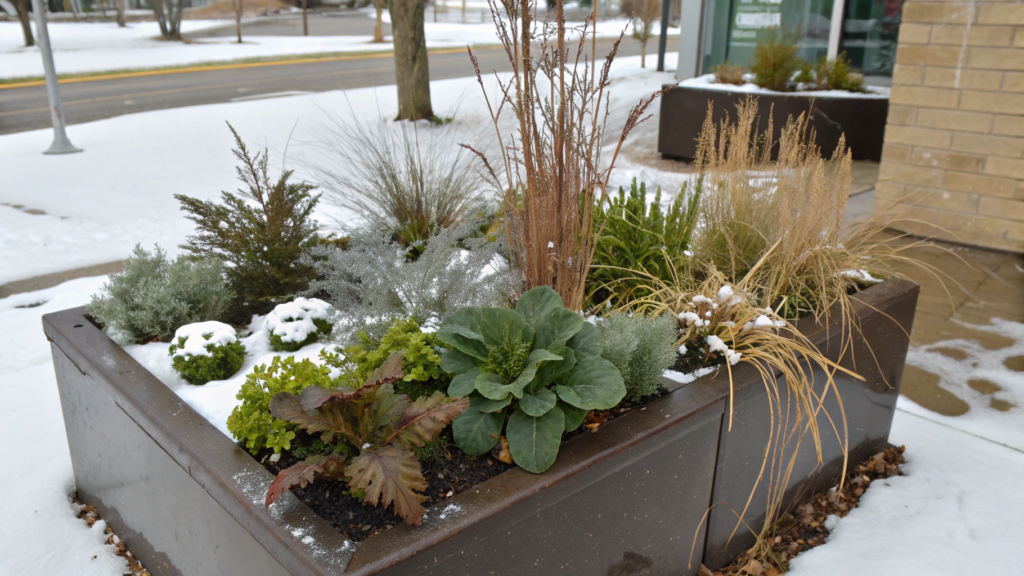
There’s always a desire to push beyond the basics and build a true winter composition that feels intentional from every angle. Even from the side; after snowfall; even at the end of January, when everyone’s patience is already at zero.
12 plants in one planter box sounds like overkill. On paper — absolutely. In practice, though, it looks surprisingly good.
Below are several mixes that don’t feel overloaded and don’t require constant attention.
Mix 1. Evergreen Backbone + Color Core + Soft Edges
The foundation mix, honestly speaking.
- 2 dwarf spruces or junipers (central structure)
- 3 ornamental cabbages in different shades
- 3 heucheras (burgundy, deep green, almost black)
- 2 ivies along the edges
- 2 ornamental sedges
Here, evergreens define the form, cabbage holds a dense center, heuchera adds depth of color, and sedge with ivy keeps the box from looking like a solid block.
This mix works well in long planter boxes starting at 48″ (≈120 cm) and up. It doesn’t require symmetry — light asymmetry actually makes it feel more alive.
Mix 2. Calm Winter Palette (for formal porches)
This one is all about restraint and texture.
- 3 boxwoods (low, same general shape)
- 3 heathers
- 2 silver artemisias
- 2 blue fescues
- 2 moss groupings (in patches, not a solid layer)
This mix works especially well next to concrete, stone, and dark wood.
Important. Plants shouldn’t all be the same size. Let the boxwoods vary in height by just a couple of inches. That small difference has a big impact on how the composition reads.
Mix 3. Movement + Winter Flowers
- 2 junipers
- 3 sedges
- 3 hellebores
- 2 ivies
- 2 ornamental onions (allium)
The sedge reacts to wind, so the composition changes even without any involvement from you.
Hellebores sometimes bloom closer to the end of winter, and that contrast against the general stillness is especially striking.
This mix is best placed where it’s visible from inside the house. It feels alive because it responds to air movement and changing weather.
Mix 4. Natural Woodland Look
If your porch or balcony faces a garden or wooded area, this option fits perfectly.
- 2 dwarf pines
- 3 ivies
- 3 ferns (cold-hardy varieties)
- 2 moss groupings
- 2 dried flowers (vertical accent)
There are no bright focal points here — and that’s a plus. The composition feels like a continuation of the surrounding space rather than decor brought in from elsewhere.
We often add a few stones or pieces of bark — not as decoration, but as part of the overall logic.
Mix 5. Late Winter Color Boost
We assemble this mix closer to mid-winter, when there’s a real craving for color.
- 2 evergreens (thuja or juniper)
- 4 ornamental cabbages
- 3 heucheras
- 3 ivies
This mix looks its best toward the end of winter. Cabbage and heuchera intensify in color after frost, and the planter starts to look better than it did in November.
Don’t be afraid of density. During cold weather, plants grow slowly, and tight spacing isn’t an issue here.
A few things that affect the final result
- Not all 12 elements need to be living plants. Branches, dried flowers, and moss are full-fledged parts of the composition.
- Layers matter more than symmetry. Height, density, edges — think like a designer, not just a gardener.
- The right container matters. A lightweight box can ruin even a perfect mix if it gets pushed around by wind.
If the composition feels just a little too dense at planting time, that’s almost always a good sign. Winter eats volume. Color softens. Edges blur. And what felt bold in December usually looks simply right by February.
3. Front Porch Box Designs That Handle Freezing Temps

On a front porch in winter, you’re dealing with wind, temperature swings, and snow that melts during the day and freezes back into ice at night. This is exactly where planter boxes most often crack, warp, or simply start looking worn out.
Over time, we’ve settled on a simple principle: for a front porch, the design and construction of the box matter more than the plants. Everything else comes second.
Long, low boxes instead of tall containers
Tall, narrow pots look great in catalogs. On a winter porch, they’re rarely the best choice.
Low, rectangular boxes:
- are more stable in the wind
- freeze more evenly through their depth
- hold their shape better after snowfall
Optimal sizes:
- length — 36–60″ (≈ 90–150 cm)
- height —14–18″ (≈ 35–45 cm)
- depth — at least 16″ (≈ 40 cm)
These boxes are easier to weight properly and much harder to tip over with a sudden gust of wind.
Material matters more than style
For porches that truly freeze, three options work best:
1. Composite / dense plastic
Doesn’t fear moisture, doesn’t crack, and requires no maintenance. The key is choosing models without thin walls. For these situations, we use Keter Urban Bloomer Resin Raised Garden Bed — it handles freezing temperatures and full loads easily, even with dense winter plantings.
2. Wood with thick walls
Works if:
- boards are at least 1″ thick (≈ 2.5 cm)
- there’s proper drainage clearance
- the wood has already gone through at least one outdoor season
Thin decorative boxes made from soft wood are almost guaranteed to fail in winter.
3. Concrete (or concrete with additives)
Heavy, stable, visually clean. Ideal for porches where the box is meant to stay in place for years.
Boxes with a “weight buffer”
There’s always more air movement on a porch. Because of that, we almost always do the following:
- a gravel layer of 2–3″ (≈ 5–7.5 cm)
- dense soil mix
- sometimes stones added between plants
This isn’t just about drainage. It’s about stability. A good front porch box in winter is one you don’t feel the urge to check after every storm.
Symmetry is your friend
On a porch, symmetry works better than almost anywhere else.
- two identical boxes on either side of the door
- the same plant height
- similar color accents
This creates a sense of order even when everything around is snow, ice, and gray sky.
Inside the boxes themselves, symmetry isn’t required. Let the plants grow freely — the container shape is what holds the rhythm.
Placement
If the porch is:
- open and exposed — place boxes directly on the floor
- covered — they can be slightly raised on feet or stands
What matters is preventing water from pooling underneath. Ice under a container is a common cause of cracks in spring.
We’ve noticed one thing: if a box looks good a week after the first hard freeze, it almost always makes it to spring without issues. If something already looks “on the edge” early in winter, it only gets harder from there.
Tip. For a front porch, you don’t need ten different designs. Two or three reliable formats that handle frost, look calm, and don’t demand attention are more than enough.
4. Evergreen & Decorative Grass Pairings for Winter Curb Appeal

A pairing of evergreens and ornamental grasses is often what saves the winter look of a home.
Evergreens provide structure. Grasses bring movement. Together, they create a strong, appealing front-porch presence.
Why this combination works so well in winter
- Evergreens hold their shape
They create a visual framework. Even when everything around is covered in snow, the eye catches onto a stable silhouette. - Ornamental grasses break the stillness
Grasses react to wind, shift slightly under snow, and cast shadows. The house stops looking “frozen in place.” - Textural contrast
Rigid needles paired with soft grass lines add depth that’s hard to achieve in winter using other plants.
This combination reads well from a distance — and for curb appeal, that’s critical.
The basic pairing formula (the one we use most often)
- 1–2 evergreens as the foundation
- 2–4 ornamental grasses around or along the edges
- some air between plants
You don’t need to pack the planter tightly. In winter, open space isn’t a mistake — it’s part of the design.
Pair 1. Dwarf spruce + sedge (Carex)
A very calm, restrained combination. The dwarf spruce provides a dense center. Sedge adds soft, cascading lines and keeps its color even in cold weather.
This pair works especially well near entry doors, along walkways, and in long rectangular boxes. Sedge doesn’t snap under snow and quickly returns to shape after a thaw.
Pair 2. Juniper + blue fescue
One of the most high-contrast options. Juniper is dense, dark, and steady. Blue fescue is light, almost metallic, with a fine texture.
Together, they create a clear visual rhythm, especially against snow or a light-colored facade. This pair looks great on modern porches and minimalist homes.
Pair 3. Thuja + miscanthus (compact varieties)
For situations where more height and presence are needed. Thuja sets the vertical line. Miscanthus adds volume and movement. Even dried seed heads work as decorative elements.
Important. For containers, choose compact miscanthus varieties — otherwise spring brings surprises.
Pair 4. Boxwood + fine-leaf grass (festuca, carex)
Ideal for classic porches.
Boxwood holds a clean shape, while the grass softens its form. The composition looks cared for, but not rigid.
This is a good option if:
- the house is traditional
- the facade is light
- strong contrasts aren’t desired
Pair 5. Dwarf pine + tall grass as an accent
This composition works when you want a stronger statement. One evergreen acts as an anchor. One grass reads as a gesture.
We often use this pairing in corner boxes or where the architecture needs visual balance.
A few important notes from practice
- Grasses shouldn’t be too soft.
Choose varieties that hold their shape in winter instead of collapsing into a soggy mess. - Don’t be afraid of a dry look.
In winter, dry grasses read as texture, not a problem. - Snow is part of the composition.
A good pairing often looks better with snow than without it.
If a house looks good in winter without relying on color, the design is truly working. Evergreens and ornamental grasses aren’t a backup plan — they’re a full-fledged tool. Sometimes, just one well-chosen pair is enough to make a porch feel alive while the garden rests.
5. Low-Maintenance Balcony Planter Boxes
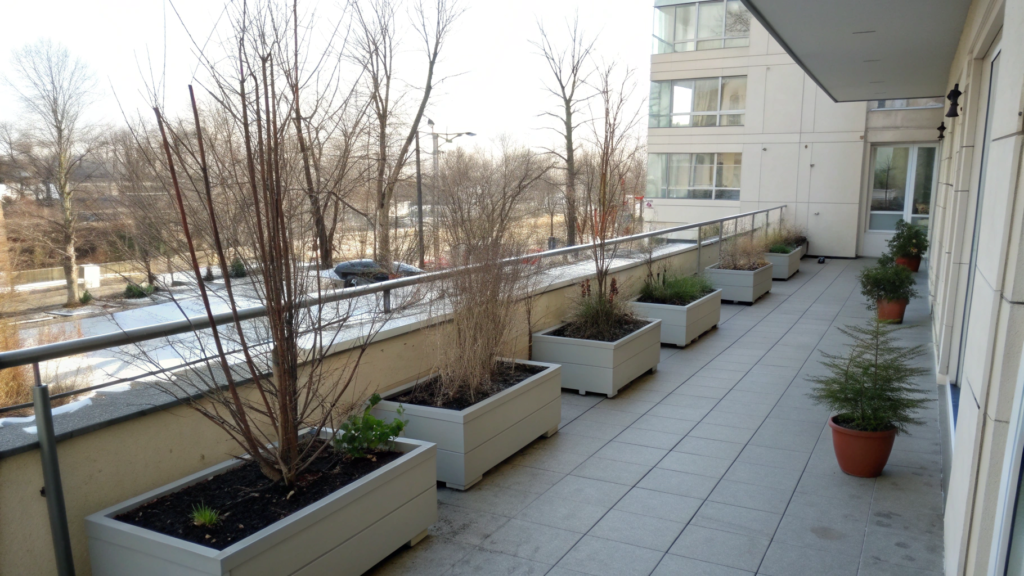
A balcony in winter is always a compromise. Less space. More wind. Temperatures swing faster than they do on the ground.
That’s why we almost always approach it from the opposite direction — fewer plants, fewer shapes, more stability and visual order. This mindset keeps a balcony feeling alive during the cold months without turning it into another thing that needs constant care.
1. One evergreen + filler (minimum effort)
The simplest and most reliable option — and the one we use most often.
What goes inside:
- 1 dwarf evergreen (juniper, spruce, thuja)
- moss, bark, or decorative gravel as filler
On a balcony, this works especially well because plants aren’t competing for moisture or space. The soil freezes evenly, the root system stays more stable, and the overall look remains clean for weeks at a time.
This is a planter you can leave alone all winter without worrying that it’ll look tired by spring.
2. Two identical boxes = visual order
If the balcony allows for two planter boxes, symmetry almost always wins.
What we do:
- 2 identical containers
- the same plant mix
- the same height and density
Even the simplest planting starts to look intentional when it’s repeated. This matters even more on small balconies, where visual chaos shows up faster than in a garden. Symmetry creates structure and makes the space feel calmer.
This trick often saves balconies with minimal furniture and rigid geometry.
3. Low, wide boxes instead of tall pots
For a balcony, this isn’t just about looks — it’s about safety and longevity. A lower center of gravity means less freezing stress and a lower risk of tipping.
Optimal sizes:
- length — 24–36″ (≈ 60–90 cm)
- height — 12–16″ (≈ 30–40 cm)
Tall, narrow pots are usually the first to suffer in winter. The soil freezes solid, roots get stressed, and the container reacts more aggressively to temperature swings.
4. Repeating one plant instead of mixing
This idea only sounds boring until you see it in real life.
Examples:
- 3–5 identical boxwoods
- 5–7 blue fescues
- several matching junipers planted in a line
Repetition creates rhythm, and rhythm creates a sense of design. On a balcony, this matters a lot because the space is read quickly and all at once, without background elements to soften mistakes.
Identical plants also respond to cold in the same way, so the composition doesn’t fall apart visually.
5. Grasses as the main element
Ornamental grasses are some of the most underrated winter plants for balconies.
They don’t need pruning in cold weather, respond well to wind, and hold their shape even under snow. One grass paired with an evergreen adds movement and depth without overcrowding the planter.
Even dry seed heads work as a decorative feature, not a problem that needs fixing.
6. The container matters more than the plants
On a balcony, the container is at least half the success — if not more.
What matters:
- frost-resistant material
- drainage holes
- sufficient weight
A weak container can ruin even the best planting choice.
7. One focal point instead of “full greenery”
A balcony isn’t a garden, and it doesn’t need to look like one. Sometimes one well-chosen planter box works better than five different ones.
A single focal point gives the eye something to rest on, keeps the space uncluttered, and doesn’t demand constant attention. In winter, that simplicity really matters.
If a balcony looks tidy in winter, doesn’t need attention, and doesn’t irritate you — it’s done right. Low-maintenance isn’t about doing less later. It’s about choosing solutions ahead of time that handle the season calmly, without your involvement.
6. Snow-Resistant Arrangements for Front Porches
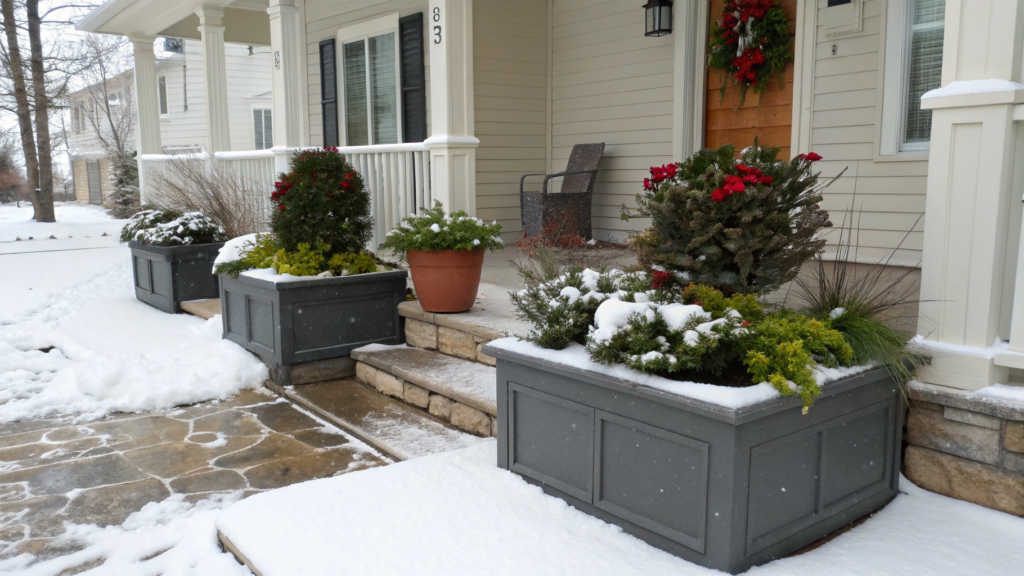
For planter boxes on a front porch, snow means weight, moisture, pressure, and constant freeze–thaw cycles. If a composition isn’t planned in advance, it either falls apart visually or fails physically — containers crack, plants break, and everything starts to look tired by mid-winter.
That’s why snow-resistant arrangements for front porches deserve special attention.
1. Keep the center of gravity lower than feels necessary
What works best:
- 1–2 low evergreen plants in the center
- most of the plant mass kept below the rim of the planter
- no thin, rigid vertical elements
Snow presses from above. When a composition is too tall, the load concentrates in one spot. Low, dense forms distribute weight evenly. After a thaw, this type of planter doesn’t look “collapsed” and doesn’t need urgent fixing.
2. Flexible plants instead of rigid forms
In winter, flexibility beats visual perfection.
Best candidates:
- junipers with softer needles
- sedge (Carex)
- ivy
- ornamental grasses with thin blades
These plants bend under snow and calmly return to their shape. Rigid forms without support usually look damaged after the first serious snowfall, even if the plants themselves survive.
3. Density is protection, not a mistake
For snow, sparse planting performs worse than dense planting.
When plants are placed close together, snow settles as a single layer instead of falling into separate “pockets.” This reduces point pressure and lowers the risk of ice forming inside the planter. Dense planting also slows soil freezing, which is especially important on front porches.
4. No “empty bowls” or concave shapes
Planters and arrangements that form depressions are traps for snow and ice.
Avoid rounded shapes with a sunken center, empty spaces between plants, and decorative elements where water can collect.
Water in these spots almost always freezes overnight and expands. A slightly overfilled planter is better than a neat one that collects ice.
5. Stones, gravel, and weight are mandatory
A snow-resistant arrangement is almost always heavier than a standard one.
What we do:
- a gravel layer of 2–3″ (≈ 5–7.5 cm)
- dense soil mix
- sometimes stones placed between plants
This helps the planter stay in place even when snow melts unevenly or is partially cleared away. Lightweight containers often shift in winter, and that quickly ruins the entire composition.
6. The container must survive winter, not just look good
For a snow-exposed porch, the container is the key element.
Reliable options:
- dense composite materials
- high-quality frost-resistant plastic
- concrete
7. Decor that doesn’t break
If you add decorative elements, they need to be flexible or completely inert.
What works well:
- birch or willow branches
- pine cones
- moss
- dried florals with sturdy stems
In winter, decor either survives the load calmly or turns into a problem. Fragile materials almost always lose.
8. Symmetry saves the look after snowfall
For a front porch, symmetry is insurance.
- two identical planters
- the same height
- similar compositions
Even if snow settles unevenly, symmetry visually smooths it out. The porch stays composed and doesn’t look skewed.
If a composition looks good after a snowfall — not just before it — it’s truly snow-resistant.
Snow always reveals weak points. And if it didn’t find any, spring won’t bring surprises.
7. Versatile Wooden Boxes That Fit Any Porch Decor
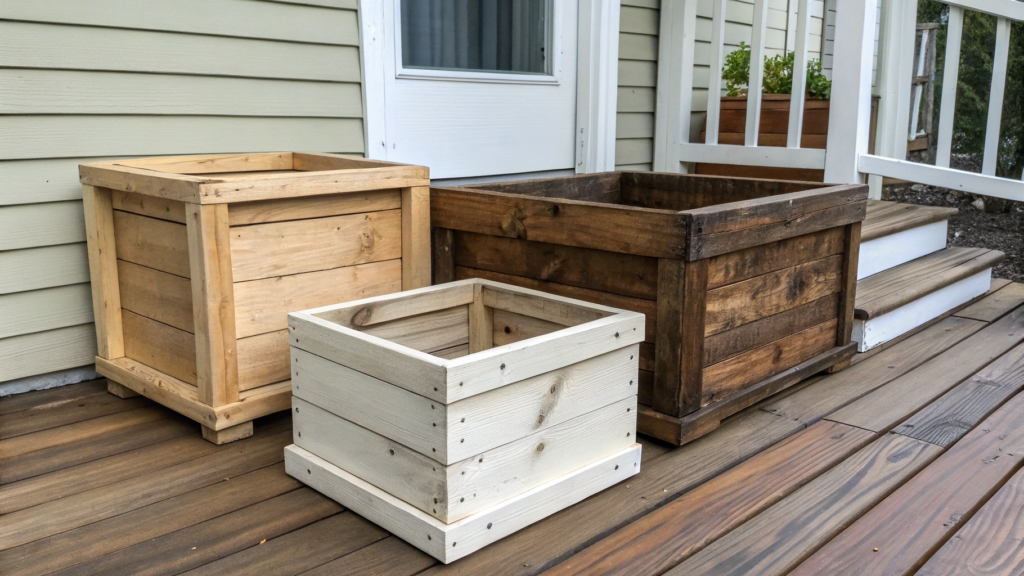
With wooden planter boxes on a porch, there’s a subtle difference: some look refined for years, others fall apart after one season. The difference is almost always in the details — construction, board thickness, and how the box behaves in cold weather.
1. Classic rectangular boxes without decoration
The most versatile format possible.
A simple wooden rectangle reads easily next to any facade — from farmhouse to modern. It doesn’t compete with the architecture or pull attention to itself.
These boxes work so well because their look fully depends on what’s inside. Today it’s a winter composition, in spring flowers, in summer herbs. The shape stays relevant in any season.
2. Natural wood without paint (or with light oiling)
Untreated or lightly oiled wood looks especially good in winter.
Over time, it darkens, color nuances appear, and the box starts to feel like part of the house rather than a separate object. On a porch, this works better than bright paint, which often feels out of place in winter.
Important. If oil is used, it must be suitable for outdoor conditions and freezing temperatures. A light refresh once a year is enough to keep the box going for a long time.
3. Thick boards matter more than design
This is the point most often ignored — and for winter, it’s critical. We look for:
- board thickness of at least 1″ (≈ 2.5 cm)
- solid joints without gaps
- minimal decorative cutouts
Thin wood reacts faster to moisture and frost. Thick boards hold their shape even when the box is filled with heavy soil and sits under snow for months.
4. Wooden boxes placed on the floor, not on legs
In winter, stability matters more than “airiness.” Boxes that sit directly on the floor:
- have no cold air circulating under the base
- don’t loosen or wobble in the wind
- distribute snow weight more evenly
If we want to lift the box visually, we do it minimally — just ½–1″ (≈ 1–2.5 cm), mainly to prevent water from pooling underneath.
5. One style, different sizes
A great technique for porches of any size.
- two identical boxes in different lengths
- or one long box and two shorter ones
- always in the same style and material
This keeps the porch composed without looking overly rigid. It works especially well near doors, columns, or railings.
6. Wood plus simple form equals maximum flexibility
A box without carving, complex profiles, or contrasting paint fits almost any home. This kind of wooden planter box changes through plants and seasonal details, not through its own shape.
These are the boxes you don’t want to replace after a couple of years — because they don’t get visually tiring.
A good wooden planter box isn’t the one that immediately draws attention. It’s the one that, after a few years, looks like it’s always been part of the house. If the box doesn’t compete with the porch, doesn’t require constant attention, and calmly survives winter — it’s the right choice.
8. DIY Concrete Box Designs That Outlast the Season

We didn’t come to concrete right away. First there was wood, experiments, compromises. Then the first concrete box appeared — heavy, simple, a bit rough. And it just stayed. One winter passed, then a second, then a third. And the box was still there.
1. Rectangular concrete box without legs
The most reliable and most versatile option. The shape is a simple rectangle.
No curves, decorative chamfers, or thin edges. The simpler the geometry, the fewer weak points.
Concrete distributes snow load evenly, and the absence of legs reduces the risk of the bottom freezing through. The box sits flat on the porch and doesn’t “shift” during temperature swings.
We make these boxes at least 16″ deep (≈ 40 cm). This gives roots a stable zone and allows them to survive frost without extra insulation.
2. Thick walls instead of delicate shapes
In concrete boxes, thickness is not about aesthetics — it’s about survival.
Working parameters:
- wall thickness: 1½–2″ (≈ 4–5 cm)
- reinforced bottom
- minimal decorative elements
Thin walls look neat, but they’re the first to crack during freeze–thaw cycles. Thick concrete behaves calmly and predictably, even with wet soil inside and snow sitting for weeks.
3. Simple formwork instead of complex molds
DIY mistake number one is a complicated shape. We use plywood, boards, and straight angles.
The simpler the formwork, the lower the chance of internal stress in the concrete. And stress is the main enemy in winter. It’s not always visible right away, but it’s exactly where cracks start later.
A simple box almost always outlasts a designer one.
4. Drainage is mandatory, not optional
In concrete boxes, drainage matters more than anywhere else.
What we always do:
- drainage holes at least ¾” (≈ 2 cm)
- gravel layer 2–3″ (≈ 5–7.5 cm)
- dense but non-clay soil
Without drainage, water stays inside. And water in winter means expansion, pressure, and cracks. Even high-quality concrete doesn’t tolerate standing moisture.
5. Reinforcement — even for small boxes
Even a small concrete planter box benefits from reinforcement. We use:
- metal mesh
- or fiberglass reinforcement
This doesn’t complicate the process but significantly extends lifespan. Reinforcement helps the concrete “hold together” when temperatures fluctuate and snow load shifts unevenly.
6. Weight as an advantage, not a problem
Concrete is heavy. And that’s a plus.
- the box doesn’t move in wind
- doesn’t tip during snow removal
- doesn’t react to uneven melting
We always plan placement in advance, because moving it later is not easy. But in winter, it requires zero attention.
7. Neutral look that fits everything
DIY concrete works because it doesn’t dictate style.
A smooth gray surface pairs well with wood, works with brick, and doesn’t clash with facade colors.
In winter, concrete looks especially appropriate — calm, solid, without unnecessary decoration.
8. The right concrete mix is half the success
For outdoor boxes, we use mixes designed specifically for exterior use and freezing conditions. Quikrete Crack Resistant Concrete Mix already includes additives that reduce the risk of microcracks during temperature swings.
This is not the place to experiment. Cheap mix almost always costs more after a couple of seasons.
If DIY concrete planter boxes survive the first winter without cracks, the second one isn’t scary anymore. And if in spring you look at it and don’t think “I’ll redo it next year,” then everything was done right.
9. Budget-Friendly Plastic Alternatives With Style
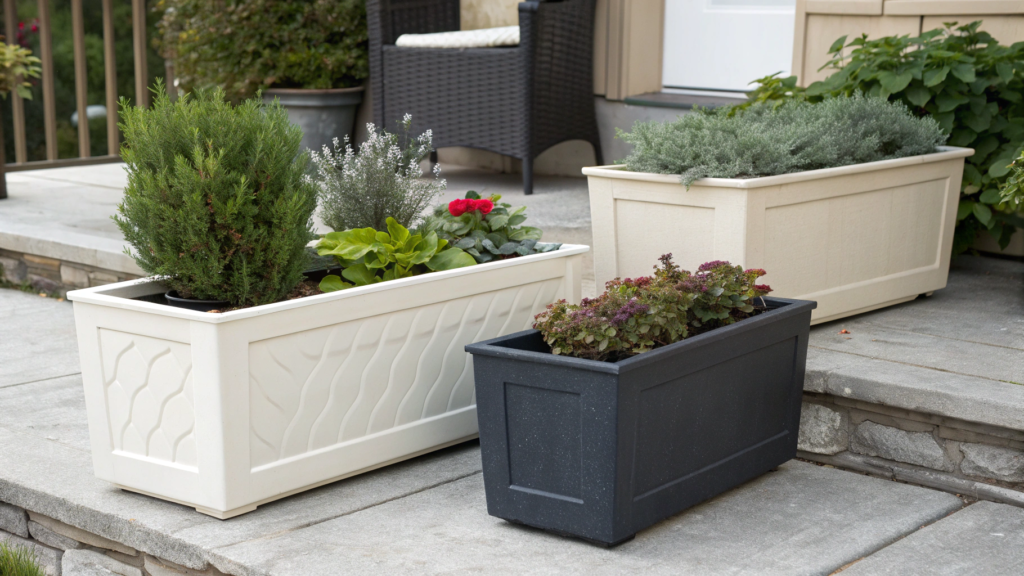
Plastic planter boxes are often dismissed too early. And unfairly so. In cold climates, they often turn out to be the most durable option: they don’t absorb moisture, don’t react sharply to temperature swings, and require no winter maintenance at all.
1. Frost-resistant plastic with rigid walls
Not all plastic is the same, and in winter this becomes especially obvious.
Plastic designed for outdoor use:
- keeps moderate flexibility in freezing temperatures
- doesn’t become brittle during freeze–thaw cycles
- doesn’t “ring” or feel fragile
Boxes with thin or decorative walls often look fine in fall, but by mid-winter start behaving unpredictably. The material loses elasticity, microcracks appear, and the container visually ages in a single season. High-quality frost-resistant plastic with rigid walls survives winter without noticeable changes, and this is clear both visually and in use.
2. Neutral shape instead of complex design
Straight lines and simple geometry work better:
- they don’t collect snow in corners
- they read more cleanly against the house
- they stay visually relevant longer
Complex shapes, reliefs, and decorative details only emphasize the artificial feel of plastic in winter. A simple form, on the other hand, keeps the focus on the plants and the overall composition, not the container itself.
3. Matte surface instead of gloss
This is one of the most underestimated factors.
Matte plastic doesn’t glare against snow, looks softer in overcast light, and hides scratches and signs of wear much better.
Glossy finishes in winter often feel out of place — especially on porches or balconies surrounded by natural textures. A matte surface helps plastic blend into its surroundings instead of standing out.
4. The right size matters more than appearance
Small plastic boxes almost always struggle in winter.
Working sizes for cold climates:
- length — 30–36″ (≈ 75–90 cm)
- depth — at least 14″ (≈ 35 cm)
More volume means more stable soil temperature and less stress for roots. Even the simplest plastic container looks more confident when proportions are right and plants aren’t cramped.
5. Weighting is mandatory
Lightweight plastic is both an advantage and a drawback. That’s why we almost always:
- add a gravel layer 2–3″ (≈ 5–7.5 cm)
- use a dense soil mix
- sometimes place a few stones between plants
After that, the box stops reacting to wind, doesn’t shift during snowmelt, and handles porch cleaning calmly. Without added weight, even a good plastic container becomes a source of unnecessary hassle.
6. Repeating identical boxes instead of mixing different ones
When the budget is limited, repetition becomes a design tool.
Two or three identical planter boxes create rhythm, look intentional, and remove any sense of randomness.
Different boxes in different shapes and colors almost always look scattered, especially in winter when there are fewer visual elements overall. Repetition, by contrast, makes the space feel composed and orderly.
7. Wood-look plastic as a compromise
High-quality plastic boxes with a wood-like texture look noticeably calmer than standard plastic. They handle moisture well, don’t crack in freezing temperatures, and require no treatment, while visually pairing nicely with porches, facades, and other natural materials.
In winter, when the color palette becomes more muted, these containers don’t pull attention to themselves and feel appropriate even without bright plantings.
8. Minimal decor that doesn’t highlight the material
With plastic, restraint matters. Best options are:
- moss
- branches
- dried florals
- decorative gravel
These elements add texture and depth without drawing attention to the container itself. Bright or fragile decor, on the other hand, immediately highlights the plastic and breaks the overall balance.
A good plastic planter box in winter is one that doesn’t call attention to itself. It simply holds its shape, supports the composition, and requires no intervention. And sometimes, these are the smartest solutions — affordable, visually calm, and reliable in real winter conditions.
10. Bright Planter Box Ideas for Late Winter Refresh

Often, planter boxes are the easiest way to refresh a space without waiting for spring.
The key here is not to overdo it. Brightness at the end of winter should be intentional and precise — otherwise everything quickly starts to feel out of place.
1. Ornamental cabbage as the main color accent
Late winter is its time. No qualifiers needed. Ornamental cabbage:
- becomes brighter after frost
- holds a dense, solid shape
- isn’t afraid of snow or wind
We often use it as the center of a composition, not as a filler. Purple, pink, and cream varieties look especially strong against gray skies and weathered snow.
It’s important to give it space. In tight plantings, it loses impact and turns into just “another plant.”
2. Leaf contrast instead of flowers
Flowers at this time are a risk. Leaves with strong color, on the other hand, work reliably.
Good candidates:
- heuchera (burgundy, lime, almost black)
- variegated ivy
- ornamental grasses with a golden tone
These plants don’t look “too early” or out of season. They simply add depth and contrast when everything around feels flat.
3. A light-colored container as a source of brightness
Sometimes it’s not about the plants at all.
Light-colored planter boxes reflect light, visually refresh the porch, and highlight even dark greenery.
At the end of winter, we often swap dark containers for light gray, cream, or concrete ones. Even without changing the planting, the space starts to feel fresher and lighter.
4. Colored branches instead of live flowers
This is one of the safest techniques for late winter.
Branches that work especially well:
- willow
- birch
- decorative branches with colored bark
They can be added to an existing box without disturbing plant roots. They bring height and a sense of renewal, without maintenance and without fear of returning frost.
5. Bright edges, calm center
The “frame” principle works well in late winter.
How we do it:
- center — evergreen or neutral
- edges — bright or contrasting plants
This keeps the composition visually stable while still making it feel refreshed. Brightness highlights the shape of the box rather than overwhelming it.
6. Repeating a single bright element
One color is better — when it’s intentional. For example:
- several identical ornamental cabbages
- repeated heuchera in one shade
- matching bright branches in two boxes
Repetition creates rhythm and keeps brightness from turning into chaos. This is especially important on porches and balconies, where the entire space is visible at once.
7. Refresh without a full replacement
At the end of winter, there’s no need to redo everything. Sometimes it’s enough to:
- replace one plant
- add branches
- swap the top layer for light-colored gravel
This kind of “soft update” saves energy and money while still giving a sense of forward movement. Psychologically, it works better than waiting out winter without any change.
8. Colors that work in overcast light
Not all bright colors behave the same in winter.
The most reliable options:
- purple
- burgundy
- soft pink
- light green
Bright yellow and pure red often feel too harsh against winter light. Softer, more complex tones read calmer and stay pleasant longer.
Late winter isn’t the time for radical moves. It’s the moment when small changes deliver the biggest impact.
One bright planter box by the entrance, one refreshed container on the balcony — and the space already feels different. Not like “winter to survive,” but like a transition. And that’s enough.
Winter porch
Good winter planter boxes don’t demand weekly attention.
They simply stand there, hold their shape, and support a sense of order while everything else rests. And if in February you look at your porch or balcony without irritation — that means everything was done right.
I’m curious how you handle this at your place. What survives winter best for you — wood, plastic, concrete?
Have you tried dense winter compositions, or do you lean toward minimalism?Write in the comments — those real observations are always more useful than any theory.