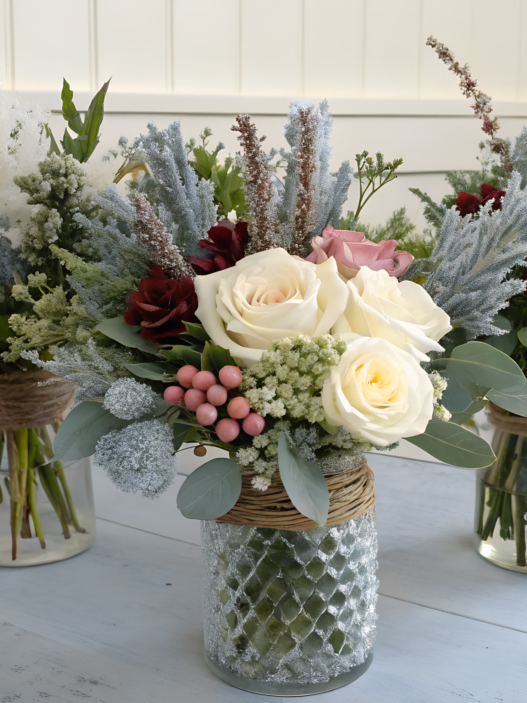
Winter floral arrangements can transform a home, a wedding, or any space into a place where you just want to stay a little longer.
We’ve tried almost everything, and every time I’m reminded that winter is the perfect season for creativity — it doesn’t demand perfection. It asks for inspiration and a bit of imagination.
In this article, I gathered 10 winter floral styles. Everything we created ourselves through different winters, everything that survived frost, evening dinners, friends’ weddings, grand lobbies, and our own kitchen counters.
If you want inspiration, practicality, and ideas that actually work in winter — you’re in the right place.
1. Classic Winter Wedding Bouquet Ideas
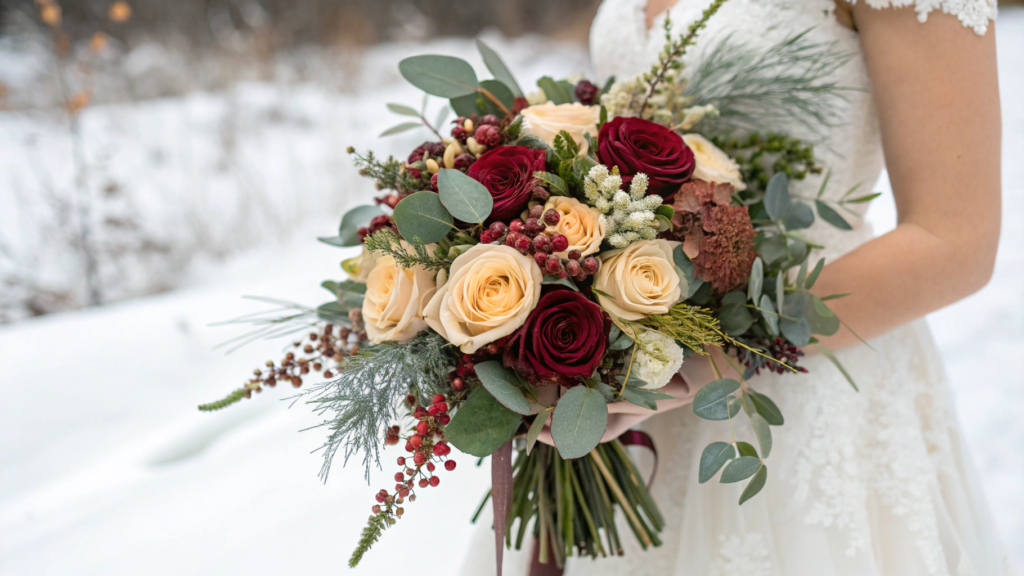
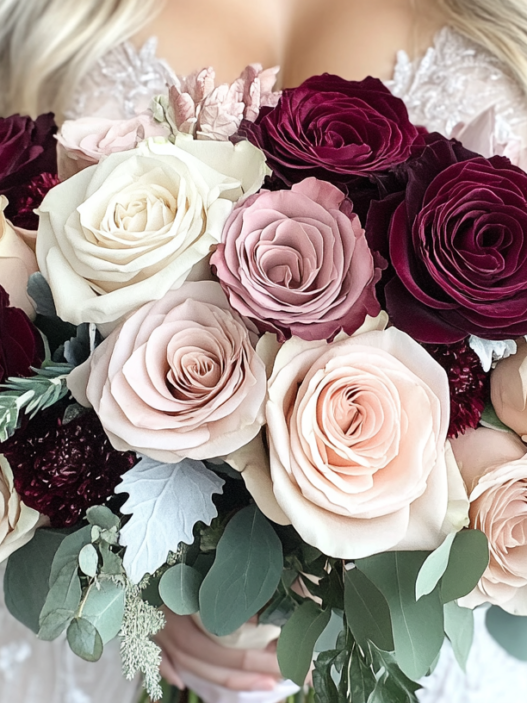
I’m always amazed by the contrast in winter weddings. Outside it’s cold, and in the bride’s hands — a bouquet that almost glows with warmth. I learned to make bouquets like this back in our old house in Idaho.
I’ll walk you through winter wedding bouquets that never fail.
Classic Ingredients for a Winter Bouquet
A winter bouquet often looks very warm. I usually start with a basic shape and then add hardy accents. Here’s the list of flowers and materials you’ll need:
Base (structure and durability):
- White roses (6–8 stems)
- Peonies in winter? Sometimes yes! If there’s import (2–3 stems)
- Anemones (4–6 stems)
- Ranunculus (6–10 stems)
Winter greenery (what makes the bouquet feel “wintery”):
- Eucalyptus (2 stems, big branches)
- Fir (3–4 short pieces)
- Cedar or juniper (a few soft, fluffy fragments)
Accents (what makes it feel like a wedding):
- White hypericum berries (4–6 stems)
- Succulents (1–2 small)
- Cotton (1–2 heads)
- Silver brunia (3–5 balls)
I love adding evergreens because they hold shape and smell incredibly calming. There are even studies about the impact of pine scents on stress levels — the Journal of Environmental Psychology describes how pine aroma helps reduce anxiety.
The Most Fail-Proof Winter Wedding Bouquet Recipe
- Create a soft floral base. Take 5–6 white roses and 4 ranunculus and gather them into a light spiral. Don’t rush — roses love space, and giving them a bit more air between stems makes the bouquet look fuller. Ranunculus adds roundness, like a layer of soft snow settling on the center. This step gives the bouquet its soft winter foundation.
- Add structural winter greenery. Insert 1–2 short fir pieces at the very base. They hold the shape even if the bouquet is out in the cold. Then add a cedar branch on the side — it’s soft, with a fuzzy texture. This greenery is easy to position so it subtly peeks through the petals.
- Place the accents that make the bouquet wintery. Put 3 anemones closer to the top edge — their dark centers add depth. Then add 2–3 brunia balls; their cool silver tone always looks instantly winter-like, even without snow. Brunia gives the bouquet a true winter character.
- Add a touch of softness or contrast. If you want a gentler look — add 1 cotton head on the side. It warms up the composition.
If you want contrast — place a small gray-green succulent near the base of the spiral. It adds structure and makes the bouquet look more expensive. - Secure the bouquet with the right ribbon. Evergreens can be stiff, so you need a firm ribbon that won’t slip. I usually use Floral Tape Green by Royal Imports — it grips the stems tightly and holds even in low temperatures. Good tape keeps the bouquet stable and winter-proof.
A Few “Classic” Ideas for Winter Weddings
Idea 1. White Monochrome with Textures
This is for those who love a clean style:
- Only white flowers
- Only eucalyptus greenery
- Plenty of ranunculus for softness
- A bit of cotton for airiness
The result is a bouquet that feels like it was put together on a quiet winter morning by the window.
Idea 2. White-Silver Classic
This version always looks luxurious, even on a small budget.
- Add silver brunia, a gray succulent, and a couple of dusty miller sprigs.
It looks fresh, slightly bolder, but still classic-classic.
Idea 3. Evening Elegance
When the wedding is closer to evening, I like slightly darkening the bouquet’s center.
For that, I add:
- Anemones with dark centers
- A short evergreen piece
- A succulent a bit below the center
It becomes voluminous and very expressive.
Little Tricks That Actually Work in Winter
- Store flowers in a cool room — winter makes this super easy.
- Make the spiral tighter than usual — evergreens can puff out.
- Add at least one matte-textured element — the bouquet instantly looks more professional.
- White roses look brighter in winter when paired with either a matte gray detail or deep green-blue juniper.
Tip. If you need to transport the bouquet, place it in a box with a slightly damp cloth near the stems.
2. Elegant Church Floral Displays

Winter church arrangements always need something a bit deeper than just “pretty.” They have to be durable, large-scale, and slightly ceremonial. But they don’t have to be expensive or complicated.
There are even studies suggesting that dense evergreen aromatic compounds stay longer in cool indoor spaces, which means evergreens are our best friend for large cold interiors. This makes them a perfect winter choice.
Key Elements That Create Elegance
(without overload, without glamour — just clean winter beauty)
- White amaryllis — tall, noble, with clear geometry.
- Lilies — for a light scent and bold shape.
- Fir and cedar — the base; without them the arrangement loses its winter feel.
- Candles or LED alternatives if you need safe, long-lasting light.
- Silver brunia — like a hint of frosty shimmer.
- White chrysanthemums — inexpensive, durable, and ideal for volume.
Three Types of Church Arrangements That Always Work
1. Tall Altar Display
The one everyone sees from any point in the room. It’s usually made like this:
- 5–7 tall amaryllis
- 4 large white lilies
- A dense cushion of evergreens (fir + cedar)
- A bit of brunia for silver accents
- A few long eucalyptus stems that flow softly to the sides
The arrangement should be at least 24–28 inches (60–70 cm) tall. In a church, visual weight gets lost if the flowers are too small — height becomes your main visual anchor.
2. Side Arrangements Along the Aisle
For this type of display:
- 10–12 white chrysanthemums
- Bundles of fir, 3–4 stems each
- 2–3 natural linen ribbons
- Mini candles or LED lanterns (churches rarely allow real flame)
If you want more depth, you can add 1–2 white roses to each section — they instantly create a wedding-style accent.
3. Entryway Arrangement (for “first impression”)
This is the area people notice even before the bride. We make it slightly warmer:
- 3 white amaryllis
- A full evergreen base
- Cotton or a soft cream ribbon
- 5–6 anemones for depth
- One accent element — for example, a silver succulent
If you have large floor baskets — perfect. They support the weight of the evergreens and look impressively substantial.
Small Tricks That Make Life Much Easier
There are a few simple but powerful techniques. For example, I always use ceramic or metal vases — they’re more stable, and their weight works in your favor, especially when evergreens begin to expand.
And one more thing: I never use cheap floral foam. It crumbles and the flowers don’t last as long. With OASIS Floral Foam Maxlife, arrangements hold better and look more structured.
Winter interiors often give a cold tone, so I almost always add at least one cream or beige accent — a chrysanthemum, a ribbon, or even cotton.
Add the evergreen branches closer to the end, not at the beginning — otherwise they will dominate and won’t let the flowers take their positions. Flowers should lead the arrangement, and evergreens should support it.
Simple Recipe for an Elegant Winter Church Arrangement
- Create a wide evergreen base. Take 6–7 fir branches and 3 cedar branches. Lay them as overlapping layers — like building a soft green cushion. In a church, small bouquet-like shapes get lost, so a wide foundation gives the arrangement a strong visual presence.
- Position the amaryllis to create vertical lines. Take 3 amaryllis and place them near the center, but not strictly aligned — one a bit higher, one slightly forward, one to the side. Amaryllis look especially beautiful in high ceilings. Tilt them slightly forward so they remain clearly visible.
- Add softness with chrysanthemums. Take 4–5 white chrysanthemums and place them around the amaryllis so they appear to “hug” the height. Their round shape softens the evergreen lines and creates a layered winter texture.
- Insert silver accents for a frosty shine. Add 2–3 brunia stems along the outer circle. Brunia works like crisp frost — subtle, not dominant. Place it above the greenery but below the main flowers.
- Light accent — candles or LED. If the church allows real candles, place them near the base but slightly aside. If not, use Homemory Flickering Flameless Candles — their warm honey glow creates a soft winter light effect.
- Final asymmetry. Add a bit of evergreen on one side or place a chrysanthemum slightly higher on the other — tiny shifts make the arrangement look more alive and naturally balanced.
3. Festive Home Centerpieces for the Holidays
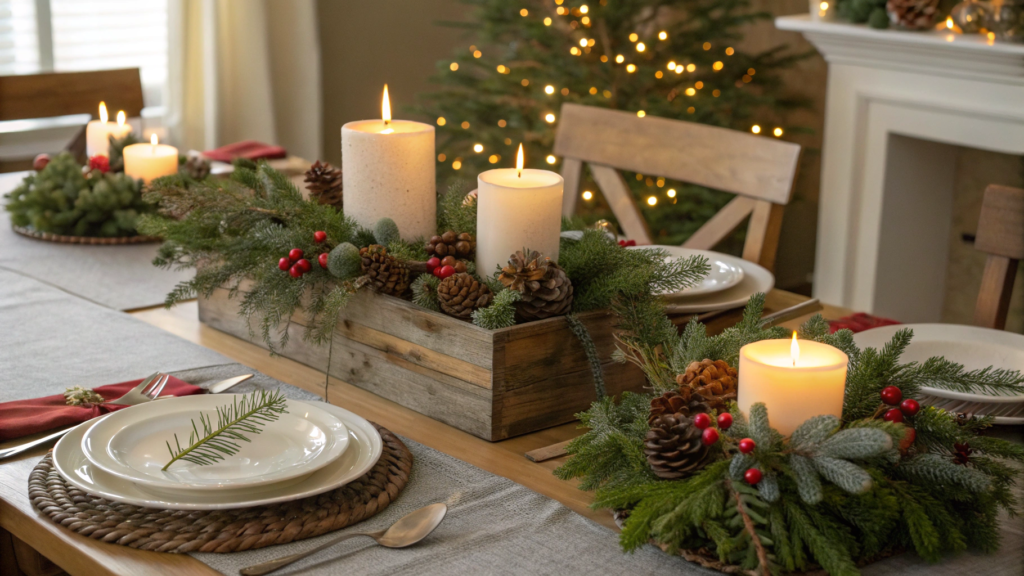
Unlike weddings or large events, everything at home feels softer. The light is a bit warmer. And the table is where people gather, reconnect, and just feel like themselves again.
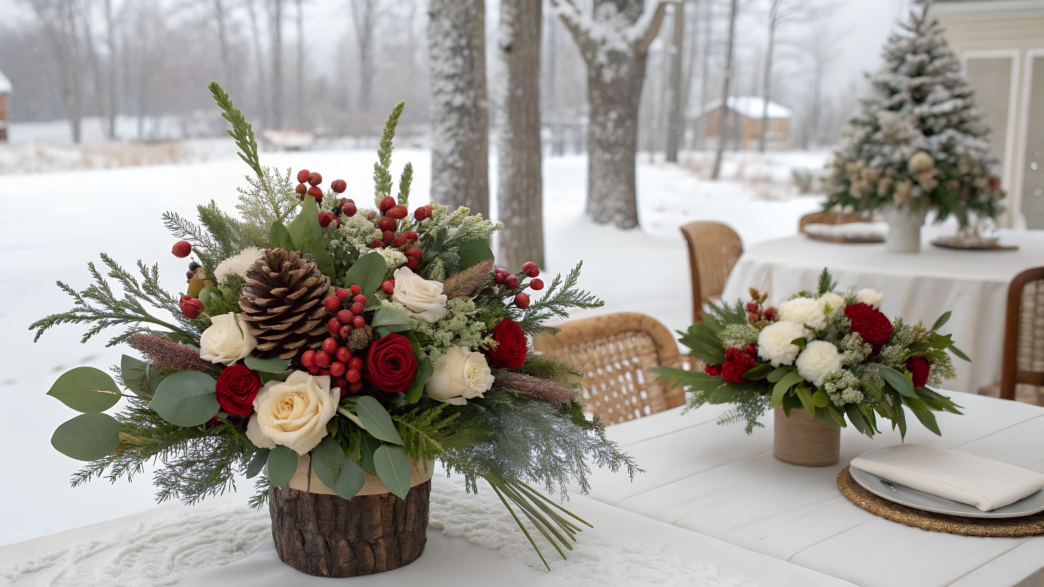
We often managed to put together something beautiful from evergreens, a couple of candles, and random branches Lindy brought home from her walk. And honestly, these “home” versions are still the ones I love the most — they always feel warm and effortless.
Main Elements for a Holiday Centerpiece
(everything accessible, everything easy to assemble at home)
- Fir, juniper, or cedar — the base, the scent, the texture.
- Amaryllis or white chrysanthemums — large flowers that create the center.
- Cinnamon, dried oranges, pinecones — small accents that “speak” holiday without excess shine.
- Candles or LED lights — for soft glow.
- Small glass vases or wooden trays.
Sometimes I add a bit of eucalyptus — the soft gray-green shade makes the arrangement calmer.
A Few Home Ideas That Always Look Festive
1. Centerpiece with Three Candles
Perfect for a long table. We take:
- Evergreen base (fir + juniper)
- 3 candles of different heights
- A couple of dried orange slices
- A few cinnamon sticks
- 3–4 white chrysanthemums for fluffiness
Place the candles in a triangle so the eye moves gently. The greenery should almost “hold” the light inside and create a soft holiday glow.
2. Natural Rustic Centerpiece
We made this one last Christmas — we had lots of evergreens but not much else. It turned out surprisingly cozy. You’ll need:
- A wooden tray
- A dense evergreen base
- 1 large amaryllis
- A handful of pinecones
- A touch of silver brunia
I like scattering the pinecones slightly along the edge — it creates a natural, unfussy feeling.
3. Centerpiece on a Round Plate
Perfect for those who want something quick but beautiful. You’ll need:
- Cedar and a bit of juniper
- 1–2 candles
- A couple of eucalyptus sprigs
- 3 anemones
- Several slices of dried lime
The central arrangement turns out compact but very expressive. And the dried lime makes the scent fresh and bright.
Simple Recipe for a Holiday Centerpiece
- Create an evergreen ring. Take 6–8 fir branches and lay them in a circle so they slightly overlap. The base should be firm but not heavy. If the table is small, make an oval — centerpieces don’t have to be perfect.
- Add a large floral accent. Place 1 amaryllis or 3–4 chrysanthemums in the center. Amaryllis adds height; chrysanthemums add softness. Position the flowers so they face slightly outward rather than straight up — it makes the arrangement look more inviting and open.
- Insert aromatic accents. Add 2 dried orange slices, 2 cinnamon sticks, and a couple of pinecones. They’re not just decorative: cinnamon and evergreens in a warm room create a gentle holiday aroma.
- Add light. Use candles; for safety, use Homemory Flickering Flameless Candles. The light should be soft, not harsh — otherwise the arrangement loses depth.
- Break the symmetry slightly. Add one branch of greenery at the edge, a bit further than the rest. Or place a cinnamon stick on the side. This small “imperfection” makes the centerpiece feel homey and alive.
Small Tricks. I always start with texture, not flowers. Evergreens are not the background — they’re the main “drawing” of the centerpiece. If you layer them and twist their directions slightly, the centerpiece begins to look like it grew naturally.
Add one warm-toned element even if the whole palette is cool. It can be dried orange, cinnamon, or a cream-colored flower. Warmth among green and white adds depth.
And of course, a damp sponge under the base. Winter indoor air is dry, and evergreens last longer with even a bit of moisture.
If the centerpiece is low, try spreading the flowers toward the edges instead of clustering them in the center. It makes it feel welcoming rather than formal.
Why This Type of Centerpiece Is a Good Idea
It lasts long, smells pleasant, and you can assemble it in 20–30 minutes without special skills.
And most importantly — it creates that very atmosphere you can’t buy: a little quiet, a little warm, a little wintery. The logic is simple: minimal effort, maximum effect, and every time you walk past the table, you feel the holidays have truly arrived.
4. Outdoor Arrangements That Withstand Frost
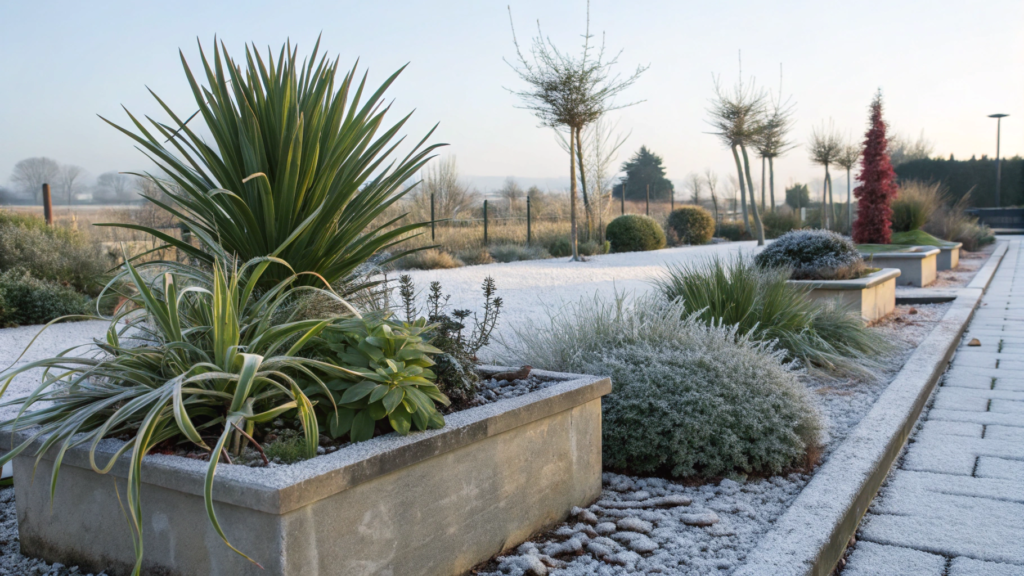
I learned to make frost-resistant arrangements not from books, but from that first house in Idaho. The wind there could be so strong that we’d build a display by the entrance, set it up, feel proud… and sometimes wake up to sad remnants of what used to be a beautiful idea.
That’s how I started studying plants that can truly live in the frost, not just “tolerate” it.
Plants with a waxy coating and dense cell structure lose moisture much more slowly and don’t darken from cold — something I now trust completely because it’s been proven by real winters.
Plants and Materials That Easily Survive Frost
- Evergreens: fir, thuja, juniper
- Chamaecyparis — keeps its shape for up to a month
- Magnolia foliage — dense, doesn’t blacken
- Succulents — especially echeverias
- Brunia — perfect silver accent
- Hypericum berries — if frost isn’t below −10 °C
- High-quality artificial berries — add brightness
- And of course, red dogwood branches. I use them almost every time.
Winter Ideas That Work Outdoors
1. Arrangement in Large Outdoor Planters
You’ll need:
- Lots of evergreens (fir, thuja, juniper)
- 6–8 red dogwood branches
- Magnolia leaves
- 2–3 succulents
- A couple of brunia stems
Evergreens create volume, magnolia adds gloss, and dogwood gives vertical lines that look especially striking against snow or cold concrete — a strong visual structure.
2. Arrangement with Frost-Resistant Succulents
Holds up perfectly until −6–8 °C. The secret of succulents is in their cell structure.
Gather:
- A low planter
- A layer of evergreens
- 3–4 echeverias
- Magnolia around the rim
- Juniper as an accent
It looks simple, clean, modern, and very cold-weather friendly.
3. Vertical Outdoor Arrangements
This is all about scale — in front of the door or along the walkway.
Use:
- 10–15 thuja branches
- 10 dogwood branches
- Pinecones (natural or painted)
- An evergreen cushion at the base
You can secure the pinecones with thin wire — the wind can undo everything.
Simple Recipe for a Frost-Resistant Outdoor Arrangement
(minimum care, maximum durability)
- Create a dense evergreen foundation. Take 8–10 fir branches and press them firmly into the soil or leftover autumn potting mix. Fir should form a bowl — dense, heavy, with a confident shape. The evergreens are the skeleton of the arrangement, and they’re the first to survive frost, giving the setup a solid winter base.
- Add branches that create height and contrast. Place 6–8 red dogwood branches vertically, with two or three angled to the sides. This red tone looks incredibly bright in winter — even a few stems create structure. The colder the light, the redder the dogwood appears.
- Add magnolia leaves for texture. With 5–6 leaves the arrangement already looks more elevated. Magnolia survives cold well thanks to its thick, leathery structure. Place the leaves at mid-height to create a “band” of depth.
- Add frost-resistant accents. Place 1–2 succulents closer to the base. They handle short frosts and add a calm, modern look. A couple of brunia stems give a soft silver winter shimmer.
- Secure the arrangement and protect it from wind. Use strong wire or Floral Wire by Darice — flexible, sturdy, and doesn’t snap in the cold. Tighten the evergreen base if it feels loose; winter tests everything for strength.
Small Tricks to Make the Arrangement Last Longer
I always tamp the soil tightly around the stems — if the base moves, the frost will ruin everything. I place fir at an angle so it doesn’t stand “like soldiers” but lies in layers — it resists the wind better.
If the frost is strong, I use a little plant antifreeze spray (polysaccharide-based). It creates a thin film on the leaves and helps prevent blackening.
And I never leave empty gaps between branches — cold loves gaps. The denser the arrangement, the longer it lives. This density creates a naturally insulated structure.
5. DIY Winter Floral Ideas on a Budget
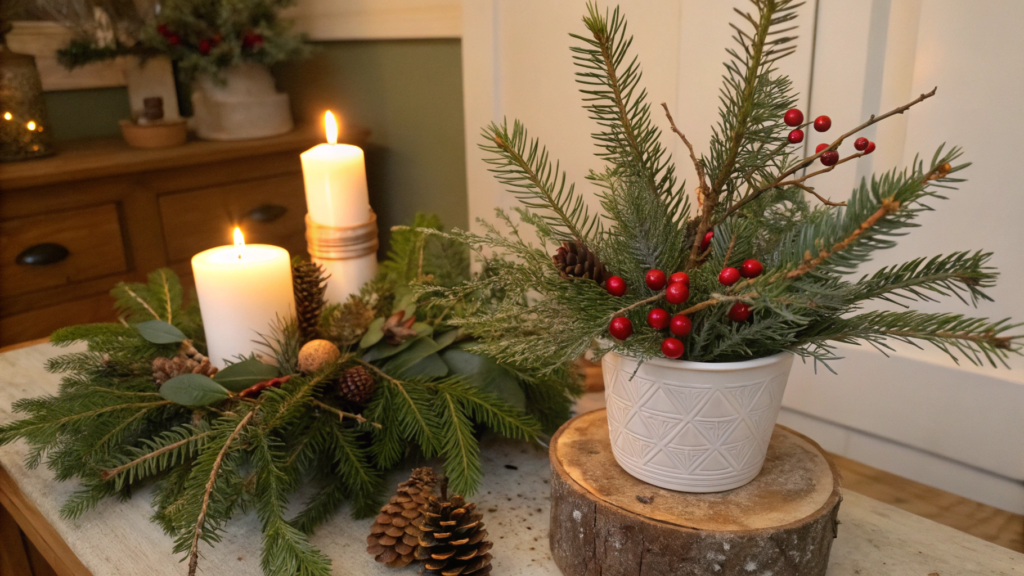
Ever had two fir branches, one candle, and a huge desire to save money? That’s exactly when real budget winter arrangements are born. And honestly, many of them I love even more than the expensive ones — because they have inventiveness and that feeling of making something beautiful with your own hands. They always feel natural and personal.
Materials That Work Perfectly for Budget Winter Arrangements
- Evergreens (fir, pine, thuja) — you can collect fallen branches in your yard or a park.
- Dried oranges — inexpensive, smell wonderful.
- Cinnamon, anise, pinecones — affordable and stylish.
- Mini succulents — long-lasting, striking, often found in store discount sections.
- Dogwood branches or any bright wood you can find in nature.
- Inexpensive chrysanthemums — one of the most durable winter options.
- Sometimes we even used leftover gift wrapping — ribbons, kraft paper, string. And you know what, it looks surprisingly polished.
Ideas for Budget Winter Arrangements
1. “Everything From the Kitchen” Centerpiece
We created this one when we needed something urgently and the stores were closed (classic holiday-eve situation). You’ll need:
- 1–2 oranges (slice and dry them)
- A couple of cinnamon sticks
- A handful of pinecones
- A bit of fir
Lay everything in a bowl or on a flat plate. The result is unexpectedly cozy (without excess shine). And the scent is calm, warm, and wintery.
2. Mini-Succulent and Evergreen Arrangement
Very modern, very budget-friendly.
Put one mini succulent in the center, surround it with evergreens, add a couple of brunia stems. On top — one short cinnamon stick.
I like this style for its clarity. It feels clean and intentional.
3. Jar Arrangement
Our old favorite. Back in Idaho we made these for neighbors. You’ll need:
- A glass jar (a regular jam jar works)
- Some evergreens
- 1 candle or LED light
- A few dried berries (or high-quality artificial ones)
Evergreens go around the edges, the candle goes in the center. Looks charming and not cheap at all.
Simple Recipe for a Budget Winter Arrangement
(with minimum cost and maximum effect)
- Create a base of evergreens and dried elements. Take 6–7 fir branches and lay them in a light circle or oval. The base doesn’t need to be perfect — natural “incompleteness” makes the arrangement warmer. Add 2–3 dried orange slices and one cinnamon stick to create aroma and a clear visual center.
- Add one bright element for the accent. This can be a chrysanthemum, an anemone, or a mini succulent. Just one! Budget arrangements love minimalism. Place it slightly off-center to keep the look natural.
- Place small details that create depth. Use pinecones, juniper sprigs, or brunia. They’re inexpensive but incredibly wintery. Arrange them so they peek through the evergreens and create little pockets of air between layers.
- Add a light accent. Use candles or a small LED. For a safe option, choose Homemory Flickering Flameless Candles. Light makes the arrangement look warm even without expensive flowers — a big-impact detail.
- Break the symmetry. In budget arrangements it’s especially important not to chase perfection. One pinecone to the side, a small piece of evergreen on top — and everything instantly looks far more professional.
Small Tricks That Help Save Money and Still Make It Beautiful
I always collect leftover evergreens after trimming — they’re perfect for small arrangements and completely free. Dried oranges are cheaper to make at home than to buy — and the scent is richer. If I buy chrysanthemums, I split the bunch into individual heads and spread them across several mini-arrangements — one purchase works three times over.
And the most important thing — texture matters more than the number of flowers. If the evergreens are arranged beautifully, the whole setup feels thoughtful even if there’s only one flower. Good texture gives the arrangement a finished, intentional look.
Why These Arrangements Are a Great Idea
Because they prove a simple truth: beauty doesn’t have to be expensive. They last long, take minutes to assemble, and look like they cost much more than a couple of dollars. And the best part — they always show your hand, your mood, your winter.
6. Romantic Candlelight Floral Concepts
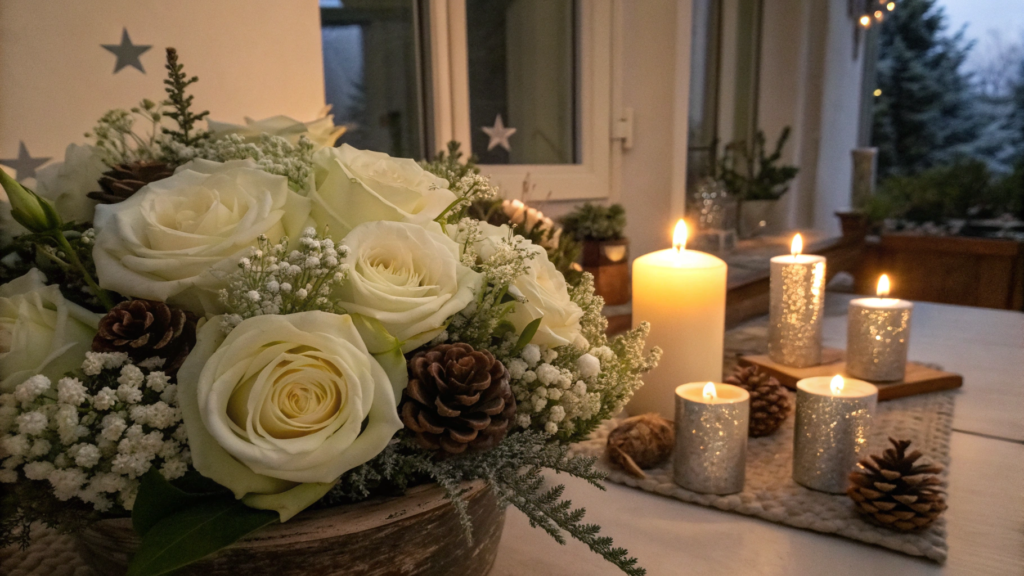
Have you noticed that on a winter evening, when the light drops a little lower, quieter… the room fills with that romantic breath of candlelight? And the flowers behave completely differently in that moment. They stop being the center of the arrangement and become partners to the light.
Candles aren’t décor — they’re the atmosphere where flowers start to look softer and more alive.
White roses near candles become creamier, and brunia looks like a silver star.
Flowers That Pair Perfectly With Candlelight
- White roses — warm up in candlelight.
- Cream chrysanthemums — fluffy, soft, ideal for romance.
- Ranunculus — create a “silky foam” effect.
- Eucalyptus — smooth lines, airiness.
- Fir and cedar — light winter texture.
- Cotton — soft accent.
And yes, battery-powered candles are no longer a scary compromise. Technology has grown, and some models look almost identical to real flame — a practical candlelight option.
Candlelight Arrangement Ideas That Create a Romantic Mood
1. Low Round Arrangement Around a Candle
This version creates a feeling of intimacy.
You’ll need:
- 1 large candle (or LED)
- Evergreens
- 3 chrysanthemums
- 2 ranunculus
- A bit of eucalyptus
The flowers should “hug” the candle — not cover it, not lean on it, but surround it with a soft ring.
2. Two Candles and a Long Arrangement
Great for a long table.
Place two candles at the ends, and between them — free lines of evergreens and several cream flowers. You get an arrangement that naturally suggests where the eye should move.
3. Candles + Cotton + Magnolia
This style is more aesthetic, more modern. Magnolia leaves reflect the light so beautifully that it almost feels like the arrangement is lit from within.
Simple Recipe for a Romantic Candlelight Arrangement
- Create a soft evergreen–eucalyptus base. Take 4–5 fir branches and 2 eucalyptus stems. Lay them in a half-circle, leaving the center open for the candle. Evergreens give texture; eucalyptus gives movement. Symmetry doesn’t matter here — you want it to feel natural, as if you just placed greenery on the table and it fell into place beautifully.
- Add a floral “diffused light” effect. Place 2 chrysanthemums and 2 ranunculus so they peek through the evergreens. This isn’t a strict arrangement — one flower can be closer to the center, another a bit to the side. Ranunculus catches the candlelight especially beautifully when placed at different heights.
- Set the candle and check the light tone. For safety, I often use Homemory Flickering Flameless Candles.
Set the candle in the center, but not perfectly straight — a slight shift makes the arrangement feel more alive. If the light is too cool, add one cream detail (a ribbon, cotton, or a chrysanthemum). A warmer accent keeps the composition soft and cohesive. - Add a small accent for depth. Brunia works perfectly here — its silver balls reflect warm light and create tiny “points” of volume. Place them low, closer to the evergreens.
- Add natural looseness. Turn one branch, lift one flower slightly — let the arrangement avoid being “strict.” Romance always has a bit of intentional looseness.
Small Tricks for Winter Candlelight Arrangements
I almost never place the candle exactly in the center — a small offset makes everything warmer and more interesting. If it’s a battery candle, wrap the base slightly with evergreens to hide the mechanism. And if you use a real candle, place a small glass plate under it — it protects the table and keeps the arrangement tidy.
Choose cream flowers over crisp white — they react better to warm light. And most importantly: don’t make the lines too sharp. Candlelight loves softness, and the flowers should reflect that warm, gentle glow.
7. Contemporary Minimalist Winter Compositions
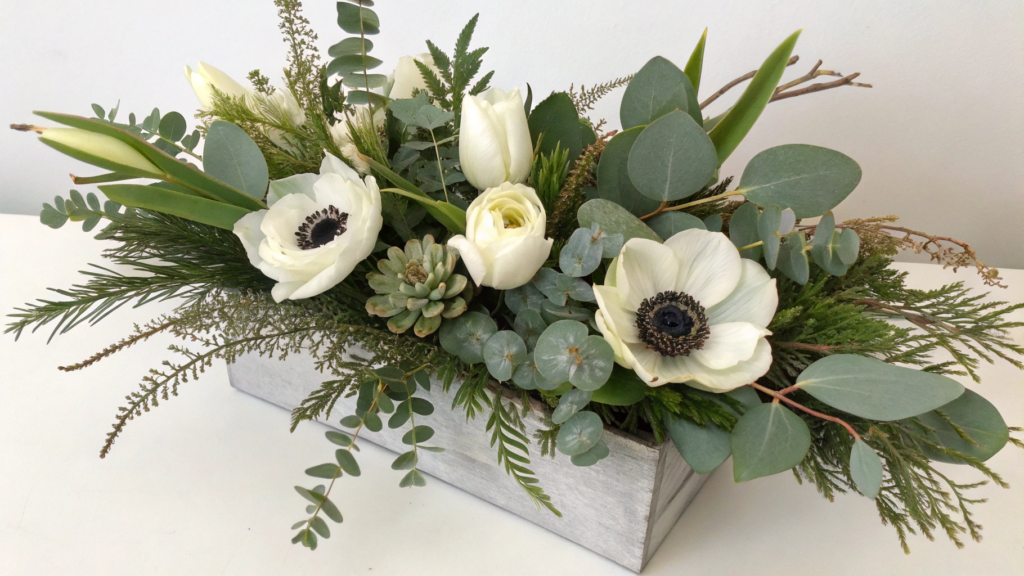
Modern minimalist winter arrangements speak to me deeply. Sometimes they look much stronger than any lush version. Their power comes from clarity, space, and the feeling that every element has a purpose — a clean winter aesthetic.
Elements That Work Best in a Minimalist Winter Style
- Eucalyptus — the main breath of the line.
- Anemones — simple but expressive accent.
- Succulents — structured, calm, “modern.”
- White tulips — purity in its pure form.
- Juniper branches — light winter texture.
- Magnolia leaves — for a reflective sheen.
- Brunia — a pinpoint cold accent.
It’s important not to overcrowd. Minimalism relies not on quantity but on shape and intention.
Ideas That Look Modern and Minimalist
1. One Large Flower + One Branch
Place in a narrow tall vase:
- 1 anemone
- 1 long eucalyptus branch
- 1 juniper sprig (low)
Just three elements — and it looks like an art object.
2. Bowl-Shaped Composition With a Succulent
Take a low ceramic dish:
- 1 succulent in the center
- around it — 2–3 evergreen fragments
- one magnolia leaf on the side
A stylish, clean look. It’s the type hotel lobbies love — but at home it looks even better, creating a quiet modern statement.
3. Mini Tulips in Glass
This is quiet beauty. In a glass cylinder:
- 3 white tulips
- a bit of water
- one thin eucalyptus feather
A composition for those who love order but not coldness.
Simple Recipe for a Minimalist Winter Arrangement
(nothing extra, only lines and textures)
- Choose one main element. It can be an anemone, an amaryllis, or a large echeveria. Place it in the vase slightly tilted — minimalism hates stiffness. A gentle angle creates movement and a soft modern flow.
- Add a supporting line. Take one eucalyptus branch. Yes, just one. This allows the arrangement to breathe. Position it so it guides the eye upward or sideways. In modern minimalism, the line is everything.
- Create a subtle winter accent. Use one juniper sprig or one magnolia leaf. Juniper adds a cool tone; magnolia adds reflective shine. These elements should sit below the main flower so the arrangement stays tiered, not flat.
- Add a small texture. One brunia head — and the arrangement gains depth. It’s not “decor,” it’s the tiny point that completes the space. In minimalism, less is stronger than more.
- Make a final light adjustment. If the arrangement sits in a dim corner, place a small LED candle nearby. Something subtle. I often use Homemory Flickering Flameless Candles. It gives a gentle soft light that highlights the lines without distracting.
Small Tricks for Contemporary Minimalism
Minimalism loves contrast of form, not color. Use different heights, not different shades. White is especially beautiful in winter — next to window light it becomes slightly bluish, and next to candlelight — slightly warm.
Minimalism doesn’t tolerate “noise.” Better remove one branch than add. If the arrangement feels “empty,” that’s okay — in winter, emptiness becomes part of the mood and creates intentional negative space.
Sometimes I even make an arrangement only from magnolia leaves — two or three stems. And it looks far more striking than lush bouquets. Minimalism is the courage to leave air between elements.
Minimalist compositions require minimal cost and maximum taste. And when assembled correctly, they look as if you brought them from a designer studio.
8. Rustic Farmhouse Floral Charms
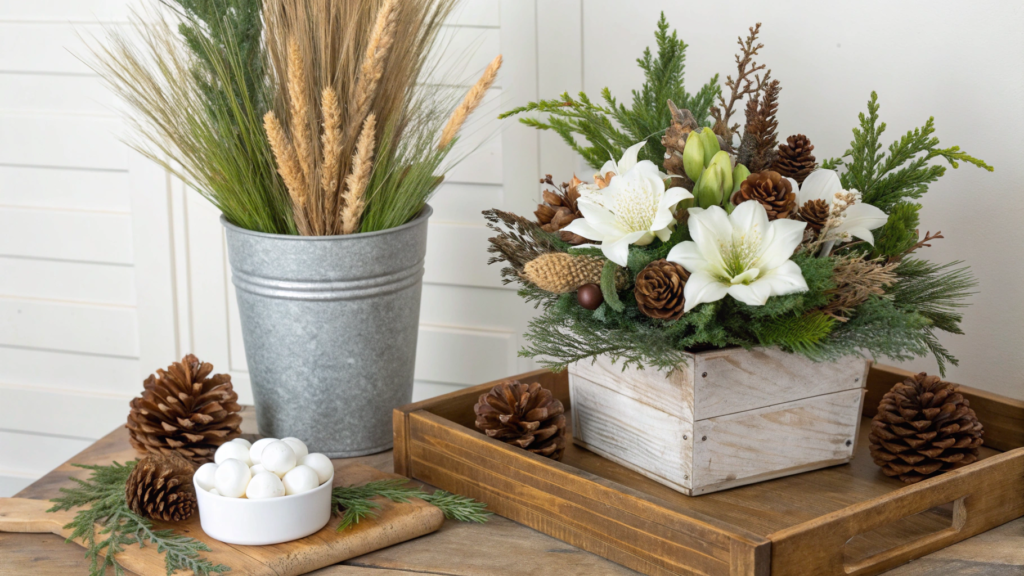
A quiet morning on a farm — a little frost on the windowsill, the smell of wood, the sound of logs shifting in the stove. That feeling is the core of “rustic farmhouse” — a style you don’t invent, you feel. It’s a mix of texture, honesty, and natural warmth — a true winter farmhouse mood.
Materials That Fit Perfectly Into the Farmhouse Style
- Fir, pine, spruce — the foundation.
- Dried grasses (oats, wheat, millet).
- Cotton — softness, contrast of textures.
- Pinecones, driftwood, bits of bark.
- Ceramics, enamel bowls, buckets.
- Jute rope, rough ribbons, burlap.
- White chrysanthemums and warm cream flowers — a little goes a long way.
You don’t need to buy all of this — half of it is outside, in the pantry, or in your Christmas box.
Farmhouse Arrangement Ideas
1. Arrangement in a Metal Bucket
Probably the most classic version. You’ll need:
- A bucket or ceramic pot
- Lots of evergreens
- A couple of wheat stems
- 3 cream chrysanthemums
- A few cotton balls
The evergreens give mass, the chrysanthemums give light, and the cotton gives softness — this contrast always works and creates a warm rustic balance.
2. “Warm” Arrangement on a Wooden Tray
We made this for a Christmas dinner, and it became the centerpiece of the table. You’ll need:
- A wooden tray
- Dried grasses
- Fir
- 1 large amaryllis
- Pinecones and bits of bark
The wooden base makes the arrangement naturally grounded.
3. Bowl With Cotton and Evergreens
Very budget-friendly and very beautiful.
- Enamel bowl
- Cotton
- Cedar and pine evergreens
- A few short dogwood branches
The colors stay clean and calm, with no unnecessary decoration — a simple winter harmony.
Simple Recipe for a Winter Farmhouse Arrangement
(everything accessible, honest, and deeply wintery)
- Build a wide evergreen base. Take 8–10 fir or pine branches and lay them loosely but densely. In farmhouse style, strict lines only get in the way — here you want natural looseness. The evergreens should extend past the container rim, creating movement and a free-flowing rustic shape.
- Add dried elements for height. 4–5 stems of wheat or oats instantly make the composition feel more “farmhouse.” Place them closer to the center so they look like an organic extension of the greenery.
- Add a soft floral accent. Place 2–3 cream chrysanthemums or one large carnation. In farmhouse style, flowers aren’t queens — they’re participants. They should look muted, not bright.
- Add cotton for softness. 1–2 cotton balls — and the arrangement becomes warmer. It’s like a wool blanket among evergreens. Place them low, near the base.
- Finish with wood texture or pinecones. Add a couple of pinecones or pieces of bark. If needed, you can secure them with Floral Wire by Darice for stability.
Small Tricks of the Farmhouse Style
Farmhouse loves texture contrast but dislikes brightness. Choose three textures — evergreens, dried grasses, cotton — and stop there. The simpler the set, the stronger the result.
The evergreens should be a bit tousled. Don’t trim the edges — let the natural lines stay. If the arrangement looks too “assembled,” add one stem of dried oats to the side — it instantly softens everything.
And the vessels you use shouldn’t shine. Old, matte, slightly scratched items give the depth that makes farmhouse feel authentic. This creates that quiet, lived-in character without feeling primitive.
9. Grand Hotel-Style Lobby Displays

Lindy and I always slow down when we see these kinds of displays. There’s something theatrical in them, yet surprisingly calm: scale, air, light, and vertical lines.
The first time we made a “hotel-style” display was for a winter charity evening in Idaho. Our whole team was terrified it would collapse under its own weight right at the entrance. But to our surprise, it stood for three days, survived crowds of people, and still looked good on day three — a true lobby-level endurance test.
Elements That Fit Perfectly Into Large Lobby Arrangements
- Amaryllis — the kings of winter vertical décor.
- Red dogwood branches — they create architecture.
- Magnolia leaves — shine, drama, structure.
- Fir, cedar, thuja — dense, durable base.
- Brunia or silver berries — cold accent.
- Orchids — if you need something more ceremonial.
- Pinecones — when you want a natural touch.
The main rule: no small flowers — they get lost instantly.
Lobby Display Ideas That Work in Winter
1. Tall Arrangement With Dogwood and Amaryllis
A classic for large hotels.
You’ll need:
- A massive vase (ceramic or metal)
- 10–12 red dogwood branches
- 6–7 amaryllis
- Lots of fir at the base
- 4–5 magnolia leaves
Dogwood builds the “skeleton,” amaryllis give scale, magnolia adds depth — a bold vertical structure.
2. Lush Arrangement With Orchids and Evergreens
For a more luxurious, slightly dramatic look.
Use:
- White orchids
- Mixed evergreens
- Magnolia
- A bit of silver brunia
The result is soft but luxurious.
3. “Winter Garden” Display
A very modern style:
- Long eucalyptus branches
- A low evergreen cushion
- A couple of amaryllis
- Several large pinecones
It looks like a natural winter art piece.
Simple Recipe for a Large Hotel-Style Winter Arrangement
- Create a massive evergreen base. Take 15–20 fir branches and build a wide dome. These arrangements rely on density. The evergreens should be layered like shingles to distribute the flower weight evenly and create a strong winter foundation.
- Build an architectural dogwood frame. 8–10 red dogwood branches will give the display its vertical character. Place them in the center at different angles. Don’t be afraid of bold lines — in a big space they look natural.
- Add large flowers for visual weight. Place 5–7 amaryllis in different points of the base. They should “grow” out of the evergreens, not stand separately. Some can be higher, some lower — the slight variation creates that natural hotel-style ease.
- Bring in magnolia for shine and depth. Lay 4–6 magnolia leaves in the lower tier — the glossy dark green instantly adds richness. Magnolia handles dry winter air well, so you can leave it confidently for a week.
- Add accents that reflect light. Brunia is the best choice. A few heads create silver points that look especially beautiful in the evening. You can also add pinecones or pieces of bark.
If the display stands in a high-traffic area, secure elements with Floral Wire by Darice for stability — a practical large-scale trick.
Small Tricks for Large Winter Arrangements
If the arrangement is very large, don’t try to fill all the space with flowers. In big rooms, air is part of the design. Leave gaps between branches and evergreen layers — light passes through better and the arrangement looks more expensive.
Always use heavy vases: metal, stone, thick ceramics. Lightweight containers behave unpredictably in winter.
Large displays love distance. Don’t place them right against the wall — pull them out 20–30 cm. The shadows from magnolia and dogwood create a depth effect that looks absolutely stunning — a signature lobby look.
10. Seasonal Fragrant Arrangement Combinations
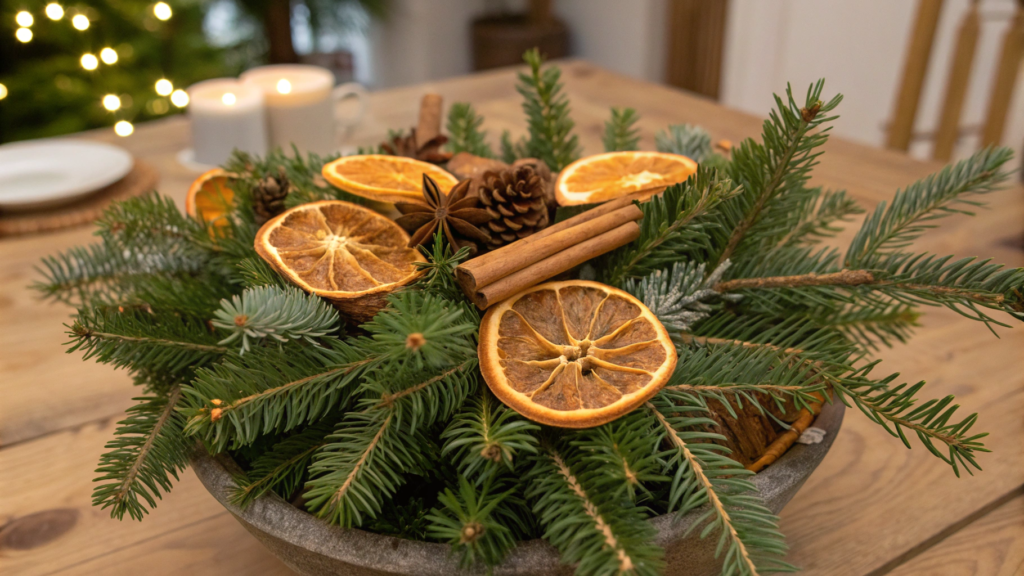
Winter fragrant arrangements are probably the most “emotional” kind of floristry. The scents of evergreens, cinnamon, citrus, eucalyptus — it’s not just a set of plants but something from childhood, from winter holidays, from moments when the house is just waking up. These scents create a deep winter atmosphere.
Key Fragrant Elements That Work Perfectly for Winter
- Fir, pine, spruce — fresh winter aroma.
- Eucalyptus — light menthol freshness.
- Orange, lime, mandarin (dried) — bright citrus note.
- Cinnamon, star anise, cloves — warm kitchen spice.
- Rosemary and bay — herbal freshness.
- Cotton, magnolia — soften the composition.
- White chrysanthemums — beautiful, neutral, with a long-lasting leaf scent.
Ideas for Seasonal Fragrant Winter Arrangements
1. Citrus + Evergreen Arrangement
This is absolute winter classic. You’ll need:
- Fir + a bit of pine
- 4–6 slices of dried orange
- 2 cinnamon sticks
- A bit of eucalyptus
- 2 chrysanthemums for softness
The aroma becomes bright but calm — citrus keeps the air lively, and evergreens create the essential winter background.
2. “Warm Spices” in a Ceramic Bowl
Perfect for those who love coziness without complicated flowers. In the bowl:
- A handful of evergreens
- 3 cinnamon sticks
- 2 star anise
- 3 dried mandarin slices
- A bit of rosemary
The scent is like a warm kitchen late in the evening.
3. Fresh Arrangement With Eucalyptus and Lime
For modern interiors, bright rooms, kitchens.
- Lots of eucalyptus
- Juniper
- 3 slices of dried lime
- 1 anemone
- A bit of brunia
It looks cool and feels fresh — almost “green.”
Simple Recipe for a Winter Fragrant Arrangement
(affordable, beautiful, works in any home)
- Create an evergreen base with space. Take 6–8 fir branches, but don’t arrange them too tightly. Leave gaps — airiness helps the scent spread better. Fir is the base that gives that unmistakable fresh winter aroma.
- Add warm spices. Place 2 cinnamon sticks, 1–2 star anise, and a couple of cloves. Spices work as “rare accents,” not the foundation, so don’t overload. Warm, spicy notes linger especially well in dry winter air.
- Add a citrus note. 3–4 dried orange slices — enough to brighten the air. Citrus oils are volatile, so they are the first to “speak” when you walk past the arrangement.
- Add herbal freshness. Add 2 eucalyptus sprigs and 1 rosemary sprig — herbal notes make the arrangement more complex and deeper. Together with evergreens they create a soft spa-like winter freshness.
- Strengthen the composition and add softness. Insert one cream chrysanthemum or a cotton ball. This “softens” the whole aromatic mix visually and aromatically. If the arrangement stands in a high-traffic area, I sometimes secure branches with Floral Wire by Darice.
Small Tricks for Fragrant Winter Arrangements
I always slightly dry citrus at home — it smells stronger than store-bought. Eucalyptus releases its scent better if you gently press one leaf (just once, no need to crush it).
I place spices closer to the center because it’s slightly warmer there — even a few degrees change the aromatic profile more than you think.
Air needs to move between elements; otherwise the scent gets trapped inside the evergreens. Fragrant arrangements are all about airflow and movement.
Why These Combinations Are a Good Idea
Because they work in two directions at once: they decorate the space and create atmosphere. Fragrant arrangements aren’t just décor — they’re a mood-setting tool. They’re economical, long-lasting, easy to refresh, and fit any interior.
Winter arrangements
So tell me — which winter arrangement “called” you the most?
Winter floristry is an incredible thing. It helps create the mood you need and inspires you to make something warm even in a cold season.
Pick any idea, even the simplest one. Make the arrangement — with your hands, at your pace. And then tell me what you created. I’m always incredibly curious to see your versions — they’re so different, so alive.