Fall vegetables gardening isn’t just a backup plan. It’s a full-on growing season that can give you incredibly tasty, dense, vitamin-rich veggies—without the heat, the bugs, or the chaos of summer.
But to make it work, you’ve got to treat it differently than spring. Everything plays by different rules now: the days are shorter, the soil is warmer, and the timing is way tighter.
If you want a real fall harvest, you need to understand how your zone works, which crops actually have time to grow, and which ones will just waste your energy. When to plant. What your soil is telling you. Which veggies play nice together. How to water without stunting growth. And why fall is a window of opportunity, not just what’s left over.
We’ve gathered the key strategies that turn fall into a truly productive garden cycle.
1. The Zone System Explained: Why It Matters More in Fall
When you plant in spring, it feels like you’ve got all the time in the world. But in fall? Totally different story.
Fall works like clockwork. And if you don’t know what zone you’re in, your fall harvest might end before it even starts.
What the “Zone System” Actually Means—No Science Degree Required
The USDA (United States Department of Agriculture) split the country into plant hardiness zones, based on average minimum winter temperatures. There are 13 zones total, from 1 (Alaska) to 13 (Hawaii).
But for most of us gardeners, the real action happens in Zones 7 to 9—from Georgia and Texas to North Carolina and California.
Here’s a quick breakdown:
- Zone 7: average winter low between 0 and 10°F (–18 to –12°C)
- Zone 8: between 10 and 20°F (–12 to –6°C)
- Zone 9: between 20 and 30°F (–6 to –1°C)
The higher the number, the milder the climate, the longer the season—and the later you can plant fall crops.
Why Zones Matter Way More in Fall
In spring, even if you’re a little late, your plants catch up thanks to longer days and rising temps.
In fall, it’s the opposite: the days shrink, the temperatures drop, and the sun loses strength.
Whatever you plant has to fully grow and mature before growth nearly stops—and that slowdown hits way before your first frost.
If you live in Zone 7 and plant broccoli in late October, you’ve basically wasted your seeds.
If you’re in Zone 9 and don’t plant radishes by early September, you’re already too late.
When we first moved to Idaho and started figuring out our Zone 7a setup, we postponed planting until late September—just out of habit. And we lost nearly our whole spinach crop.
It simply didn’t have time to bulk up before the cold hit.
From then on—no guessing. Just the calendar. Just the data.
How to Find Your Zone, Fast
Go to the USDA Plant Hardiness Map and enter your ZIP code: https://planthardiness.ars.usda.gov
Don’t Confuse Your Zone with Your Frost Date
It’s a super common mistake. Your USDA zone only tells you your average winter low temperature.
But your first fall frost date? That can vary a lot, even inside the same zone—depending on elevation, wind exposure, proximity to water, and more.
So always check both:
- Your zone gives you the general length of your growing season
- Your first frost date is the real-world deadline for planting
For example, we’re in Zone 7a, but on our land, frosts hit in early October—because we’re in a low spot where cold air settles fast.
Why Fall Requires You to Stay Ahead of the Curve
Here’s what happens when you ignore your zone:
- You plant too late—and your cabbage never heads up
- You plant too early—and your lettuce bolts in the heat
- You plant right before a frost—and lose everything before it grows
Fall vegetables gardening is strategy, not improvisation.
2. When to Plant in Zone 7 vs 8 vs 9: The Window You Can’t Miss
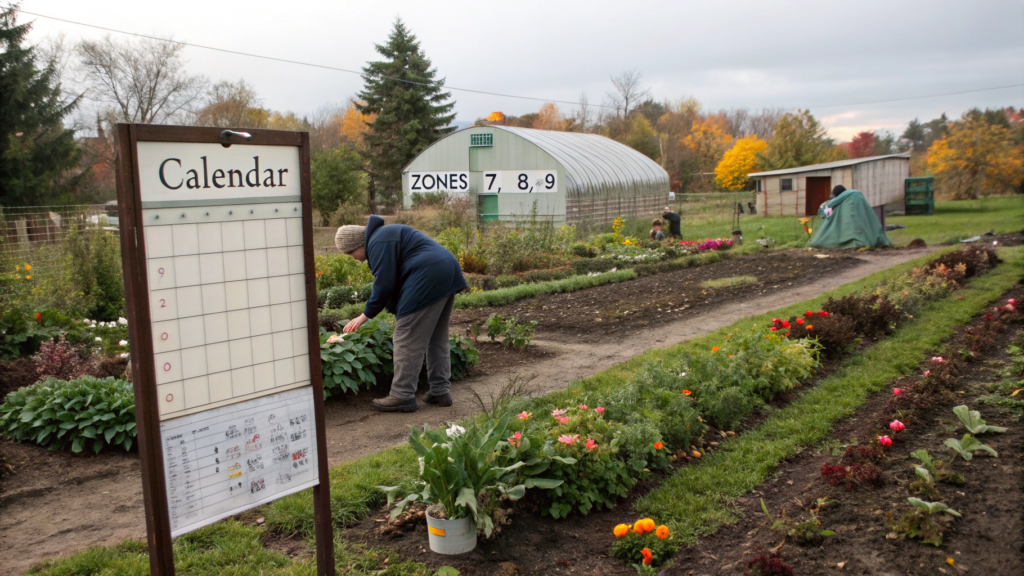
In fall, you get one shot—and if you miss it, your harvest just won’t have time to grow.
That’s why knowing your exact planting window by zone is non-negotiable.
What Determines Planting Time?
Unlike in spring—where you can get creative with grow lights or greenhouses—fall vegetables gardening depends on just two things:
- Your first frost date
- How fast your plants can grow with shortening days
Fact:. A study from Iowa State University found that when daylight drops below 10 hours (which happens in most zones by late October to November), fall vegetables growth slows to a crawl.
This is called the Persephone Period—and it’s just as dangerous as frost.
How to Calculate Your Planting Window
- Pick a crop (for example:
Cabbage = 70 days, Radish = 30 days, Spinach = 45 days) - Look up your first expected frost date:
- Zone 7: October 15
- Zone 8: November 1
- Zone 9: November 15
- Zone 7: October 15
- Subtract the number of growing days your crop needs—plus 7–10 days of buffer time for slower fall vegetables growth.
Boom. That’s your latest possible planting date.
Planting Deadlines by Zone
| Vegetable | Days to Mature | Zone 7 | Zone 8 | Zone 9 |
| Radish | 25–35 | Sept 15 | Sept 25 | Oct 1 |
| Leaf Lettuce | 45–55 | Sept 5 | Sept 15 | Sept 25 |
| Broccoli | 75–85 | Aug 1 | Aug 15 | Sept 1 |
| Carrot | 70–80 | Aug 5 | Aug 15 | Aug 25 |
| Spinach | 40–50 | Sept 10 | Sept 20 | Oct 1 |
| Turnip | 55–60 | Sept 1 | Sept 10 | Sept 20 |
Note. These aren’t planting suggestions—they’re the cutoff dates for a crop to still succeed.
What We Do on Our Homestead
Here in Zone 7a, our fall vegetables planting schedule is run like a military op:
- Early August: carrots, broccoli, cabbage
- By Sept 10: lettuces, spinach, radishes
- After that? That’s it. Just mulch and chill.
Last year, I tried a “let’s see what happens” experiment. I planted broccoli in early September—just a bit later than usual.
Well… it stalled out at three leaves. We even gave it a name: “Hope.” Because hope was all it had.
To stay on track with all the timing, we use garden markers with the planting dates.
This is the set we use from Amazon: 50 waterproof plastic stakes, marker included Garden Labels & Marker Kit
As noted by researchers from the University of Utah, August plantings give crops more time to grow before cold hits—and yields are significantly higher, especially for crops with longer growing cycles.
3. How to Read Soil Clues Before Planting Fall Crops
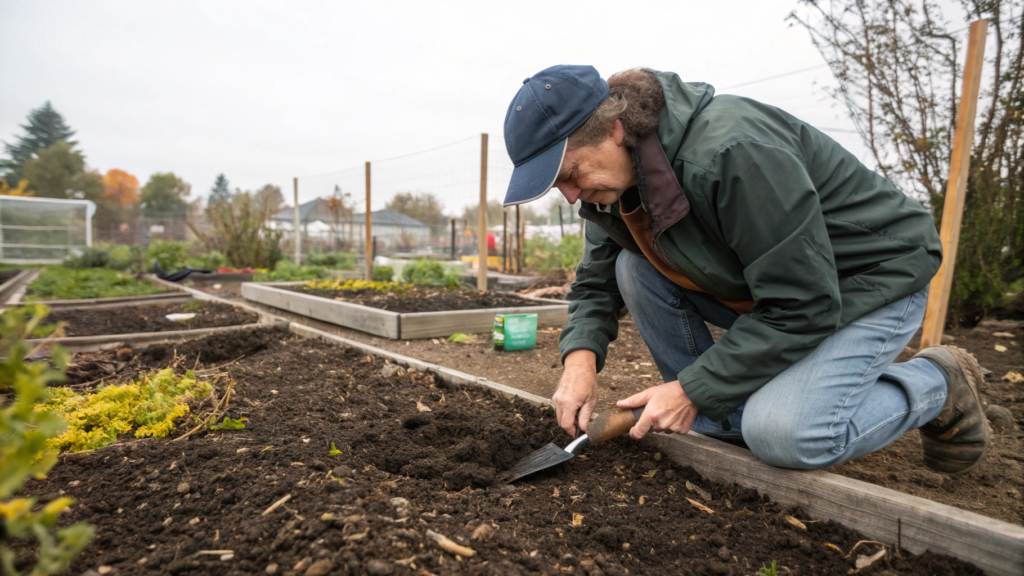
You’ve got your seeds. You know your zone. You’ve circled your planting dates.
Looks like it’s time to plant—right? Not so fast. Fall soil plays by its own rules. Even if things look good on the surface, what’s hiding under the mulch could be compacted, dry, tired… or even lacking microbial life.
Yep, we’ve been there—more than once. You follow the calendar, do everything “right”—but the plants just… don’t grow. Or worse—they sprout, then stall out.
To avoid that mess, let’s break down how to read your soil before fall vegetables planting. No labs needed—just simple field checks with almost scientific precision.
Check the Texture
After summer heat, fall soil often feels perfect: loose, crumbly, easy to work with. But don’t be fooled.
If you grab a handful and it won’t hold together at all, that means moisture is dangerously low.
Ideal fall vegetables soil should feel slightly moist, form a loose clump in your hand, and break apart with a light touch.
How to check:
- Scoop a handful from 2–4 inches deep (5–10 cm)
- Squeeze it tightly
- If it crumbles instantly — it needs water
- If it sticks to your palm — it’s too wet
Tip. If it’s been dry for weeks, water your bed 2–3 days before planting. That gives it time to settle into the “working moisture zone.”
Smell the Soil
Yep—smell it. Healthy soil should have a fresh, earthy scent—like a forest floor after rain.
If you catch these odors:
- Sour → possible waterlogging
- Rotten → organic matter isn’t breaking down
- No smell at all → low microbial activity
After dry summers, microbes slow down big time—something soil microbiologists have been pointing out for years. In fall, that’s a serious problem: if your microbes are sluggish, nutrient breakdown and uptake drop too.
Look Back at What Grew There This Summer
This is one of the smartest habits we’ve picked up: reading the clues left behind by last season’s crops.
| What You Saw in Summer | What It Means |
| Good start, then stalled growth | Likely phosphorus deficiency or compaction |
| Yellowing from bottom leaves up | Nitrogen levels crashed |
| Cabbage grew? Now slugs everywhere | Undecomposed organic matter left behind |
| Dry top, soggy below | Too much shallow watering |
Check for Compaction
If pushing a shovel in feels like digging through stone—that’s a red flag.
After weeks of sun and no loosening, your topsoil might have turned into a solid crust.
And your seedlings won’t stand a chance.
This is especially true for root crops like carrots, turnips, daikon.
What to do:
- Loosen the soil with a garden fork to 2–3 inches (5–7 cm)
- Don’t dig deep—just fluff up the surface layer
Our go-to tool Heavy Duty Garden Fork by Truper (Amazon) — 4 tines, wood handle, 42″ long. It’s ergonomic and reliable—love it from the first use.
See Mold or Slime? Don’t Panic
After watering or rain, you might spot white fuzz or mold on your mulch—especially if you’re using straw, leaves, or compost.
Good news: this can mean your microbes are active! But if what you’re seeing is slimy or smells bad, do this:
- Lift the mulch layer
- Let the area air out
- Add more loose organic matter (like leaves or worm compost)
Got Worms? Good.
One of the easiest ways to check soil health: look for earthworms. In fall, after watering, dig a 12×12 inch patch (30×30 cm).
If you spot at least 5–10 worms, that means:
- Microbial life is doing its thing
- The soil can breathe
- Organic matter is cycling properly
If you see zero worms, it’s time to feed your soil—add compost, vermicompost, or give it a drink of aerated compost tea.
Bottom Line: Don’t Plant Blind
Fall soil can be deceiving. It might look fine… but then your seedlings pop up and immediately die off.
Here’s what we check before every fall vegetables planting:
- Moisture (with the squeeze test)
- Smell
- Compaction
- How last season’s crops behaved
- A quick worm check
And we log it all in our garden journal—so we know what worked (or didn’t) this year.
4. Florida vs Texas vs Georgia: What Fall Veggies Actually Thrive
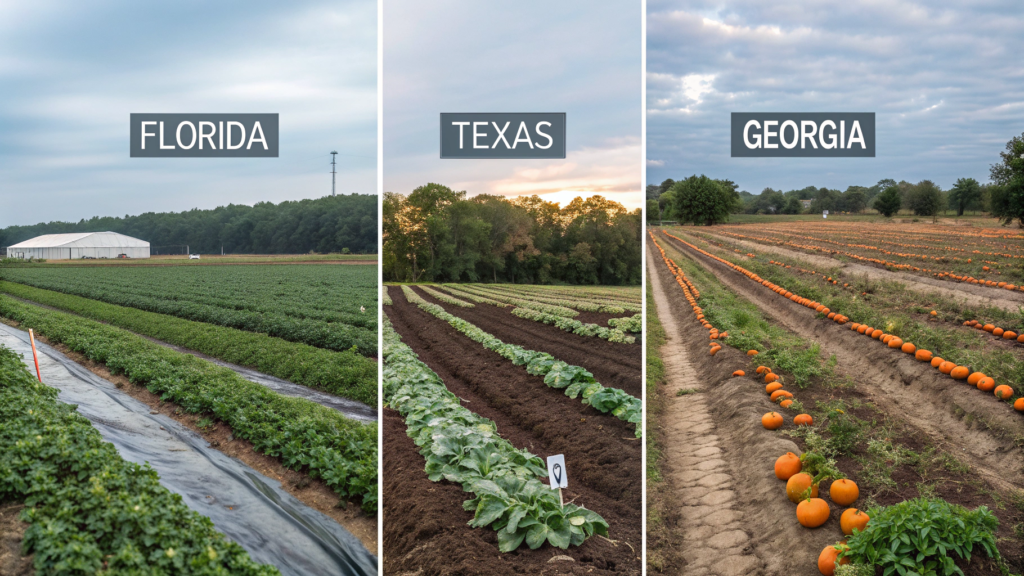
When we say “Southern states,” most people imagine you can plant anything, anytime. I mean—it’s warm, right? But the truth is way more complicated.
Florida isn’t Texas. And Georgia? That’s a whole different story.
Each of these states has its own weird fall rhythms: in some areas, “fall” doesn’t start until after New Year’s (seriously!), while in others, the heat holds on until late October—then drops like a rock in November.
If you want your fall vegetables garden to actually work, plant what really thrives in your climate—and plant it on time.
Florida. Fall Without Fall
- Season: September – January
- Zones: 8b to 11a
- Challenge: Hot and humid for way too long. Almost no frost, but diseases and pests? Year-round.
Top fall crops in Florida:
- Sweet potatoes — especially if planted in late August. Fall is when they bulk up underground.
- Kale & Swiss chard — disease-resistant and aphid-tolerant, even in humidity
- Radishes & daikon — if temps drop below 85°F (29°C)
- Okra — can keep producing into October
- Bok choy & tatsoi — love humidity and grow fast
Florida tip. To deal with humidity and fungal issues, we use powdered sulfur as a natural fungicide.
Texas. Mood Swings & Clay Soil
- Season: Late September – December
- Zones: 6b to 9b (varies by region)
- Challenge: Heat until late October, then sudden cold snaps; heavy clay soil, wind, and drought
Top fall crops in Texas:
- Carrots & turnips — thrive if soil is loose and composted
- Green onions & garlic — plant in October for early greens
- Spinach & lettuce — best right after the first cool nights
- Cabbage — grows well in East and Central TX if planted before mid-October
- Mustard greens — quick to sprout and less bitter in fall
Advice from Austin gardeners. Go for raised beds! Texas clay dries out on top but stays soggy underneath—a nightmare for tender roots.
Georgia. Southern Fall with a Twist
- Season: Late September – November
- Zones: 7a to 9a
- Challenge: High humidity early in the season, then fast cooling and unstable nights
Top fall crops in Georgia:
- Broccoli & cauliflower — plant by the end of September
- Salad greens & arugula — prefer partial shade
- Radishes & kohlrabi — great after a few rains
- Peas (English & snow) — can harvest before the deep cold
- Beets — if planted in early October, you’ll get tender leaves and small roots by December
Comparison Chart: What Grows Best Where
| Crop | Florida | Texas | Georgia |
| Sweet potatoes | yes (from August) | only in the south | rare |
| Cabbage | nope | yes | yes |
| Swiss chard | excellent | weak | decent |
| Spinach | unstable | yes | yes |
| Radishes | yes | yes | yes |
| Broccoli | nope | yes (plant early) | yes (by Oct) |
| Onion/Garlic | no | excellent | excellent |
| Mustard greens | weak | yes | yes |
| Peas | rare | yes (east TX) | yes |
Our Personal Take
Each of these states can deliver a solid fall harvest. But only if:
- You know your microzone
- You plant on time, not “when you get around to it”
- You grow what actually works in your climate—not just what looks cute in the seed catalog
5. September Countdown: The Best Crops to Start This Month
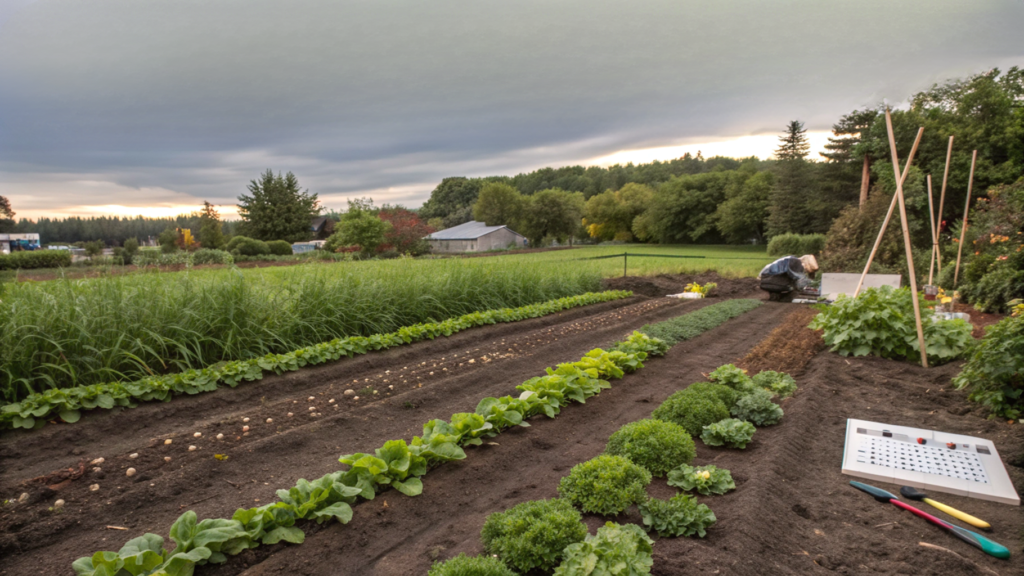
Anything you plant in September needs to either mature before frost or be strong enough to survive winter and keep growing in spring.
Here’s a list of crops you can and should plant in September. And not just “can”—the sooner the better, because in 2 weeks, you might be out of luck.
How to Use This List
I’ve grouped the crops by their time to maturity and your zone. Simple:
- In Zone 7 — stick to quick-maturing crops
- In Zone 8 — you’ve got more wiggle room, but the clock’s still ticking
- In Zone 9 — this is your sweet spot: you’ve got a couple months before real cold sets in
Fast & Easy (25–40 Days)
These crops are the speed champs. Sow them directly into well-watered, loose soil.
| Crop | Zone 7 | Zone 8 | Zone 9 |
| Radishes | by Sept 15 | by Sept 25 | by Oct 1 |
| Arugula | by Sept 10 | by Sept 20 | by Oct 1 |
| Baby spinach | by Sept 15 | by Sept 25 | by Oct 5 |
| Salad mix | by Sept 15 | by Sept 25 | by Oct 5 |
Pro tip. To keep radishes from bolting in the heat, mulch your beds and water more often—but in small amounts.
Compact seed discs work great for these crops: just lay them in rows and skip the thinning.
Mid-Speed (45–60 Days)
These guys take longer, but if you plant them in early September, they’ll make it!
| Crop | Zone 7 | Zone 8 | Zone 9 |
| Carrots | by Sept 5 | by Sept 15 | by Sept 25 |
| Beets | by Sept 10 | by Sept 20 | by Oct 1 |
| Spinach | by Sept 10 | by Sept 20 | by Oct 5 |
| Kohlrabi | by Sept 5 | by Sept 15 | by Sept 25 |
Cool fact. Carrots sweeten up in cold soil—especially if planted in late August or early September.
Slow but Powerful (60–80 Days)
These crops are almost out of time—but if you’re in Zone 8 or 9 and the weather’s mild, go for it!
| Crop | Zone 7 | Zone 9 | Zone 9 |
| Broccoli | ❌(too late) | by Sept 10 | by Sept 20 |
| Cauliflower | ❌ | by Sept 10 | by Sept 20 |
| Brussels sprouts | ❌ | ❌ | by Sept 10 |
| Chinese greens (bok choy, mizuna) | by Sept 10 | by Sept 20 | by Oct 1 |
We often plant bok choy in containers and move them into a cold frame by late October.
Future-Focused Crops
Some crops you plant in September not for fall harvest, but for spring or early summer. Fall is just the starting point.
- Garlic — plant in late September to early October
- Walking onions — root in fall, sleep in winter, sprout in spring
- Overwintering peas — survive the cold and take off in spring
- Onion sets — give you greens in fall and bulbs by May
Want to save money long-term? Grow garlic from your own cloves—just make sure you’re using untreated varieties.
Organic Garlic Starter Pack: Organic Garlic Bulbs for Fall Planting (Amazon)
Our September Calendar
Every fall, we use our own mini calendar (it’s literally taped to our kitchen wall). Here’s what we plant in Zone 7a:
- Sept 1–5: carrots, beets, kohlrabi
- Sept 6–10: spinach, lettuce, radishes
- Sept 11–15: green onions, arugula
- Sept 20–30: garlic, overwintering peas
And remember. If you missed the window—skip it. It’s better to hold off until spring than waste seeds, time, and soil.
6. Layout Strategies That Maximize Your Autumn Yield
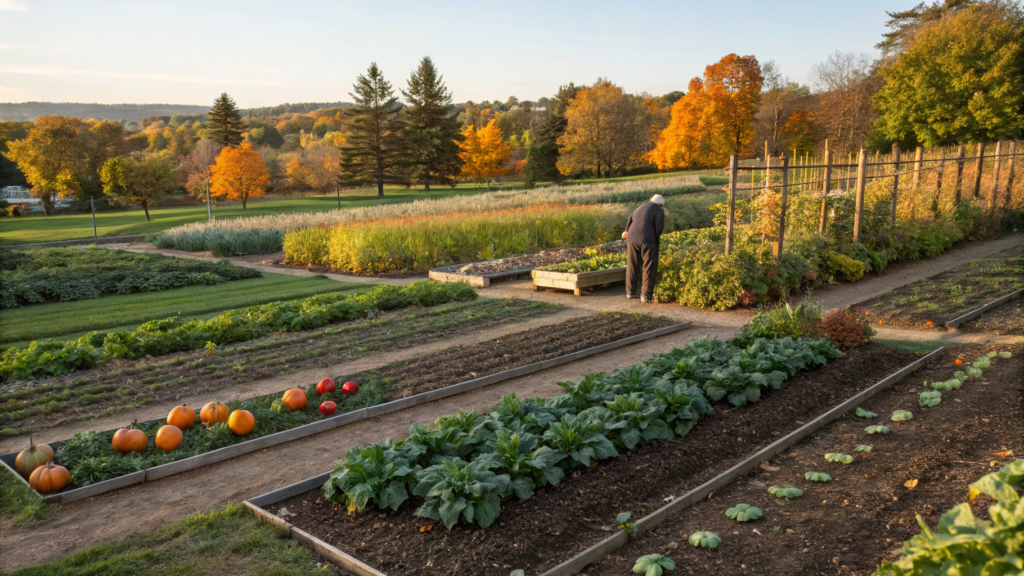
Fall is a race against time. And to win, it’s not enough to just choose good varieties and plant on time.
You also need to lay out your beds strategically by crop, timing, and sunlight.
That’s how you get 2–3x more harvest from the same amount of space.
Strategy 1. Divide Beds by Growth Speed
In fall, don’t mix crops with very different maturity rates in the same bed.
| Bed Type | Crop Examples | When to Harvest | What to Plant After |
| Fast | radish, arugula, lettuce (25–35 days) | in 3–4 weeks | peas, garlic |
| Medium | spinach, beets, kohlrabi (40–60 days) | late October | mulch or overwinter crops |
| Slow | broccoli, cauliflower (70–80 days) | November | stays in bed till frost |
Tip. Mark each planting with a date so you don’t miss the switch. Garden flags with weatherproof labels work great for this.
Strategy 2. Succession Planting
When one crop is done—plant the next one right away.
That’s especially key in fall, when every day matters.
Example:
- Sept 1: radishes
- Oct 1: garlic
- Spring: lettuce or baby spinach
This method is well-documented and works especially well in Zones 7–9.
Strategy 3. Morning Sun Beats Noon Heat
Fall sun is low, and days are short. So beds that get early-morning light outperform those in hotter afternoon zones.
Midday warmth just isn’t as useful as it was in summer—but 8–11 AM sunlight is prime fuel.
Recommended layout:
- Broccoli, cabbage — on the south side
- Spinach, lettuces — in partial shade with morning light
- Radishes — tucked between larger crops
To boost light in shady areas, try reflective mulch film — especially in southern zones: Reflective Mulch Film, Silver, 4 ft x 25 ft (Amazon)
(Note. Not very useful in cooler zones — best for Zones 8b and up.)
Strategy 4. One Bed a Day
One of the easiest fall vegetables planting rhythms? One bed per day.
This wave-style planting avoids overwhelm and helps you stay on schedule.
Sample timeline for Zone 7a:
- Sept 1–5: radish, lettuce
- Sept 6–10: spinach, kohlrabi
- Sept 11–15: beets, arugula
- Sept 16–20: garlic, onion sets
- Sept 21–25: broccoli (from starts)
Every bed gets its own day. Watering, attention, tracking—it all becomes simpler.
Strategy 5. Rows Hold Hidden Potential
Fall vegetables plants are smaller. Leaves don’t sprawl as much.That opens up the space between rows for secondary crops.
Interplanting combos to try:
- Between broccoli: lettuce or radish
- Next to kohlrabi: baby spinach
- In cabbage shade: green onions or arugula
You harvest two crops from one bed, without needing more space. It’s especially powerful on 3–4 ft raised beds.
Science Backs It Up
Intercropping is a time-tested agronomic method. It improves:
- Space efficiency
- Moisture retention
- Total harvest, thanks to shade and microclimate synergy
This method’s effectiveness is backed by ongoing field research and real-world practice.
7. Mistakes Gardeners Make with Cool-Season Fall Vegetables
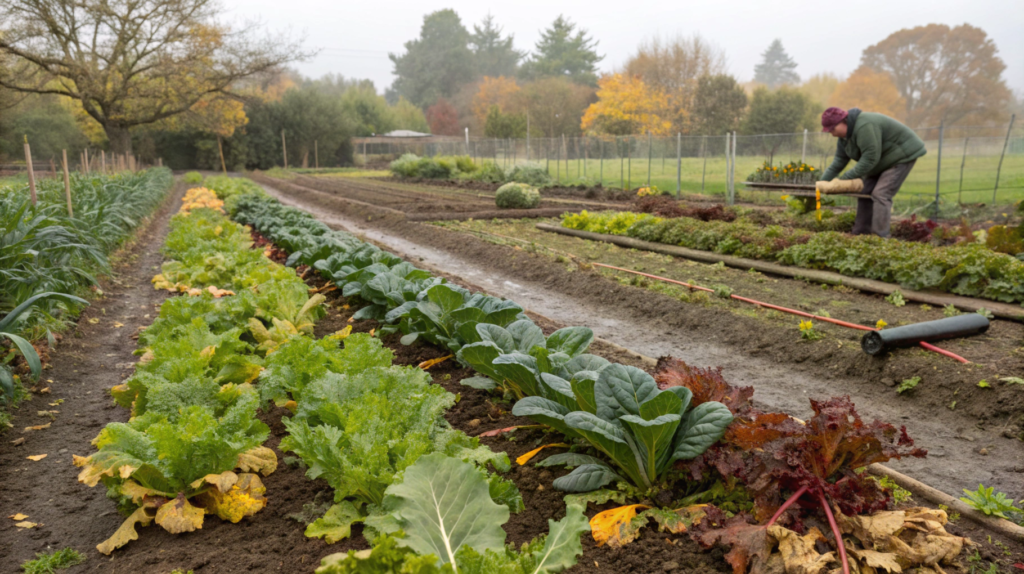
Fall vegetables gardening isn’t as “easy” as it looks. You’d think that cooler temps and fewer bugs mean it’ll run on autopilot.
But truth is — many fall veggies fail not because of the weather, but because of avoidable mistakes.
Everything below is backed by agronomic data, Extension sources, and real-life gardener experience in Zones 7–9.
Mistake #1. Planting Too Late
Fact: Most fall vegetables need to be planted 6–10 weeks before your first frost.
Miss that window, and you’ll get slow growth—or no growth at all.
(Clemson University Extension)
For example:
- Broccoli in Zone 7 needs to be planted by mid-August
- Spinach and radishes in Zones 8–9 can go in through late September
- Lettuce and greens slow down hard when day length drops below 10 hours (aka Persephone Period)
Mistake #2. Planting Without Prepping the Soil
After summer, your soil might be:
- compacted (especially in clay-heavy areas)
- dried out
- depleted from summer crops
If you don’t rehydrate and loosen it at least 3–5 days before planting, your seeds may not sprout—or will emerge weakly.
(University of Georgia Extension)
Mistake #3. Ignoring Daylight Changes
Even without frost, fall vegetables growth slows way down when day length drops under 10 hours.
It’s not just about cold—it’s also about light.
This is known as the Persephone Period, and in most zones, it starts late October to early November.
(Iowa State University Extension)
Mistake #4. Watering Like It’s Still Summer
Cooler weather means plants evaporate less moisture. But if you keep watering “like it’s July,” you risk:
- leaching nutrients
- encouraging rot and fungi
- chilling the soil below optimal levels
Solution. Always check moisture at 2–3 inches deep before watering.
(University of California ANR)
Mistake #5. Skipping Fall Fertilizer
Many folks think fall vegetables veggies don’t need much feeding.
But now’s the time to supply:
- nitrogen for leafy greens (like spinach and lettuce)
- phosphorus and calcium for brassicas and root crops
Very important. Don’t add manure or fresh compost too late. It won’t have time to break down, and may lead to excess nitrogen or fungal issues.
(North Carolina Cooperative Extension)
Mistake #6. Planting Too Densely
In fall, space feels tight, and the urge to cram more into each bed is real.
But tight spacing causes:
- poor airflow
- higher leaf humidity
- perfect conditions for disease outbreaks
For cabbage, broccoli, and kohlrabi, be sure to maintain spacing of at least 12–18 inches (30–45 cm).
For leafy greens, a minimum of 6–10 inches (15–25 cm) is required. (University of Maryland Extension)
Mistake #7. No Frost Protection
Even a light frost (32°F / 0°C) can harm young fall crops—especially if they’re still establishing roots.
Many crops like lettuce, radish, and baby broccoli are vulnerable to early frost.
Solution. Keep frost covers handy (row cover fabric, agribon, tunnel hoops)
Cover beds during the first cold nights—especially in Zones 7 and 8.
(Texas A&M AgriLife Extension)
Each of these mistakes may seem small—but in fall, you don’t get time to recover.
- One day late = a week lost in growth
- One extra watering = a whole bed of rot
- One wrong spacing = powdery mildew outbreak
8. The Science Behind Faster Growth in Fall Conditions
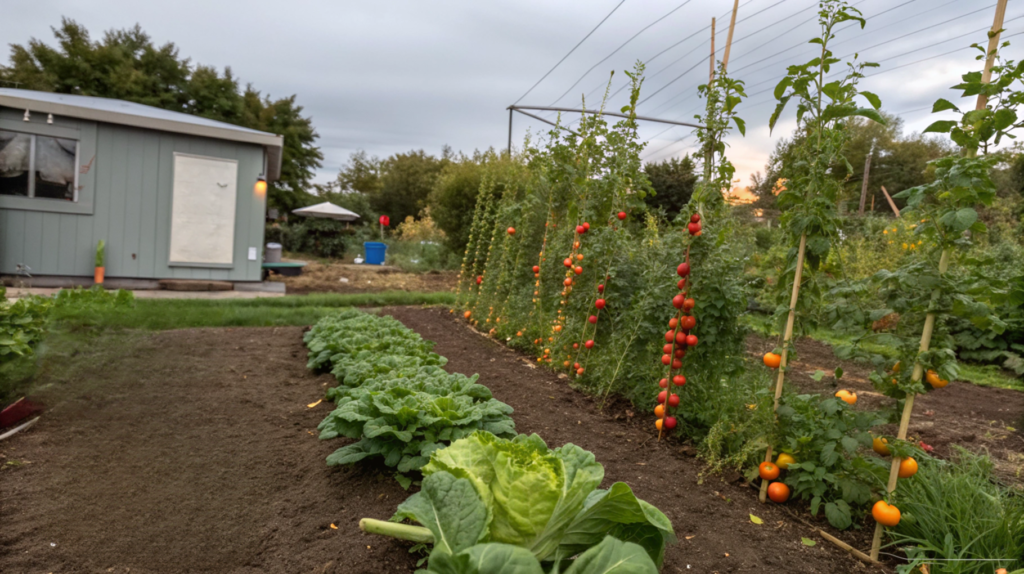
Spring feels like the ideal time to start a garden. And overall, it is.
But when it comes to actual growth speed for certain crops, fall often delivers better and more stable results.
It’s not a myth. It’s something gardeners see again and again.
Let’s break down why — based on real, science-backed mechanisms.
Soil Is Warmer Than the Air in Fall
In spring, you’re often planting into cold, barely-thawed soil.
Even if the air hits 65°F (18°C) during the day, the ground can still be 10–15 degrees colder. Which means seeds just sit there, dormant.
In fall, it’s the opposite. Summer has already warmed the soil, so even with cool air, the roots feel cozy. In warm soil:
- seeds swell and sprout faster
- microbes stay active
- nutrients are more available
That’s why you might see spinach or radish sprouting in just three days in September — while in spring, they can take over a week.
Moisture Holds Longer in Fall
In spring, you’re constantly dragging out the watering can—especially when the wind kicks in and dries out the topsoil in hours. But in fall:
- the sun is gentler
- rainfall is more frequent
- evaporation slows way down
This means the soil holds moisture longer, which leads to:
- less stress on young roots
- lower risk of seeds drying out before they germinate
- reduced need for daily watering
On sandy or light soils, this is huge—what turns dusty in May can stay fluffy and moist for weeks in September.
Slower Growth — Better Quality
In spring, plants rush to grow fast before the heat hits. That leads to:
- legginess
- watery leaves
- weak root systems
But fall growth is more balanced. There’s less light, so plants stay compact and focused. As a result:
- lettuce leaves are dense and crisp
- root crops form evenly without cracking
- greens hold their flavor instead of bolting
Fewer Pests — Less Stress on Plants
By early fall, pest populations usually drop off.
Caterpillars, flea beetles, aphids — they all slow down, especially if September is mild.
And that means:
- plants spend less energy healing wounds
- leaves stay intact
- no toxic reactions or rot from bites
This creates a low-stress zone for leafy greens and young brassicas to thrive.
Fall Triggers Urgency — and Plants Respond Fast
Yes, days are shorter. But that’s exactly what pushes plants into go mode.
They can sense the clock ticking and ramp up root and leaf growth before dormancy.
You’ll see this clearly with radishes, mustard greens, bok choy, and salad mixes.
Planted in late August or early September, they often grow faster and fuller than the same crops in early April.
Fall is a season of its own, with distinct advantages.
And one of the biggest is its ability to kickstart crops under ideal conditions:
- warm soil
- stable moisture
- fewer pests
- balanced, steady growth
No, you won’t get the explosive size of summer crops. But for speed and quality, a fall vegetables garden can be even more dependable—especially if you hit the planting window just right.
9. Watering Fall Veggies Right: Why Timing > Quantity
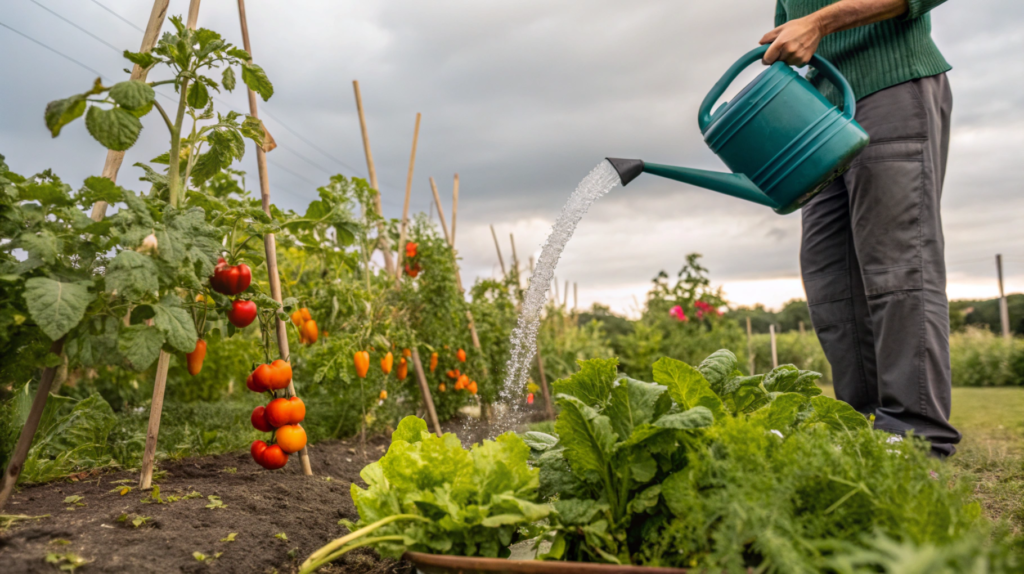
In fall, watering can make or break your harvest.
And unlike in summer, the timing of your watering matters more than the total amount.
If you’re watering your fall vegetables garden “just in case,” the way you do in July, you might actually be slowing your plants down. Here’s why.
Fall Soil Holds Moisture Longer
After a long summer, the soil stays warm—but the sun is gentler, and evaporation slows.
Even a light rain can keep the ground moist for 3–5 days. If you keep adding water on top of that, you risk:
- soil turning acidic
- oxygen being pushed out
- nutrients leaching below the root zone
This happens especially often when you’re using mulch—moisture builds up under the layer even if the surface seems dry.
When’s the Best Time to Water — Morning, Noon, or Night?
Morning is best. Here’s why:
- Water has time to soak in and support the plant during the day, when it’s actively growing
- The top layer of soil dries by evening, reducing fungal risks and slug pressure
- The water and soil temperatures are more balanced, causing less root stress
Don’t water in the evening when nights are cool. That can lead to:
- cold-shocking the roots
- gray mold and mildew
- condensation buildup on leaves, which invites disease
Exception. If your plants are visibly stressed (wilted, dried out), a light midday watering can help—just water the soil, not the leaves.
How Much Water Do Fall Crops Really Need?
Fall crops require less water overall, but steady moisture is still key.
Don’t think in terms of gallons—think in terms of moisture depth: 2 to 3 inches (5–7 cm) down.
The sweet spot:
- soil holds together in a loose ball
- it crumbles easily when pressed
- the surface is slightly moist, but not sticky
We like using a basic soil moisture meter to check. It’s simple and surprisingly accurate.
How Often Should You Water?
| Weather | Watering Frequency |
| Clear and dry (68–77°F) | every 3–4 days |
| Cloudy and humid | 1–2 times per week |
| After rainfall | often not needed at all |
If you’re growing in raised beds, you may need to water more often—especially around the edges where evaporation is faster.
But as always, it depends on your soil type and whether you’ve mulched.
Common Fall Watering Mistakes
- Watering on a schedule instead of checking actual conditions. Plants don’t need water “every two days”—they need it when the soil dries.
- Spraying the leaves during cool weather. This encourages rot and mildew, especially on brassicas.
- Watering too often but too little. A light sprinkle every day does more harm than good—it encourages shallow roots and unstable growth.
The Combo Method We Use
Here’s how we manage fall watering in our garden:
- Check soil moisture in the morning
- If unsure, stick a hand in the soil and check below the surface
- If there’s been recent rain, skip the day
- Once a week, do a deep, full soak
- Always keep beds mulched, so the moisture doesn’t vanish by noon
In fall, your plants don’t need more water—they need it at the right time and in the right amount.
A single good soak in the morning beats small daily top-ups.
It keeps your soil structure intact, nutrients in place, and roots growing strong.
10. Companion Pairings That Boost Results Without Extra Work
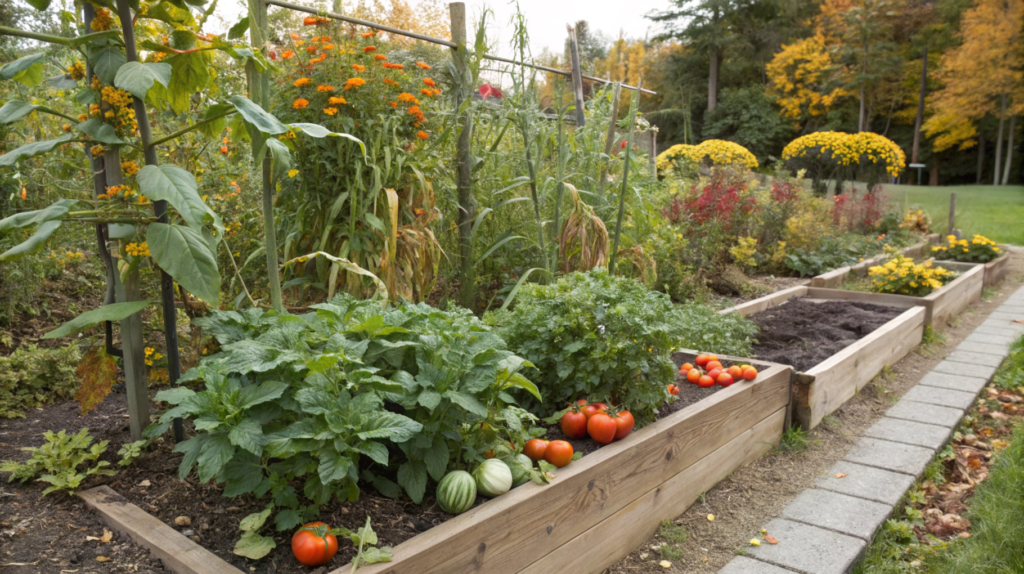
Fall vegetables gardening comes with tighter limits—less sun, colder nights, and a ticking clock.
That’s exactly why smart companion planting matters more than ever: the right combos can boost yield, protect crops, and save you time, without adding extra work.
We’re not talking complicated charts. Just simple, proven pairings that practically take care of themselves.
Why Companion Planting Matters More in Fall
In spring, you have time for extra tasks—thinning, staking, replanting.
In fall? You want your plants to support each other, not create more work.
Good fall companions can:
- improve microclimate in the bed
- protect against pests like aphids or flea beetles
- help retain soil moisture
- boost the growth of slower crops
Tried-and-True Fall Pairings
1. Broccoli + Lettuce
Lettuce grows fast and low; broccoli grows slow and upright.
By the time the broccoli needs space, the lettuce is already harvested.
Benefits:
- covers soil and locks in moisture
- suppresses weeds
- won’t compete with the main crop
Planting tip. Space broccoli 18″ apart, and tuck 2–3 lettuce plants between each.
2. Spinach + Radishes
This combo is like clockwork:
- radishes mature in 25–30 days
- spinach grows denser and lasts longer
Radishes shield spinach seedlings from wind and help shade the soil. Spinach, in return, holds moisture and blocks evaporation.
Perfect for 3–4 foot wide raised beds.
3. Garlic + Salad Mixes
Garlic deters aphids and some soil pests. Lettuce grows fast, covers bare soil, and is harvested long before garlic really takes off.
Plant garlic in rows 6″ apart, and fill the spaces in between with densely planted salad greens.
4. Carrots + Cilantro
Surprise match, but it works. Cilantro grows fast and releases a light scent that masks the carrots from carrot flies.
It also shades the soil without slowing down the roots.
Edge your carrot bed with cilantro or sow it along the perimeter.
5. Cabbage + Arugula
Arugula grows quickly and fills the space between cabbage heads.
It also acts as a trap crop for flea beetles, drawing them away from your main brassicas. After the first wave, you can either harvest or chop and drop it as mulch.
Plant arugula between rows; space cabbage 18–24″ apart in a staggered pattern.
Pairings to Avoid in Fall
- Radish near cabbage: both are brassicas and attract the same pests
- Onions with legumes: they compete for phosphorus and stunt each other’s growth
- Carrots with dill: dill inhibits carrot development early on
These rules apply year-round, but in fall, plants don’t have time to recover—mistakes hit harder.
How We Combine Fall Crops in September
Here’s a real example from a single 4-foot-wide raised bed:
- edge row: garlic
- inner rows: broccoli every 18 inches
- in between: lettuce
- outer edges (between garlic and bed): spinach
This gives us 4 crops working in harmony—each one with a role: cover, repel, grow fast, or support.
Companion planting isn’t about “magical duos.” It’s about understanding how plants grow and interact:
Some give shade. Others protect. And some just grow fast and get out of the way.
The right pairings save you water, time, and energy—and give you more harvest from the same space.
Working with Nature
A fall garden doesn’t need heroic effort—but it does demand awareness.
If you plant on time, choose the right companions, and don’t water out of habit—you’ll be amazed at the results.
This is the season where the soil is still warm, but the pace is calm.
Fewer pests, more potential. You can grow greens, roots, even cabbage—not by pushing harder, but by syncing with nature’s rhythm.
If you want to share what you plant in the fall, tell us in the comments.
Which crops thrive year after year? And which ones refuse to grow? For example, in one season, we harvested radishes three times, while the broccoli just froze and stood there like furniture. It would be interesting to know how it works for you.