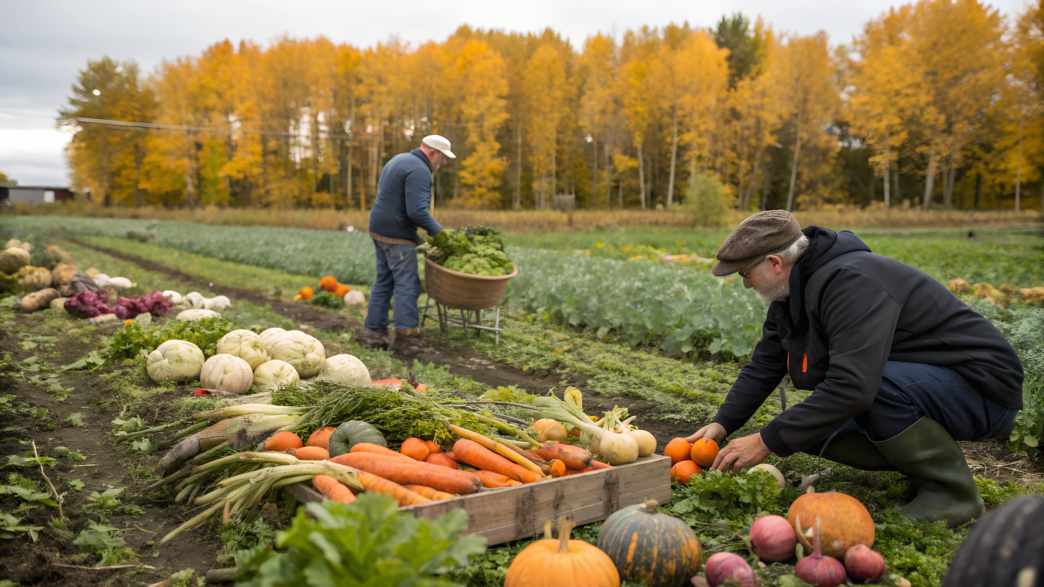
Many people still think that fall begins in September, and plantings are just “the leftovers of the season.” But when you talk to state agronomists, read studies, and simply observe your garden for years, it becomes clear: fall is its own season with its own rules, and success depends on preparation, timing, and the right crops.
We worked in two opposite climates — the dry Idaho fall and the wet PNW fall. And each region showed us one thing: if you start on time, pick resilient varieties, and prepare the soil correctly, the fall harvest is much more stable than the summer one.
This article is exactly about that — what professionals actually plant, what they avoid, which varieties don’t get sick, and how they calculate timing. No guessing, no romanticizing — just experience, research, and working solutions.
1. What Experts Actually Plant in Fall
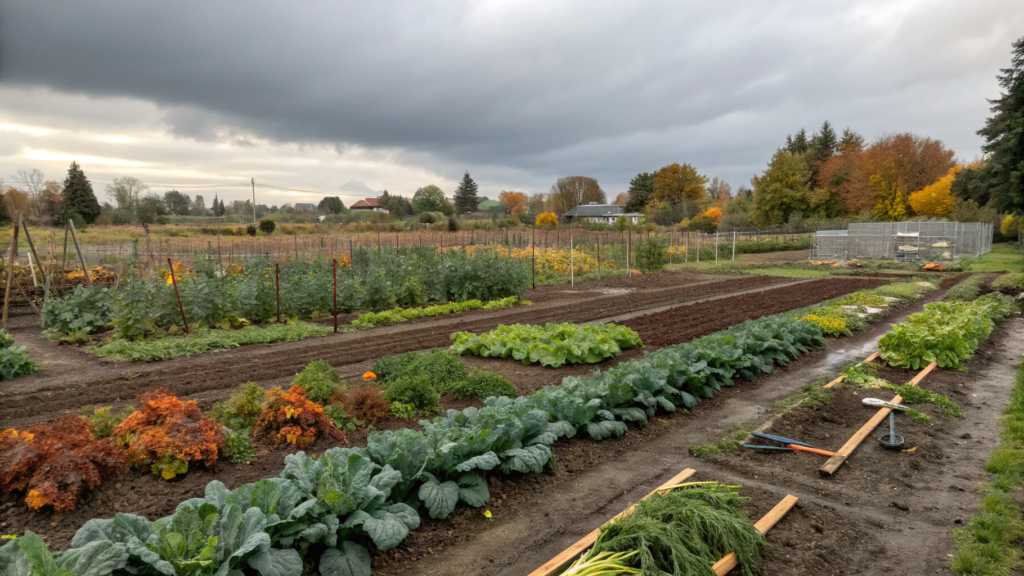
Fall is a season for strategists. Those who plan their harvest ahead and know which crops calmly withstand the first frosts, which like the shortening day, and which get their most intense flavor specifically in cold weather.
Main crops experts consistently put into fall
Experts — both state agronomists and university cooperatives — always keep four criteria in mind: cold tolerance, growth speed, disease resistance, and flavor peak during cooling. And based on this, the lists end up very similar regardless of the state.
1. Brassicas (the whole “family of strong ones”)
This is the first point for almost everyone. Not only regular cabbage, but also broccoli, cauliflower, Brussels sprouts, kale, and kohlrabi.
Kale, according to Wisconsin Horticulture Extension, becomes sweeter after light frosts. We ourselves have felt this soft sweetish note after nights around 28°F (–2°C).
Experts often mention hybrids like ‘Winterbor’ or ‘Redbor’, which handle cold down to 10–15°F (–12°C…–9°C).
Cold-hardy fall brassicas consistently top the lists across states.
2. Root crops (the real “quiet workhorses”)
There are crops that seem made for fall. Here they are: carrots, beets, turnips, daikon, and radish.
According to the Journal of the Science of Food and Agriculture, when the temperature drops, carrots accumulate more soluble sugars. That’s why fall carrots really become sweeter than summer ones — it’s not a subjective feeling.
In Idaho we always sowed carrot varieties ‘Napoli’ and ‘Yaya’ in late July–early August. And honestly: the crunch in October… mmm! Lindsey always said it was her “fall vitamin boost.”
3. Leeks and green onions
Leeks withstand cold, grow slowly but steadily, and by November become softer and more tender.
We once left a couple of beds of leeks under a snow crust in Idaho, and in January (!) they were still perky.
4. Spinach (among the top favorites of US agronomists)
Spinach in fall is ideal. And if you choose varieties like ‘Giant Winter’ or ‘Bloomsdale’, it can even overwinter under light cover.
The University of Maine notes that spinach germinates best at a soil temperature of 50–60°F (10–15°C). That’s why late August and September are the optimal time to sow.
5. Garlic (professionals plant it only in fall)
This is a rule absolutely everyone follows. Garlic is planted in October–November, when soil temperature drops to 50°F (10°C). Thanks to the cold period, the vernalization process starts, which makes the bulbs larger.
In Idaho, we saw this over and over: if you plant earlier — the bulbs are small; if you plant later — the cloves don’t have time to root. In the PNW the timing is a bit different now, but the principle is the same.
6. “Cut & Come Again” green mixes
Professionals love mizuna, pak choi, mustard greens, Swiss chard, and lettuce-spinach mixes.
These are the most stable crops for a fast harvest. Ideal for those who start the fall garden a bit late.
What consistently worked for us in Idaho:
- carrot varieties ‘Napoli’ and ‘Bolero’
- kale ‘Winterbor’
- leek ‘Lancelot’
- beet ‘Detroit Dark Red’
- pak choi ‘Joi Choi’
In fall these crops didn’t stretch, didn’t get sick, and didn’t bolt. And we harvested when most people had already closed the season.
Professional trick. Many experts start fall crops earlier than it seems logical. We’ll talk about this more in the third section, but I’ll say it briefly here: the fall garden is July and August, not September.
This is something I personally understood… well, slowly, let’s put it that way. To avoid fussing with fall crops every day, experts use resilient materials like agrifabric with a density of 0.5–1.0 oz/yd² and light hoops.
2. Cold-Tolerant Vegetables That Never Fail
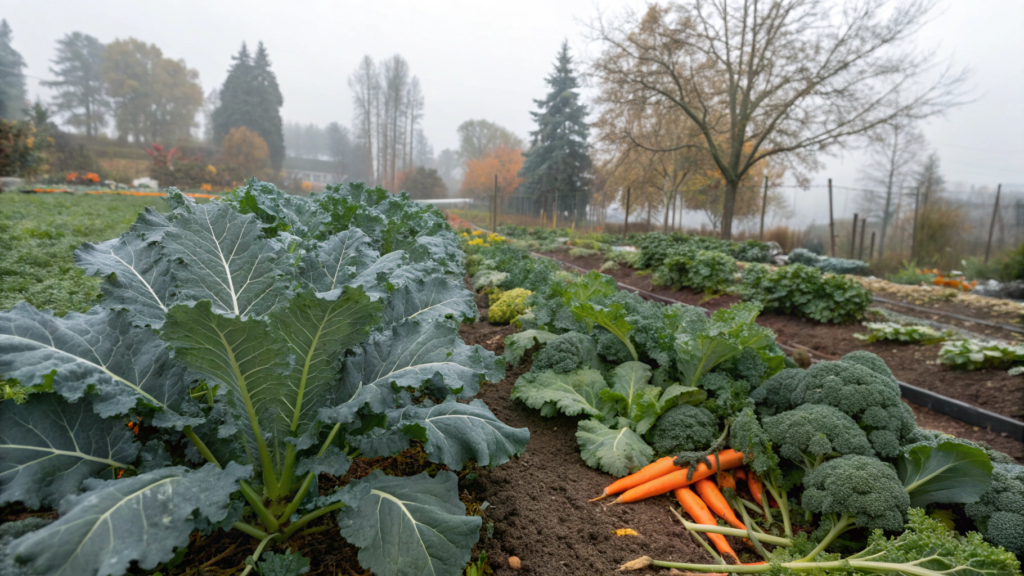
We very quickly made our own list of vegetables that NEVER fail. And professionals in the States recommend almost the same thing — rare harmony here.
Fall resilience is not a miracle. Plants that handle cold well accumulate more sugars, make their cell sap less “freezable,” and strengthen their tissues. In the Journal of Plant Physiology these processes are described as a normal reaction of plants to cooling.
And honestly, you can feel it with your hands: a kale leaf in fall crunches differently than in summer. Even the sound is different.
Here are the crops experts always include for fall:
1. Kale — the most reliable fighter
It is surprising how stable kale is. In Idaho it survived down to 10°F (–12°C) for us without cover. In the PNW — even easier.
Agronomists from the University of Minnesota also classify kale as a top fall crop, listing a range down to –15°C.
The best varieties that saved our harvest more than once:
- ‘Winterbor’
- ‘Red Russian’
- ‘Dwarf Blue Curled’
In fall the flavor becomes softer and even slightly “sweetish,” which is a normal effect of cold stress.
2. Carrots — the colder it gets, the better they taste
Here we once had a funny situation. I left part of the carrots in the bed “for just one more week.” Then the frosts hit. And… the carrots became absolutely perfect. Lindsey laughed that it was “nature’s deep freeze” — and it really was.
The reason: cold triggers sugar accumulation. Carrots calmly handle 20–25°F (–6…–4°C), especially if slightly hilled or under mulch.
Varieties that worked consistently for us:
- ‘Bolero’
- ‘Napoli’
- ‘Romance’
3. Beets — strong and steady
Beets, like carrots, love cool temperatures and hold low temperatures tightly. It can survive at 28°F (–2°C) with no cover, and even lower with light mulching.
But the best part: young beet greens stay juicy until late fall. We often harvested them as the “last salad of the season.”
Experts often use varieties ‘Detroit Dark Red’ and ‘Cylindra’.
Beets’ dual harvest — roots plus greens — makes them a fall essential.
4. Brussels sprouts — cold only makes them better
If there is a crop that “reveals” itself exclusively in fall — this is it. After cold weather it becomes denser, tastier, and acts like a plant that finally feels comfortable.
Brussels sprouts easily tolerate 20–25°F (–6…–4°C), and research from Iowa State Extension notes that some hybrids hold even 15°F (–9°C).
Working varieties: ‘Jade Cross’, ‘Long Island Improved’.
We once harvested sprouts in Idaho under a thin layer of frost — and that was the moment you understand why you put so much effort into the fall garden.
5. Leeks — “steel” among the alliums
Leeks can hold at 10°F (–12°C). And this isn’t theory — in Idaho we left them under snow a couple of times. In the PNW they practically feel like royalty.
Best expert varieties: ‘Lancelot’, ‘Bandit’, ‘Megaton’.
As they mature, the stems become denser, which is perfect for December soups.
6. Spinach — small but very tough
When nights get cold, spinach starts acting almost like a perennial — it grows slowly but keeps on living. The University of Maine notes that under light cover it calmly survives winter.
In fall they choose varieties: ‘Giant Winter’, ‘Bloomsdale’, ‘Space’. And yes, this is one of those cases when the colder it gets, the better the harvest.
7. Pak choi and other Asian greens
They grow fast, tolerate 28°F (–2°C), and their texture becomes even nicer after cold weather.
The most stable variety in our conditions — ‘Joi Choi’.
To keep these crops working without surprises, most experts use light seasonal cover: hoops + agrifabric 0.5–1.0 oz/yd².
3. Crops Experts Secretly Start Earlier Than You Think
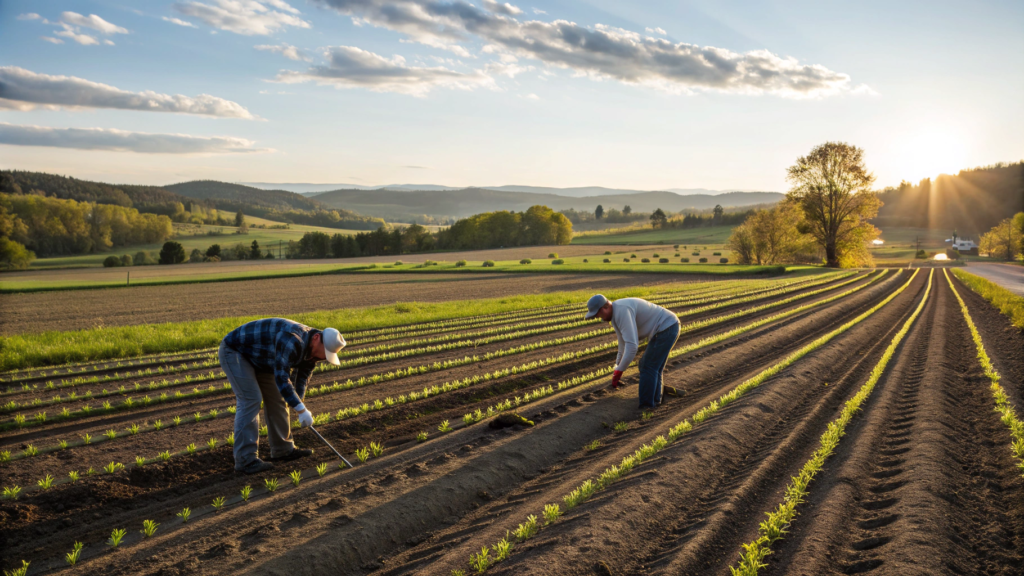
In fall, many crops need to be started so early that it still feels like “deep summer.” I once thought: “Well, what’s a couple of weeks?” And then I discovered that carrots simply do not want to grow when the day is getting shorter.
And this is not my speculation — the American Society for Horticultural Science writes that most crops slow their growth dramatically once the day drops below 14 hours of light.
Short-day slowdown is one of the main reasons fall crops fail.
1. Carrots — start in late July, not September
This is a classic: if you plant carrots in September, they will grow to the size of a fingernail and go into winter as “eternal babies.”
Experts, including the university cooperatives of Oregon and Minnesota, recommend starting carrots in the last week of July — the first week of August.
Varieties that consistently grow well with an early start:
- ‘Bolero’
- ‘Napoli’
- ‘Yaya’
2. Beets — early August
Beets grow faster than carrots, but they also dislike short days. They are started in early August, at most by mid-month.
The reason is simple: beets need to form their root before the day length falls below 12 hours. This is also confirmed by the Journal of Agronomy & Crop Science — basic plant physiology, nothing “garden myth” about it.
For early starts, beet beds are often covered with light mulch or agrifabric.
We use Garden Mate Plant Protection Fabric — a light, breathable material that helps hold moisture in heat.
Moisture retention is crucial during early-August sowing.
3. Brassicas — almost everything is planted “as if it were summer”
And this is the part I myself ignored for a long time. Brussels sprouts, cauliflower, and broccoli are started in June — early July so that by August the plants are already strong and forming heads as the weather cools.
If you start in August — there simply will be no harvest.
Working timeline:
- seed starting: second half of June
- transplanting into beds: first half of July
Best fall varieties:
- broccoli ‘Marathon’
- cauliflower ‘Snow Crown’
- Brussels sprouts ‘Jade Cross’
4. Leeks — started almost “in spring”
I’m not joking. Fall leeks are grown like this:
- sowing: March–April
- transplanting: May–June
- harvest: September–December
Professionals treat leeks almost like a perennial crop: they take a long time to bulk up, and only in fall do they become truly tender.
This is a case where an early start is not a “secret” — it’s a necessity.
5. Spinach — timing is everything
Although spinach is cold-hardy, experts start it twice:
- the first batch in late August
- the second in mid-September, to overwinter under cover
This achieves continuous harvest. The University of Maine has a clear recommendation: the optimal soil temperature for spinach is 50–68°F (10–20°C). Late fall is already colder, and August is exactly the sweet spot.
6. Asian greens — if you want success, sow in August
Pak choi, tatsoi, mizuna — all these crops are started by professionals in early August.
Why:
- they grow quickly in warm soil
- but develop perfect leaf texture in cold
- and bolt less under short days
4. Vegetables They Avoid Planting in Fall
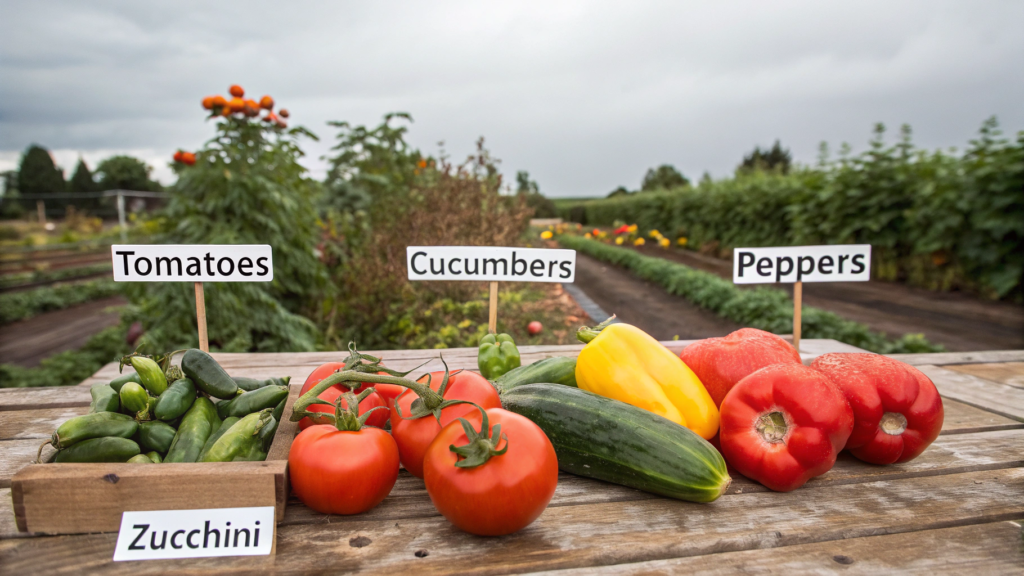
I gathered the vegetables that agronomists from university cooperatives, as well as experienced gardeners, prefer NOT to touch in the fall season. We also tried almost everything — and this is one of those cases where it’s better to listen to the elders.
1. Cucumbers — absolutely not a fall crop
This is one of those plants that critically depend on:
- warmth
- long daylight
- dry, warm nights
In fall it’s the opposite of what cucumbers need. A cucumber simply stops growing at temperatures below 60°F (15°C).
The Journal of Horticultural Science notes that cucumbers react critically to decreasing daylight — growth slows down two to three times.
We once planted cucumbers at the end of August just for the experiment… and got “little grapes” instead of fruit.
2. Tomato — growth slows almost to zero
Tomatoes are extremely sun-loving. The soil must stay above 65°F (18°C). In fall you don’t get that luxury even in the PNW, let alone in Idaho.
Professionals avoid:
- late transplants
- fall plantings
- any attempts to “catch up” on harvest in September
A tomato in fall either gets sick or barely grows. We once stretched tomatoes in a greenhouse until November — and it was the saddest plant I’ve ever seen.
3. Peppers — one of the most sensitive crops
In fall peppers completely stop blooming, the buds drop, and growth stops.
Agronomists at the University of New Mexico write that peppers sharply lose productivity when night temperatures drop below 55°F (13°C). And in fall — that’s normal.
All varieties are avoided, even ultra-early ones.
4. Eggplant — the leader in fussiness
It is even more heat-loving than peppers. For normal growth, eggplants need:
- 70–85°F (21–29°C) during the day
- at least 60°F (15°C) at night
There are no such conditions in fall. We once planted eggplants late, closer to August… and got beautiful bushes with zero fruit. Lindsey just looked at me like: “Why did we even bother?”
5. Corn — absolutely no point in fall
Corn needs a long vegetative period + warm soil + a long day. In fall — you get none of the three.
Experts completely exclude it from fall planting lists.
6. Beans — extremely vulnerable to cold
Beans react to cold so quickly that leaves turn black literally overnight at 32°F (0°C).
Agronomists from the Virginia Cooperative Extension note that beans stop growing at temperatures below 60°F (15°C).
That makes fall plantings almost guaranteed failure. Beans’ cold sensitivity is one of the highest among garden crops.
7. Zucchini and summer squash
If there were a competition for “the most sensitive crop to fall chill,” zucchini would win.
At 50°F (10°C) growth almost stops, and at 45°F (7°C) the leaves begin to collapse.
There is no point in fall plantings — the plant simply won’t have time to produce fruit.
Zucchini shuts down faster than almost any other crop.
8. Sweet corn
It has one of the longest vegetative cycles among vegetables. In fall it:
- doesn’t pollinate
- doesn’t fill ears
- doesn’t accumulate sugar
The University of Illinois directly states: fall sweet corn plantings “are usually unproductive.”
Sweet corn needs summer, not fall.
9. Okra — the first to drop
This crop evolved in hot climates. It stops developing already at 60°F (15°C) — and in fall that’s a typical night.
We once planted okra at the end of July — and even then it barely had time to produce a harvest.
10. Any long-day crops
This is an important category. In fall they avoid almost all plants that depend on photoperiod:
- long-day bulb onions
- spring garlic
- late potato varieties
They simply are not adapted to decreasing light.
A small tip for protecting the remaining greenhouse crops
Professionals sometimes try to extend the life of tomatoes or peppers under cover.
For this they often use AgriFab Frost Blanket. It creates a difference of 4–8°F (2–4°C), which sometimes helps save the remaining harvest.
5. Overlooked Fall Vegetables Making a Comeback

There are vegetables that seemed to have disappeared. People stopped planting them, stopped talking about them. But experts, university cooperatives, and those same “old farmers” are now bringing these crops back into the fall season. And I have a feeling we’re returning to something very right.
So here’s the list of crops that are quietly but confidently returning to fall beds across the country.
1. Turnips — they’re back and looking better than before
Turnips always seemed boring to me. I even avoided them at the store. But then one fall, almost by accident, we planted the variety ‘Hakurei’. And I absolutely loved it!
Why it’s coming back:
- grows fast (35–45 days)
- handles 28°F (–2°C) perfectly
- the greens are edible
- the root becomes softer and tastier after cold
The University of New England writes that turnips build up sugar at temperatures below 40°F (4°C), calling them “one of the best late-season crops.” And it’s true — the flavor is completely different from what we remember from childhood.
2. Radishes and daikon — the small fall “workhorse”
Radishes are coming back not only into salads but also into soil improvement.
Experts use daikon as a “bio-drill” — a living soil aerator that:
- breaks through compact layers
- increases water permeability
- leaves behind tunnels for spring crop roots
Varieties that definitely work:
- ‘Daikon Minowase’
- ‘Watermelon Radish’
- ‘Purple Plum’
And yes, their fall flavor is brighter — cold makes the flesh slightly sweeter and firmer.
3. Rutabaga — the comeback of a “retro vegetable”
Why it’s returning:
- handles frosts down to 20°F (–6°C)
- grows in poor soil
- stores for months
- flavor becomes creamy after cold
It’s often called “an underrated survival root,” and it sounds dramatic, but… honestly, it’s true.
Professionals choose varieties: ‘Laurentian’ and ‘American Purple Top’.
Rutabaga’s cold-creamy flavor is the reason farmers are planting it again.
4. Swiss chard — the fall favorite everyone suddenly remembered
Chard came back because:
- it tolerates cold better than most leafy greens
- holds harvest until December under light cover
- stays bright and juicy even in short days
We kept ‘Bright Lights’ chard under row cover in Idaho, and it survived several nights at 25°F (–4°C). And the flavor was much nicer than in summer — denser, but not coarse.
5. Parsnip — a crop that only reveals itself in fall
If you plant parsnip in spring, it grows… but its true moment comes after frosts. And the best part:
- it overwinters right in the bed
- the flavor becomes softer and deeper
- you can dig it up until February
We once forgot a patch of parsnips until January — and it was the best parsnip of our lives.
Frost-kissed parsnip is an entirely different vegetable.
6. Tatsoi — the quiet hero of fall
This green was long considered “exotic.” But professionals increasingly recommend it for fall plantings because it:
- grows at very low temperatures
- withstands 20°F (–6°C)
- recovers quickly after light freezing
The variety ‘Rosette Tatsoi’ is now one of the top picks among agronomists in the Midwest.
And yes, we once harvested it right after frost — the leaves were slightly crisp and very tasty.
Cold-hardy tatsoi is one of the best greens for late fall.
7. Humble oats as a vegetable green
Oats are not just a cover crop. Their young shoots are returning as:
- a vitamin-rich fall green
- a base for salad mixes
- a fast-cut leafy green
They grow it like microgreens, but outdoors. And it thrives at temperatures down to 25°F (–4°C).
Oat greens are becoming a surprising fall staple again.
6. Fast-Growing Picks for the Short Fall Season
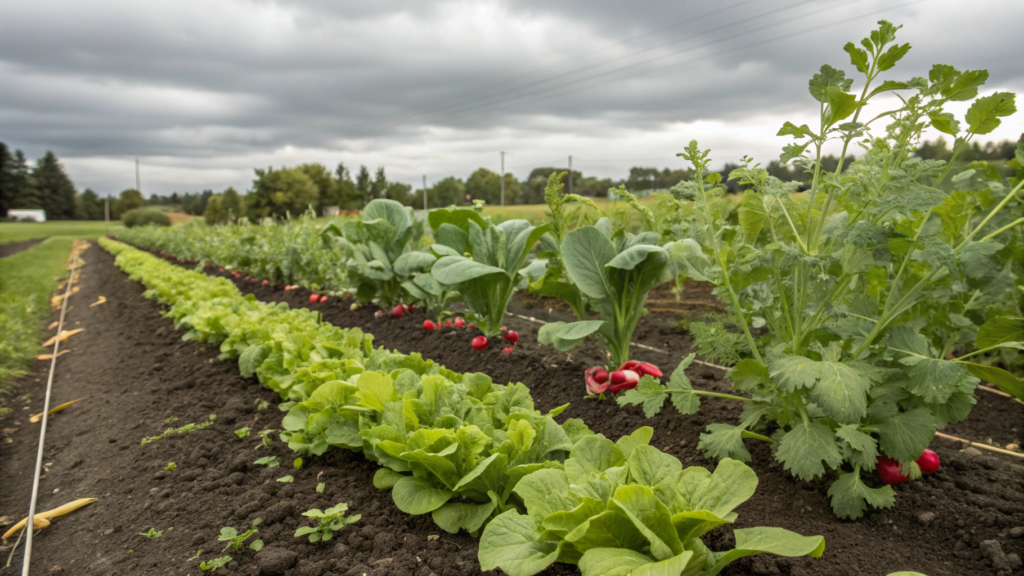
In fall, you really start valuing crops that actually produce fast. Not “potentially,” not “in the perfect climate,” but right in the real conditions — short day, cold nights, wet soil.
When we lived in Idaho, I felt the difference very clearly between varieties that managed to fit into a 30–45 day window and those that required miracles (which, honestly, don’t exist in the garden). And in the PNW the situation is similar: there is a window, but it’s short, and if you miss it — that’s it, the season is gone.
So here are the crops experts plant when it’s “almost too late,” but you still want a harvest.
Fast-maturing fall crops are the only real solution for late starts.
1. Radishes — the champion of speed
A classic, but with nuances. Radishes are a crop that can produce:
- in 25–30 days, sometimes even faster
Agronomists from the Journal of Horticultural Research say that radishes maintain stable growth even at light levels below 12 hours, as long as soil temperature stays within 50–65°F (10–18°C).
Our favorite varieties:
- ‘French Breakfast’
- ‘Cherry Belle’
- ‘Easter Egg’
And a small trick: in August–September radishes germinate better under light cover. We use the Dewitt Seed Germination Blanket, and the difference in sprouting is really noticeable.
2. Mizuna — grows almost “before your eyes”
Mizuna is a green that isn’t afraid of cold and grows at incredible speed.We once planted it in August “just to have greens,” and three weeks later we were already harvesting leaves.
Why experts love it:
- harvest in 20–25 days
- doesn’t get bitter in the cold season
- handles frosts down to 28°F (–2°C)
- grows even in partial sun
And yes, if you have no time — mizuna is perfect.
3. Pak choi — a fast and reliable Asian green
Pak choi is excellent for a late start.
Timing:
- 30–40 days to maturity
- most varieties handle light frosts
The University of Wisconsin notes that pak choi keeps active growth even when temperatures drop to 45°F (7°C). That makes it one of the best options for a genuinely short fall.
We most often use varieties:
- ‘Joi Choi’
- ‘Mei Qing Choi’
Cold-tolerant pak choi produces steadily even when other greens stall.
4. Mustard greens — they grow faster than you can decide what to cook
Mustard is a seriously underrated green. It grows fast, but more importantly — it brings strong flavor. In fall that flavor becomes softer and deeper, which is confirmed by a Journal of Food Quality study noting reduced bitterness when temperatures drop.
Growth window:
- 25–35 days
Varieties:
- ‘Red Giant’
- ‘Green Wave’
In fall you can harvest mustard almost every week — it regrows after cutting.
Regenerative mustard greens are perfect for continuous fall harvests.
5. Cut & Come Again lettuces — ideal for late starts
Honestly: if I’m late with my fall garden, this is what I plant.
Timing:
- 20–30 days to the first cut
And an important note: lettuce mixes germinate best in soil at 50–60°F (10–15°C). This is ideal for late August–mid September.
Working mixes:
- ‘Mesclun Mix’
- ‘Gourmet Lettuce Blend’
- ‘Spinach & Lettuce Duo’
We’ve tried many, but mixes always win.
6. Tatsoi — incredibly cold-hardy and fast
Tatsoi is a green that:
- grows in 20–25 days
- handles cold down to 20°F (–6°C)
- recovers after freezes
In research from Horticulture Research International it’s called “one of the most promising cold-season vegetable crops.” And in practice — that’s true.
The variety ‘Rosette Tatsoi’ gives an especially beautiful round shape.
7. Green onions — a quick win for late season
Green onions grow:
- in 25–40 days
- handle frosts well
- suit even those who get only 4–5 hours of sun in fall
In Idaho we planted green onions almost “out of nowhere,” when it seemed the season was over. And every time they made it.
Best options:
- ‘Ishikura’
- ‘Evergreen Hardy White’
8. Baby chard
Regular chard grows slowly… but baby chard is a completely different story.
You can start cutting it in:
- 20–30 days
Agronomists from the University of Utah note that chard maintains active growth even when temperatures drop to 40°F (4°C), which makes baby chard perfect for late season.
The variety ‘Bright Lights’ looks beautiful even in the cold
7. State-by-State Fall Planting Differences
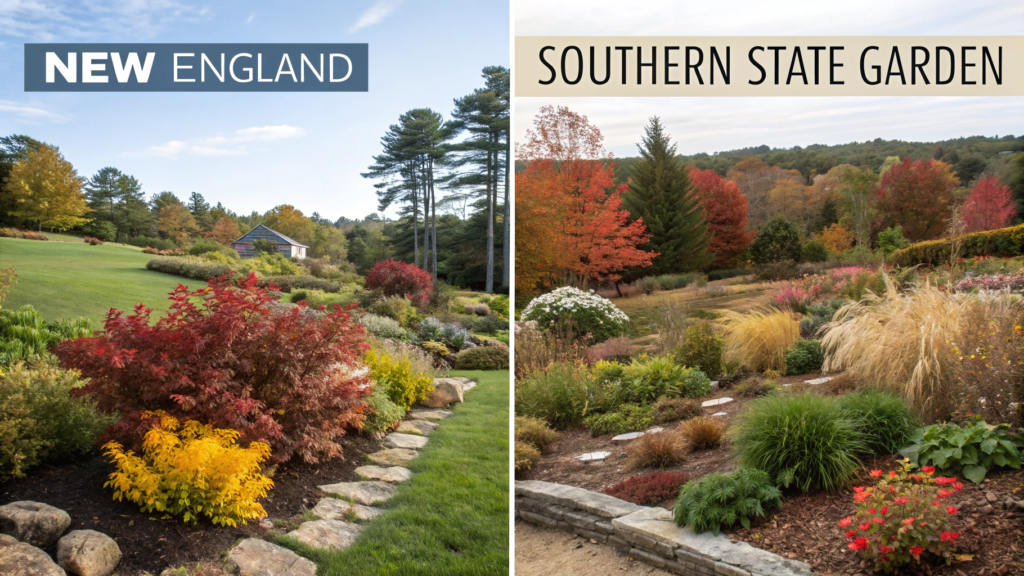
When I started comparing recommendations from university cooperatives in different states, I was honestly shocked — the differences are wild.
So let’s break down how fall plantings actually vary from state to state.
1. Northeast (Maine, Vermont, New Hampshire)
These states are champions of short falls.The season ends abruptly around late September — early October.
What this means:
- root crops start in late July
- brassicas — in June–early July
- fast greens — in August, at most early September
- garlic — in late October
The Maine cooperative directly writes that after September 14 all plantings are “based on luck.”
In Idaho we sometimes felt something similar — though the climate there is drier.
2. Midwest (Minnesota, Wisconsin, Michigan)
Here’s the key nuance: cold arrives fast, but soil stays warm for a while.
So:
- root crops: early August
- broccoli and cauliflower: late June — mid-July
- spinach: double sowing — late August and mid-September
- greens: until the end of September
A study from the University of Minnesota shows that in these states fall is better planned not by date, but by GDD — growing degree days. This really changes the game — we did this in Idaho too.
3. Northern Plains (Dakotas, Nebraska)
This is the zone of “sudden frost surprises.”
Features:
- all plantings are done 2–3 weeks earlier than in neighboring regions
- brassicas — only if started as transplants
- greens — better in mini tunnels
Experts recommend using insulated hoops. It protects from sudden freezes.
4. Central regions (Ohio, Indiana, Kansas)
A very “fluctuating” climate.
Flexibility matters:
- root crops: early August — mid-August
- brassicas: first half of July
- spinach and greens: until the end of September
- garlic: late October–November
Ohio State University recommends starting fall plantings by tracking soil temperature — the ideal is 50–60°F (10–15°C). And I fully agree: in transitional climates the calendar helps very little.
5. Southeast (Georgia, Alabama, South Carolina)
This is a completely different world. Fall here is long, humid, warm — and that creates its own rules.
Here:
- brassicas are planted in September–October
- root crops are sown in October
- greens can be planted almost until November
Scientific recommendations from the University of Georgia say that spinach is better sown after October 1 to avoid bolting. This place really flips everything upside down compared to the North.
6. Southwest (Arizona, New Mexico)
Here fall is almost like spring.
They sow:
- brassicas — in September–October
- carrots and beets — in October
- greens — from October to December
When we consulted friends in Arizona, I was shocked: their season begins exactly when ours in Idaho ends. The difference is in night temperatures, which stay mild.
7. West Coast (Washington, Oregon, Northern California)
This is our current zone. And yes, fall here is long, mild, and… wet. Very wet.
Features:
- root crops: late July — mid-August
- brassicas: late June — mid-July
- greens: from August to the end of September
- fall plantings (spinach, garlic): October
Research from the University of Oregon notes that in the PNW the key factor is soil moisture, not just temperature.
I see it myself: sometimes the soil is colder than the air because of constant rain, and that shifts timing.
8. California (south and central)
Here everything is the opposite: fall is the perfect season.
They sow:
- root crops: October–November
- broccoli: September
- greens: until December
Professionals here have one main concern — not overheating the seedlings in September.
Tip from experts. Many professionals use a simple tool — a soil thermometer. We use the Reotemp Soil Thermometer — it shows the real soil temperature, not what the weather “feels like.” And this makes planning much easier.
8. Soil and Fertility Tricks Experts Rely On
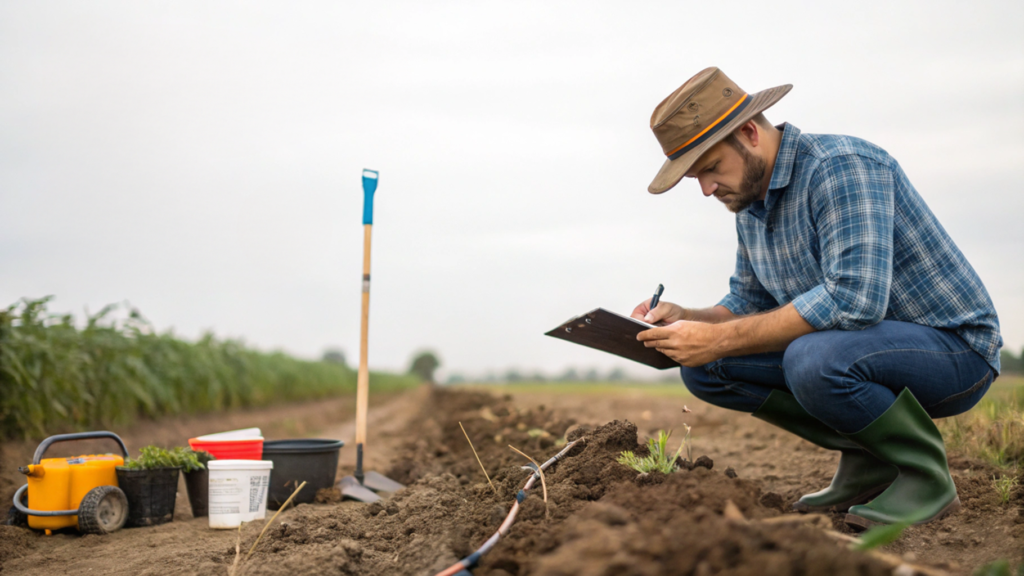
Now I finally understand the necessity of not just digging, but understanding the soil: structure, nutrients, microbial activity, moisture. Honestly, I can now say: experts rely on a few very simple but incredibly effective techniques. And if you apply them — the fall harvest becomes twice as stable.
1. Work with the soil doesn’t begin in fall… it begins in late summer
This is probably the most important part. The soil must be ready before you sow fall crops.
Experts always do three steps:
- deep loosening (not flipping!)
- adding compost
- restoring the microbiome
We always add:
- 1–2 inches (2.5–5 cm) of compost
- light loosening with a broadfork (without turning the soil)
And this works far better than any “quick fertilizer.”
2. Compost — the king of fall soil
But not just any compost. In fall it’s better to use fully matured compost because plants react to cold differently.
Mature compost:
- holds moisture
- doesn’t “burn” roots
- releases nutrients slowly
According to the Journal of Environmental Quality, fully matured compost provides the most consistent nutrient availability in cool soil.
3. “Fast” organics — only in liquid form
Experts rarely use granules in fall — they’re too slow. Instead they apply:
- fish emulsion
- compost tea
- seaweed extract
- humates
Why this works:
- cold soil dissolves granules poorly
- liquid forms absorb faster
- light nitrogen helps greens start quickly
In Idaho we literally saved a couple of fall beds with compost tea brewed for 24–36 hours. In the PNW it’s easier — humidity works in our favor.
4. Cover crops as part of fall nutrition
Professionals talk about cover crops constantly — not as a formality, but as part of fall nutrition.
Best fall cover crops:
- oats
- mustard
- brassica mixes
- phacelia
They improve structure, reduce compaction,enrich soil with organic matter,increase microbial activity.
Fall plantings of oats and mustard really help hold nitrogen in the soil and reduce leaching during the rainy season.
5. Mulch is essential — without it the soil “cools” too fast
And you can literally feel this with your hands: in fall, bare soil is cold even during the day.
Experts use:
- shredded straw
- composted manure
- shredded leaves
- wood chips (only for paths)
Thickness:
- 1–2 inches (2.5–5 cm) for beds
- 3–4 inches (7–10 cm) for paths
In Idaho we used leaves so actively that neighbors joked we were “hunting” for their trees. Well… yeah, a bit.
6. pH testing — determines the fate of brassicas in fall
Brassicas are very sensitive to pH.
- below 6.0: higher risk of clubroot
- above 7.5: poor micronutrient availability
So experts:
- test pH in late summer
- correct it with lime or sulfur ahead of time
- let the soil “settle” for 2–4 weeks
Proper fall pH is one of the strongest predictors of brassica success.
7. Organic “micro-nutrition” — a small thing with a huge effect
In fall, plants grow more slowly, which means they need:
- less nitrogen
- more potassium
- steady calcium and magnesium
Professionals often add:
- dolomite
- wood ash water
- seaweed extract
The Journal of Plant Nutrition notes that potassium increases cold tolerance in leafy crops — and based on our experience, this is absolutely true.
8. Fine-tuning moisture
This is where things get tricky. Fall can be:
- too rainy (PNW)
- too dry (Montana, Arizona)
Experts use:
- soil thermometers
- moisture meters
- low-flow drip irrigation
We use the Reotemp Soil Moisture Meter — it helps understand when to let the moisture drop and when to support it under mulch.
9. Microbial inoculants — not a trend, but a tool
Inoculants with Trichoderma, Bacillus, and mycorrhizae have become standard among many professional growers.
They increase root mass, improve phosphorus availability, boost cold tolerance.
We most often use mycorrhizae when planting brassicas — the difference is visible even by eye.
9. Disease-Resistant Varieties for Cool Weather

Disease resistance is not just a marketing line on a seed packet. It is a real, practical difference between “the harvest stands firm in November” and “why are the leaves gray and the head wet?”
So here are the varieties that agronomists, university cooperatives, and experienced gardeners consider “ironclad” for cool, damp fall weather.
1. Kale
Best of the best:
- ‘Winterbor’ — resistant to powdery mildew, handles freezes down to 10°F (–12°C).
- ‘Red Russian’ — dense leaf structure, less affected by fungal diseases.
- ‘Lacinato (Dino)’ — tolerates humid climates better, less prone to blackening.
Research from the University of Oregon notes that varieties with a waxy coating (such as Winterbor) show increased protection from Peronospora parasitica (downy mildew). And in our experience — this is absolutely true.
2. Broccoli that doesn’t rot in damp weather
Broccoli is gorgeous, but in fall it can easily suffer from bacterial rots. Experts choose resistant hybrids:
- ‘Marathon F1’ — the most reliable fall variety; dense heads, sturdy stems.
- ‘Arcadia F1’ — increased resistance to fungal infections, a classic for the PNW.
- ‘Belstar F1’ — especially good in cool climates, resistant to black spotting.
We planted Marathon for many years, and it truly survived wet fall weeks without those scary soft spots other varieties developed.
3. Cauliflower with high resistance to spotting
Cauliflower in fall is a moody diva. Humidity causes spotting, cold causes deformation.
But there are varieties that stay strong:
- ‘Snow Crown’ — resistant to leaf diseases, forms a head quickly.
- ‘Cheddar F1’ — dense structure, less prone to bacterial damage.
- ‘Graffiti’ — an impressively hardy purple variety.
Horticultural Science Review notes that varieties with a high density index (like Snow Crown) often avoid bacterial soft rot in cool environments.
4. Brussels sprouts — the denser the variety, the fewer the diseases
We noticed this in Idaho even before reading studies: dense, heavy sprouts are more disease-resistant.
Best varieties:
- ‘Jade Cross’ — classic, handles humidity well.
- ‘Hestia F1’ — resistant to bacterial issues.
- ‘Long Island Improved’ — old but reliable.
In a cool fall, Hestia behaves especially steadily.
5. Leeks — varieties that don’t rot at the base
Leeks often suffer from fungal rots, especially in wet fall conditions. But some varieties take everything calmly:
- ‘Bandit’ — one of the most resistant, great for cold regions.
- ‘Tadorna’ — handles wet fall weeks well.
- ‘Lancelot’ — dense, stable, less affected by gray rot.
The University of Maine directly lists Bandit as one of the most resistant leek varieties for cold, wet climates.
6. Spinach — resistance starts with the right seed
Spinach in cool weather can get downy mildew very quickly. Resistant hybrids save the harvest:
- ‘Space F1’ — resistant to several races of downy mildew.
- ‘Giant Winter’ — tolerates fall humidity better.
- ‘Regiment’ — resistant to disease complexes and cold.
We often plant Space for fall — and so far it’s the most “indestructible” spinach of the cold season.
7. Beets — varieties that don’t suffer from leaf spotting
Fall and humidity create perfect conditions for cercospora leaf spot.
These varieties show the best resistance:
- ‘Red Ace F1’ — high resistance to leaf spotting.
- ‘Detroit Dark Red’ — time-tested; leaves hold longer.
- ‘Boro F1’ — tolerant to cold moisture.
Studies from the Plant Disease Journal confirm: Red Ace shows low susceptibility to Cercospora betalina in cold, humid conditions.
8. Green onions — pick the right variety and disease is almost nonexistent
Green onions are usually hardy, but in fall weak varieties get sick easily.
Experts choose:
- ‘Evergreen Hardy White’
- ‘Ishikura’
- ‘Tokyo Long White’
They’re more resistant to fungal infections and respond better to cold rain (in the good sense).
For prevention, experts often use a quality sprayer to apply treatments in a thin layer. We use the Chapin Fine Mist Sprayer — it gives a fine, even mist and helps treat plants without waste.
10. Insider Timing: When Pros Really Start Their Fall Gardens
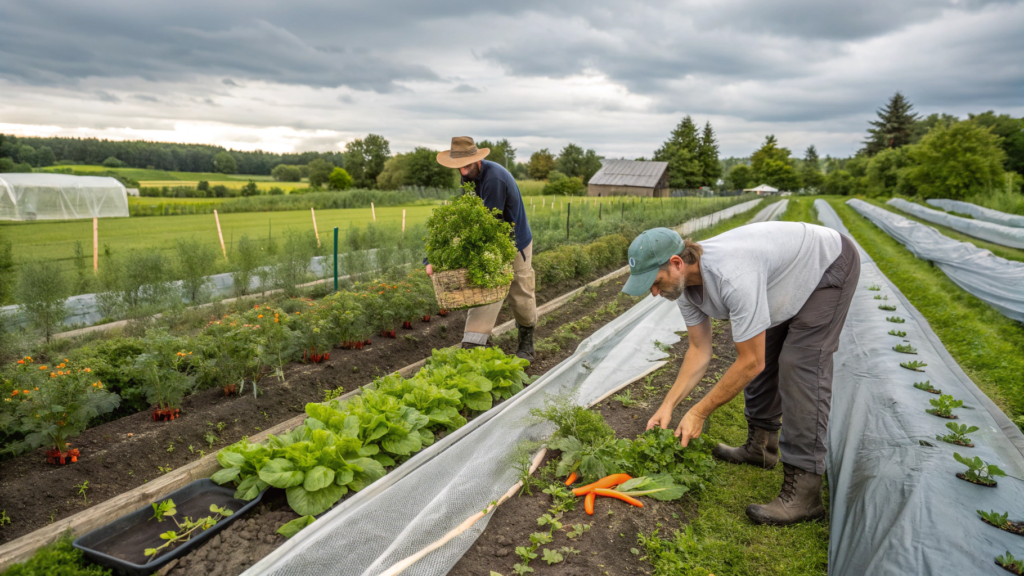
(and why these dates almost always surprise people)
While regular gardeners grab a shovel in September, experts are already calmly harvesting young carrots and covering their second wave of spinach.
Fall is strategy. And that strategy always begins earlier than logic suggests.
1. Professionals start preparing for fall back in June
Sounds insane? We thought so too. But here’s how agronomists and Garden Coaches think:
- the day starts shortening after June 21
- plants react to this immediately
- fall crops must build mass before day length drops below 12–14 hours
According to the Journal of Applied Plant Science, a reduction of photoperiod by 30–60 minutes slows root crop growth by 18–27%. That is a huge number, honestly.
From this comes the first insider principle: you prepare for fall while it’s still peak summer.
2. The main planting wave — July
Here is what professionals actually do in most states:JULY is the “fall May.”
They plant:
- carrots (late July)
- beets (late July — early August)
- brassicas (transplants go in early July)
- leeks (which were started back in spring)
- early radishes and greens (second half of July)
Mid-summer sowing is what gives fall crops enough time to size up.
3. August — the month when experts “fill the gaps”
In August professionals:
- re-sow green crops
- add mizuna
- start salad mixes
- plant spinach (first wave)
- add radish every 10–14 days
Agronomists at the University of Oregon call August the “last chance window” — after it, the Northwest season contracts sharply.
And yes, the soil is still warm in August, but plants already follow the short day. This imbalance is what makes August so important.
4. September is not the start of fall gardening. It’s the midpoint.
Gardeners have been misunderstanding this for years… including me.
In September professionals:
- sow the second wave of spinach
- start tatsoi
- add green onions
- sometimes plant late turnips
- set up mini tunnels
- in the PNW — begin fall-planted crops
But almost no one plants long-season root crops.
5. October — the month for fall-to-winter plantings
Here’s what experts actually do in October:
- plant garlic
- start overwintering spinach
- mulch beds
- lay cover crops (oats, mustard)
- set up protective covers
And that’s it. October is not a planting month. It is a preparation month.
We once tried to plant beets on October 1 in the PNW. They sprouted — and then just froze in development. They stood there like decorations.
6. Professionals calculate “backwards”
This is the key tool. They calculate: (days to maturity) + (14 days for slowed fall growth) + (14 days before first frost)
Example:
- Carrot ‘Bolero’ — 60 days
- Slower fall growth — +14 days
- Buffer before frost — +14 days
- Total: 88 days
If the first frost is October 10, you plant: October 10 minus 88 days = July 14.
This is why it seems like experts start “unreasonably early.”
7. Mini tunnels let you start 2–3 weeks earlier
In fall this is one thing. But in July–August mini tunnels provide:
- a gentler, more humid microclimate
- protection from root overheating
- stable germination
Season-extension tunnels shift the whole schedule forward.
8. A personal experience that completely rewrote my understanding of timing
When we first moved to the PNW, I decided to plant a fall garden in early September.
That was the mistake — the one I referenced in articles for the next three years like it was a comedy episode.
Spinach grew… well… tried. Carrots didn’t move at all. Now I start the fall garden in late July.
And honestly, fall beds have become the most reliable ones of the whole year.
9. The tool professionals never start the season without
A soil thermometer. Soil is not air. It cools much more slowly. And soil temperature is what determines the growth speed of fall crops.
We use the Reotemp Soil Thermometer — one of the most useful tools ever, especially in transitional climates.
Soil-temperature tracking is essential for real fall planning.
Fall Results
If the variety is chosen well, the soil prepared early, and the timing respected, the results are instantly visible: carrots become sweeter, brassicas firm up, spinach handles cold nights easily. If something was rushed — that’s visible too.
We’ve planted fall crops “too late” many times and got threads instead of root crops. And we’ve planted beds in July many times and harvested perfect produce almost until winter.
So the final question to the reader is simple and practical: Which crops actually work for you in fall? What succeeded, and what didn’t?Share in the comments — these observations help not only beginners, but also those who’ve gardened for years. Fall loves precision, and the more experience we collect together, the easier it becomes to make the season predictable.