
A garden is where you express yourself. Where every patch of soil can become a canvas, and a simple rock — a little detail that changes the entire mood of the space.
Lindy and I love things like that. Simple, affordable, heartfelt. Especially when there’s a bit of play, a touch of art, and a whole lot of warmth.
In this list, we’ve gathered 20 of our all-time favorite ideas — from simple little “ladybugs” to mandalas, from hand-lettered stones to full-on rock snakes. Some we made ourselves, some we spotted from others who also love filling their gardens not just with greenery — but with feeling.And isn’t it just the best? To walk through your garden and suddenly smile. Or pause; remember something; just stop for a second by some random rock — and feel like you’re home.
1. Frog-shaped garden rock art

There’s something surprisingly meditative about painting garden rocks. When I first tried making frog-shaped garden rock art, I realized — this wasn’t just a hobby anymore. It was something that actually brought our yard to life.
Lindy and I started with a single stone. One smooth, oval rock we found on the trail by the creek. And it practically begged to become a frog.
What you’ll need:
- 1 smooth oval rock about palm-sized (around 5–6 inches long / 13–15 cm)
- Acrylic paints (green, black, white, yellow)
- Brushes of different sizes (you’ll definitely want a fine one for the pupils!)
- Weather-resistant sealant — otherwise your little frog will melt in the first rain!
- Optional: hot glue and small wooden legs or plastic googly eyes
Tip. Don’t skimp on the sealant! We use Rust-Oleum Clear Enamel Spray — it keeps the paint looking fresh and prevents peeling even after 2 seasons.
How we do it:
- Wash the rock. Seriously. Even if it “looks clean.” Dirt and dust will mess with your paint.
- Sketch out the basic shape with pencil. Head, legs, back. Even if the shape is weird — that’s what makes it look alive.
- Paint the base coat. I use two shades of green — one for the back, one for the belly. Add a bit of white for highlights.
- Add the details. The eyes are the key! A black circle, a white dot — and boom, it’s looking straight at you.
- Seal it! Don’t skip this part. We use two coats, with about 30 minutes of drying time between them.
- (Optional) Attach wooden legs or use plastic for raised eyes — if you want it to be more sculpture than painting.
We like hiding these little frogs at the base of rose bushes, near the pond, or even along the garden path. One time, a neighbor actually thought it was real!
A bit of science — because we’re not just painting, we’re thinking too!
Studies have shown that decorative elements — especially bright, recognizable ones (like frogs or bugs!) — increase visual engagement and help both kids and adults feel more connected to their outdoor space.
Put simply — they make you want to go outside more often!
Frog-shaped garden rock art isn’t just decor. It’s a way to make your space not just beautiful — but playful. The kind of garden that people fall in love with.
2. How to paint fairy doors on rocks

A garden isn’t just about the plants — it’s about the atmosphere, the little things that catch your eye.
And if you’ve ever wanted to add just a touch of garden magic to your space — paint a fairy door on a plain rock. Seriously.
At our old homestead, we had this one messy woodpile where the boards kept shifting. We used to joke, “Looks like gnomes live there.” One day, I picked up a stone and painted a tiny door on it. Placed it right at the base. The next day, our neighbor’s daughter brought a little pine cone and placed it by the door — “a gift for the fairies,” she said.
Ever since then, fairy doors started popping up all over — at the base of a tree, under a shrub, even in the greenhouse (yep, the fairies live there too, especially mid-season).
What you’ll need:
- A flat-faced rock — about 4–5 inches tall (10–13 cm)
- Acrylic paints: brown, beige, green, white
- Fine-tipped brushes (size 0 or 00 for detail)
- Pencil for sketching
- Weatherproof sealant — something like Mod Podge Outdoor Sealer
- Optional: tiny rhinestones or mini decor items (like small nails as door handles)
How to paint a fairy door on a rock — step by step:
- Find the right rock. Oval or rectangular with a smooth face works best — that’s your door canvas.
- Sketch the outline with pencil. Arch or rectangle, maybe hinges, a little window, a frame. Fairies love the details 🙂
- Start with the base color. We paint the whole door in brown or gray, then add wood grain lines, highlights, wear marks, and greenery — like moss.
- Add life. One little door handle (we use glitter glue sometimes!) or a tiny twig ladder around the rock makes the whole thing feel real. Not just cute — like it’s been there for years.
- Seal it. Two coats are best, especially if you’re placing it under a tree or somewhere that gets rain.
You can place your fairy door at the base of a tree, along a path, on a fence post, or tucked in a hidden herb patch.
I actually love placing them in spots where no one expects them. People walk by and — oh! a door!
That surprise alone brings a smile. And a smile in a garden? That’s a design feature, too.
Studies have shown that contact with nature — even through visual anchors like whimsical objects, “secret corners,” and playful elements — reduces stress and increases satisfaction with time spent outdoors.
So yeah — fairy doors aren’t just cute. They’re a little psychological reset. Especially if your garden has kids around (or if you’re the kind of grown-up who still secretly believes in fairies).
3. Butterfly design on garden rocks

You really can’t imagine a garden without butterflies. And it’s not just the butterflies themselves — it’s the feeling they bring. Lightness. Quiet. Something alive — even if it’s just a painting.
That’s why I adore butterflies on garden rocks. And when you’re painting them with your kid (or your friend, with a glass of lemonade in hand) — that’s when the sweetest memories happen.
Why butterflies?
Because they’re a visible symbol of change. And they just look amazing anywhere — against greenery, mulch, gravel, stone. A rock with a butterfly fits right into a lavender patch and instantly looks like it belongs.
We once made a whole set of 7 butterfly rocks, each one different, and placed them along the path to the garden. It felt like a mini art gallery. And yep, it was pretty awesome.
What you’ll need:
- Flat rocks — best if they’re roundish, about 4–6 inches wide (10–15 cm)
- Acrylic paints: black, white, and your color of choice (we love turquoise, orange, and fuchsia)
- Fine liner brush (size 0 or 1)
- Pencil or white chalk for sketching
- Outdoor sealant — like FolkArt Outdoor Sealer
How to paint a butterfly on a rock — our way:
- Prep the rock. Wash it, dry it. Sometimes we lightly sand it too — paint sticks better that way.
- Sketch the shape. Draw the body (a vertical teardrop) and two wings. They can be symmetrical — but don’t have to be. Nature isn’t perfect, and that’s the beauty of it.
- Paint the wing base. We usually start with a dark background (black or navy), then layer on the design.
- Paint in layers. Start with bold color blocks, then add lines, dots, and veins. Use white for highlights — it really brings it to life.
- Add the body and antennae. Keep it simple. One clean line can make it feel “alive.”
- Seal with two coats — let it dry in between. Make sure it’s waterproof and sun-safe.
Best places to set them?
In your daisy or lavender beds — let them pretend they’re real. Next to veggie beds — they make great garden markers (we’ve got one “perched” near the raspberry bush every year), on top of stumps, or at the edge of your garden path.
Tiny touches that make a difference:
- Add a name to the rock: “Vanessa,” “Lucy,” “Maya.” Gives it personality.
- Use white paint dots around the wing edges — it makes the butterfly look like it’s floating.
- For more complex designs, try butterfly stencils — if freehand drawing isn’t your thing.
Research confirms that visual variety in a garden — especially with natural forms like butterflies — boosts feelings of joy and calm. It’s not just pretty — it does something to you.
You step into the garden, spot a butterfly rock… and stay a little longer. Just breathing.
If you’re painting with kids — start with butterflies. They’re fun and easy. And who knows? Maybe you’ll end up with a whole collection of flying stones.
4. Hidden trail rock path ideas
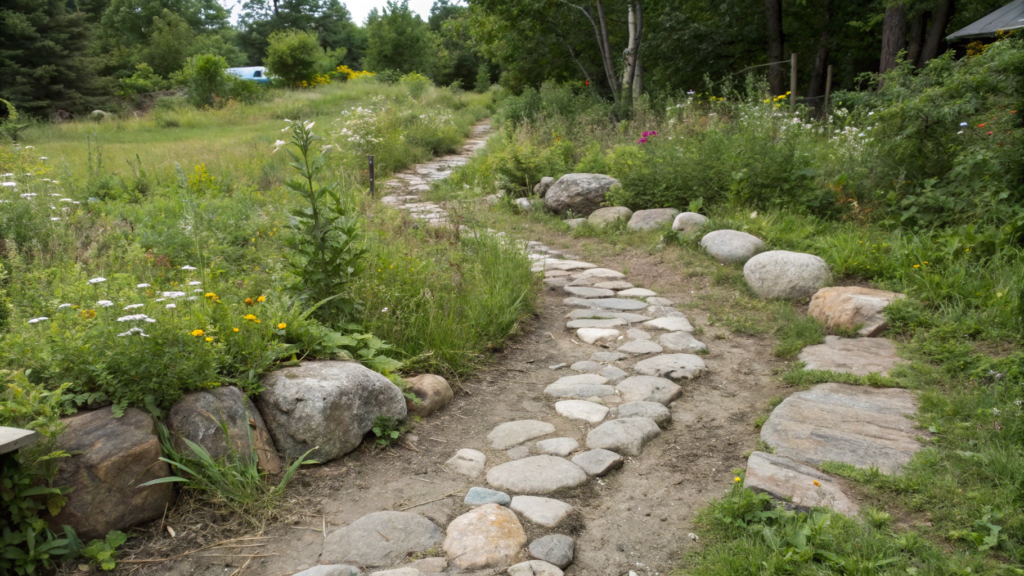
I’m pretty sure the most beloved spots in any garden are the ones not marked by obvious paths.
You kind of know there’s something back there… but you won’t be sure until you walk toward it.
That’s why hidden rock paths became our guilty pleasure. Not the neat border-lined alleys — but the kind that look like they just grew there on their own.
When our property was still overgrown and wild, we decided not to clear out one particularly messy corner. We’d just carve a path through it — so anyone walking that way would feel like a little explorer.
The next day, we started collecting rocks for the trail. Not pavers, not gravel. Just real, natural-looking stones — the kind that look like they’ve always been there.
What you’ll need:
- Flat stones (flagstones or irregular slabs, about 1.5–2 inches thick / 4–5 cm)
- Soil leveler (you can rent a manual one)
- Soil and sand
- Optional: moss, thyme, verbena — to green up the gaps
- Gloves, trowel, time, and a good mood
Hidden trail variations we love:
1. A path under arching branches
Use low-growing shrubs or ornamental trees. Lay the stones leaving grass or mulch between them. Important. Don’t lay them too close together. Uneven spacing “breaks” the intentional look — in a good way.
2. A path between beds or bushes
This one’s my favorite — it visually connects the veggie garden to the lounge area. Between tall tomatoes and mint, there’s a loose stone trail. It feels like someone’s sneaking through for a secret harvest.
3. A secret route to the compost
Yep. Even the way to your compost pile can be beautiful. Ours goes through a patch of flowers — no main path leads there. Only those who know can find it.
How to lay a hidden stone path:
- Pick your route. Let it curve slightly — skip the straight lines.
- Remove the top layer of sod — around 2 inches (5 cm) deep.
- Add sand and level it out.
- Set the stones into the ground, so they sink a little. Let them poke up just enough, but not trip anyone.
- Sow moss or thyme between them — and give it time to “swallow” the edges of the stones.
Tiny touches that create big feelings:
- Place a few painted pebbles along the sides (like ladybug painted rocks)
- Add a couple of small signs with short messages — but off to the side. Let them feel like little clues.
- One time we glued a seashell to a stone — and now it’s the “wish rock.” I don’t even know who came up with it. But that’s the point.
Is there real benefit to these paths? Studies show that garden trails built with natural materials and soft curves lower anxiety and get people moving more than straight, formal paths.
A trail like that doesn’t just lead you — it invites you in. You’re not just walking.
You’re exploring.
5. Decorating your garden with a single stone

Sometimes one stone is enough. No paint, moss. and scatter of little accents around it. Just — a stone. But not just any stone. One that carries something in it.
Why can a single stone change everything?
We had this spot at the eastern edge of our garden. A dead zone. No shade, no good soil.
We spent forever trying to decide what to put there — until we dragged a boulder up from the ravine. Warm gray-blue, flecked with quartz. And we just placed it. No sign. No border.
A week later, I realized everyone who came into the garden walked over to look at that one spot.
And every single person saw something different in that stone.
How to choose the stone:
- Shape. Something unusual, asymmetrical. Round, or sharp-edged — doesn’t matter, as long as it catches your eye.
- Texture. Smooth = calming. Rough = a story waiting to be told.
- Color. Gray, navy, near-black feels bold. Light tones with speckles feel peaceful.
- Size. Doesn’t have to be huge. Even a palm-sized rock can become the centerpiece, if you place and frame it right.
Ideas for using just one stone:
1. Accent stone in a flowerbed
Set it just off-center. Skip the symmetry. Plant sedum or thyme nearby — let the stone “grow out” of the green.
2. Divider between garden zones
If your space is split — veggie patch here, lounge zone there — place a statement stone where the two meet. It’ll act as a visual pause.
3. A stone as your “quiet place”
Put it where your garden touches the wild: by the edge, near the stream, beside the trail.
We framed one in a semicircle of pebbles — and now it’s our little silence spot. We just sit there when we need to breathe.
Can you decorate it?
Yes — but gently. If you’d like, add a small message (a plant name, a date, a short quote) with waterproof stone markers. Or place a mini sign beside it on a stake. Just don’t distract from its presence.
Landscape therapy experts say that strong, solitary visual anchors help the eye rest. They give you a focal point — and help you drop into stillness and reflection.
It’s not about decorating. It’s about balance.
6. Mandala rock art for the garden
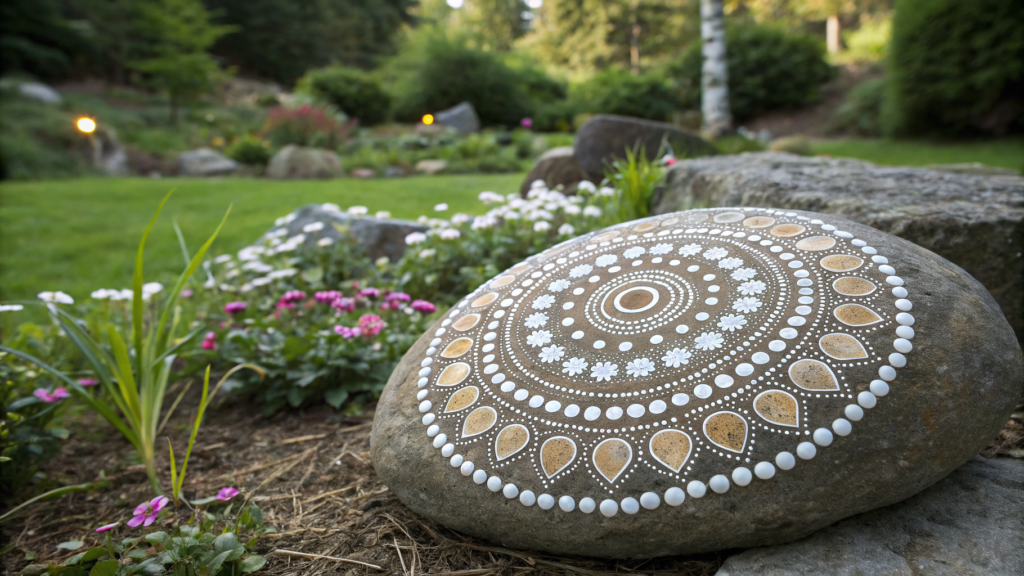
Sometimes, when everything’s just too loud — in life, in your head, in the house — I pick up a brush… and just start making dots. One after another. No plan. No goal.
That’s how our first mandala garden stones were born.
And it turned out to be way more therapeutic than I ever expected.
What is a mandala — in simple terms?
It’s not a religious symbol. Not just “art for the sake of pretty.”
A mandala is order in chaos. A center that radiates out in layers. Symmetry. Calm.
And when you create a mandala on a rock — especially for your garden — it’s like building a small island of structure in all that green flow.
What you’ll need:
- Smooth round stones — ideally about 4–6 inches (10–15 cm) in diameter
- Acrylic paints — white, gold, blue, green, black (or whatever colors speak to you)
- Dotting tools — or just wooden skewers, cotton swabs, dull pencils
- Base coat paint for the background (black or navy works beautifully)
- Sealant — we recommend Mod Podge Dishwasher Safe Gloss— holds up even in high humidity
How we paint mandalas:
- Prime the rock — coat it in a dark color and let it dry. Two coats is best.
- Find the center — you can sketch it with a pencil or just eyeball it.
- Start with one dot in the middle. Then build rings around it — clockwise or not, doesn’t matter.
- Work in layers. Move from the center outward. Change colors, dot sizes, tools as you go.
- Don’t rush. Don’t fix. Don’t compare.
That’s the whole point. Every dot is a quiet breath.
Where to place mandalas?
By your favorite seating spot: next to a chair, hammock, or on a stump.
In your herb garden — the contrast between the design and wildness is incredibly calming.
Or hide one in a tucked-away spot where nobody usually looks — let the mandala be for you, not the guests.
We have one placed right on the ground by a wild rose. You almost can’t see it. But I always know it’s there.
Studies confirm that meditative activities like dot-painting mandalas — along with regular interaction with nature (even in the form of garden crafting) — help reduce anxiety and improve mood.
It hits differently when you’re not just painting, but seeing that rock in your garden every single day.
It becomes an anchor of calm and grounding.
A few tips from us:
- First time? Use a stencil. A mandala template set really helps with symmetry.
- Don’t be afraid of mistakes. The garden accepts any design.
- Want your mandala to really pop? Paint it in colors that contrast with your plants — like white and blue dots on a bed of red mulch.
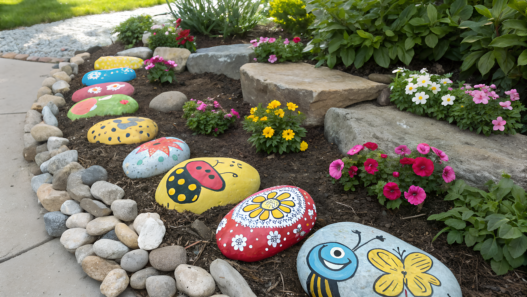
7. How to make ladybug-painted rocks
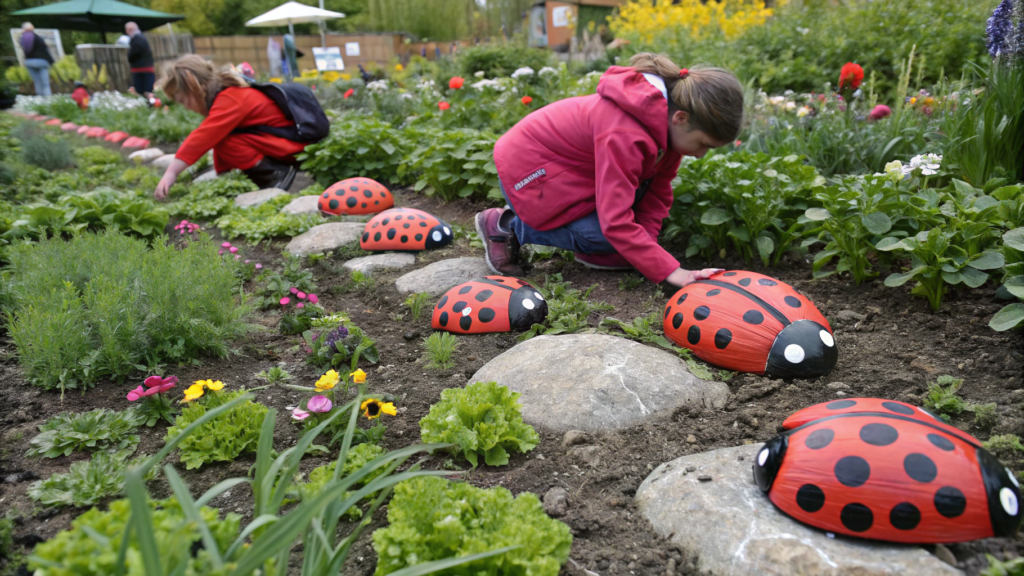
As a kid, I believed that if a ladybug landed on your finger, you had to make a wish.
These days, I just paint them. And every single time I do, I catch myself thinking:
maybe that wish was simply to be here — in this garden, right now.
Why ladybugs?
Because they’re so recognizable — even from a few steps away.
They’ve got a simple, almost cartoon shape, easy enough for a kid to paint.
Minimal colors, maximum vibe. They’re cute, always bring a smile, and they totally belong in a tidy, thriving garden.
Lindy and I once painted twelve and just “released” them into the veggie beds.
To this day, neighborhood kids come over to search for new ones. Sometimes they even pretend they’ve found a real one.
What you’ll need:
- Smooth, rounded rocks — oval works best, around 2–3 inches (5–8 cm)
- Acrylic paint: red, black, white
- Flat brush, detail brush, toothpick or dotting stick
- Sealant — a must! It adds gloss and protects from sun and rain
How we paint them:
- Wash and dry the rocks. Sometimes we sand them lightly.
- Paint them red — that’s your base. Let it dry.
- Add the black head — cover about ¼ of the top.
- Draw the center line — from the head down to the end.
- Dot the spots. A toothpick or cotton swab works great.
- Add the white eye dots — that’s when they come alive.
- Seal with 2 coats — wait 30–40 minutes between coats.
We place them right in the garden beds — between lettuce and carrots. Or along the edge of the path, like they’re crawling in a row. They look great in planters on the porch, too. Or in the kids’ area of the yard.
Sometimes I just tuck one under the mint bush — like it’s peeking out, half-hiding.
Ideas to expand on:
- Paint a whole family: mom, dad, little one.
- Add names — like Lara, Greta, Dotty.
- Make one in yellow or green — a “non-standard” ladybug.
- Glue a magnet to the back and stick it to metal planters.
Even the simplest garden decorations — especially the bright, playful, “alive” ones — grab attention, spark emotion, and pull people into the space.
They help kids feel like they belong in the garden.
And honestly? They give adults that same exact smile we all need — just as much as we need tomatoes.
Try it. And if you get hooked — go ahead and start an army. We’ve already got a whole battalion on patrol.
8. Rock snake path DIY
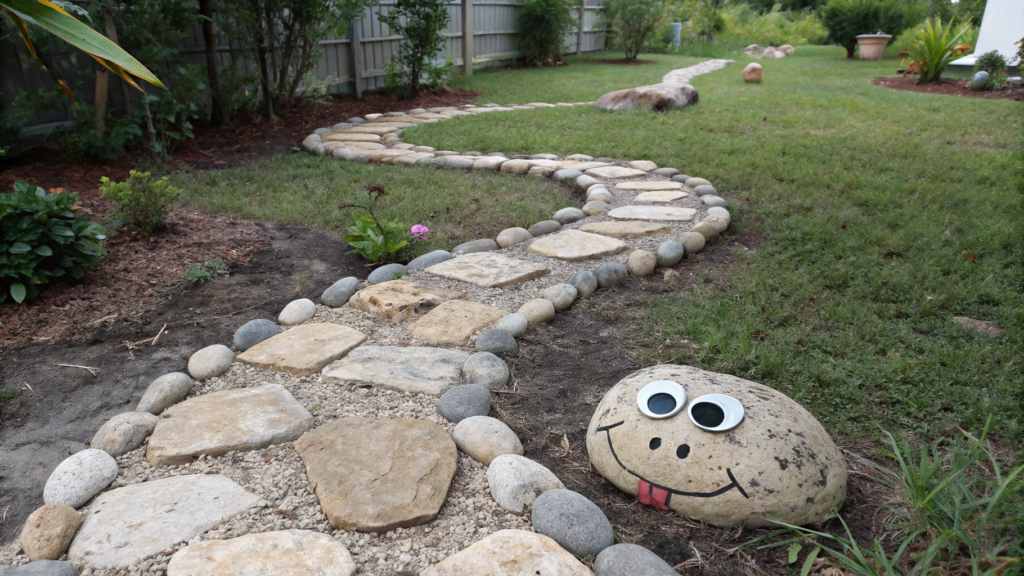
Some garden projects don’t need skills or special tools.
But they give you… well, let’s call it real emotional attachment.
A rock snake is exactly that kind of project.
We found about ten stones along the fence — not pretty ones, kind of weird shapes.
And we decided to just lay them in a line.
A week later, we had a six-foot snake. With eyes, spots, a tongue, and even a name. (Her name’s Selma).
What you’ll need for a rock snake:
- Stones of different shapes, but similar height (3–6 inches / 8–15 cm)
- Paint — anything you like, but don’t forget white and black for the eyes
- Weatherproof sealant
- Brushes
- Optional: paint markers, stickers, glitter, buttons!
- And a bit of imagination — to keep going after stone #5
How we do it:
- Pick a path. Let it curve a little — it’s a snake, not a train.
- Lay out the stones, starting with the biggest one — that’s the head.
- Paint eyes and a tongue — just two white dots with black centers, and a little red triangle.
- Each following stone is a scale. You can make them match or paint each one totally unique.
- Seal everything — we like using Rust-Oleum Painter’s Touch Clear, holds up great in garden weather.
That’s the magic of the snake — it grows. Every season you can add more “scales.” Guests, kids, neighbors — everyone wants to paint one.
Now it’s kind of a tradition: if you visit us — you leave a scale for Selma.
Where to place your garden snake?
- Along a garden path — like she’s showing the way
- In a gravel or mulch zone — looks especially striking
- In a kids’ corner of the garden
- Or next to a border you want to visually “soften”
By the way, if you build it from smooth pebbles without painting, you’ll get a minimalist version. Just as lovely — but totally different. Depends on your garden’s mood.
A garden snake isn’t just fun. It’s a way to keep the project open-ended. A visual story that grows with your space. And it helps kids (and adults!) feel part of the garden’s life.
Not “mom planted everything,” but “we painted scale number seven and named her Dory.”
This project needs no plan. No budget. It just appears — and lives its own life in the garden.
9. Color-splash pebble art for outdoor decor

Not every stone has to be carefully painted with eyes, wings, or dots. Sometimes — the more chaos, the more energy. Color splashes on pebbles are a way of saying: “I let myself play.”
And guess what? The garden loves it, too.
Worried you’ll overdo it?
You literally can’t mess this up. Color-splash is that one technique where there are no mistakes. Use brushes, flick paint with a toothbrush, drip from above, finger-smudge, or roll the stones right into the paint. And every single one turns out different.
We stepped outside after a rainstorm — our paint box and a bucket of pebbles were still on the porch. An hour later, we had a full tray of bright little dots.
Now they live between the sage and the dahlias.
Sometimes peeking out from the mulch. Sometimes just chilling on the edge of a step.
Wherever they show up — it’s instantly brighter.
What you’ll need:
- Small smooth stones — pebbles about 1–3 inches (2.5–7.5 cm) across
- Acrylic paints — all the rainbow colors. Especially yellow, turquoise, coral, and white
- Brush, old toothbrush, sponges, fingers — all fair game
- A tray or cardboard — to keep the mess off everything else
- Sealant — we use FolkArt Outdoor Gloss Sealer, great for uneven surfaces
How we make color-splash art:
- Lay the pebbles on a tray or cardboard — keeps your workspace clean
- Dip a brush and flick paint over them — you’ll get wild splashes
- Drop some color and blow through a straw — instant swirl
- Blend two colors directly on the stone — don’t worry if they mix. That’s the whole idea.
- Let them dry completely, then seal — glossy finish makes them look like they’re still wet, in a good way.
Where to place them?
- In containers with annuals
- Around the edge of a flower bed
- In porch planters — especially if your pots are plain and need a “mood buddy”
- As a mini path to your outdoor shower or pond
Or — arrange them into a geometric shape or gradient if you’ve got enough. We once made a rainbow circle around an apple tree in mulch. Turned out surprisingly beautiful.
Psychologists say that bold color accents in outdoor spaces boost visual perception and give your brain a kind of “anchor point.”
Especially useful in zones where nothing’s blooming yet.
Bright stones work like visual magnets — they pull the whole picture together, even if the garden’s just waking up.
Color-splash pebble art for outdoor decor is probably the easiest and fastest way to make your garden feel like it’s truly yours. Not perfect. But yours. With smudges, fingerprints and joy.
10. Hand-lettered stones for garden decoration

Some words stick in your heart longer than the flowers bloom.
And one day I thought — what if we let those words live in the garden?
That’s how our love for hand-lettered garden stones began.
Why is it so touching?
Because it’s deeply… human. No fancy shapes, no perfect forms — just a stone and a message. Sometimes it’s a plant’s name, planting date. Sometimes just: “You’re home.”
What you’ll need:
- Flat stones, anywhere between 2–6 inches (5–15 cm)
- Permanent marker — we recommend Sharpie Oil-Based Paint Marker— won’t fade or wash off in the rain
- Sealant — to protect the writing
- A general idea of what you want to say — to your garden, or to yourself
Lindy and I usually write straight onto the stone. No stencils. No prep. The letters may be a little wobbly — but that’s the charm. It’s your handwriting, not a font.
What to write:
- Plant names — especially helpful if you don’t have labels
- Short phrases: “Breathe.” “Grow slow.” “Summer always comes back.”
- Names: “Mom,” “Ollie,” “Lindy” — anyone who wants to leave their mark
- Or even a line from a poem (if the stone’s big enough)
Where to place your hand-lettered stones:
- At the base of a tree — like it’s guarding the words
- Right in the flower bed — as a living label
- On a step or by the greenhouse door
- Or tucked into some quiet spot — where one day, you just happen to look… and find a familiar phrase
A few tips from us:
- Worried about handwriting? Sketch it with a pencil first, then go over it with the marker
- You can use stencils — but honestly, don’t
The garden loves your hand, not perfection - Always seal it — especially if the marker isn’t rated for outdoor use
Hand-lettered stones for garden decoration are like planting not just a flower — but a thought. Not for anyone else. Just for you. To remember, smile and pause.
11. Sunflower Painted Rock for Flower Beds

Sometimes a flower bed just looks… dull. Not because anything’s wrong with it, but because it’s missing something. A little color. A little sun.
That’s why one day Lindy and I decided to try sunflower painted rock art. It was late summer, and the real sunflowers had already bowed their heads. And, as usual, I couldn’t quite let go of the season.
So I painted the first rock — bright yellow with a warm brown center. And since then, I paint another one every year. It’s kind of a tradition now — a little sunshine in every season.
What you’ll need:
- 1 flat oval rock, around 4–6 inches (10–15 cm) in size
- Yellow, brown, and orange acrylic paint
- Paintbrushes of various sizes — make sure you have a fine one for details
- Outdoor clear sealant, like Rust-Oleum Clear Enamel Spray
- Optional: white paint marker for writing messages like “Sunshine lives here”
How we do it:
- Wash the rock. Even if it looks clean — always wash it. Dust and oil will mess with your paint.
- Paint the center. A warm brown circle — doesn’t need to be perfect. We don’t even use a stencil — just a brush and a steady hand.
- Add the petals. Broad, bright yellow petals radiating from the center. Sometimes I add a bit of orange at the base to give it depth.
- Refine the details. Use the fine brush to outline, add little lines and veins.
- Let it dry. Overnight is best.
- Seal it with clear coat. Two coats, 30 minutes apart. Makes the paint last through the season and protects it from rain.
Tips from experience:
- The shape of the rock can vary, but ovals work best for keeping the petal layout balanced.
- Don’t worry about “imperfect” petals — they make the piece feel alive, not overly polished.
- A few rocks grouped together (in different sizes) look better than just one. We often place them in clusters along garden paths or at the edge of raised beds.
Sunflower painted rocks are a simple way to bring in bright, lasting light.
Even when the sky’s grey, your garden can still feel like summer.
12. Glow-in-the-dark Constellation Rock Art
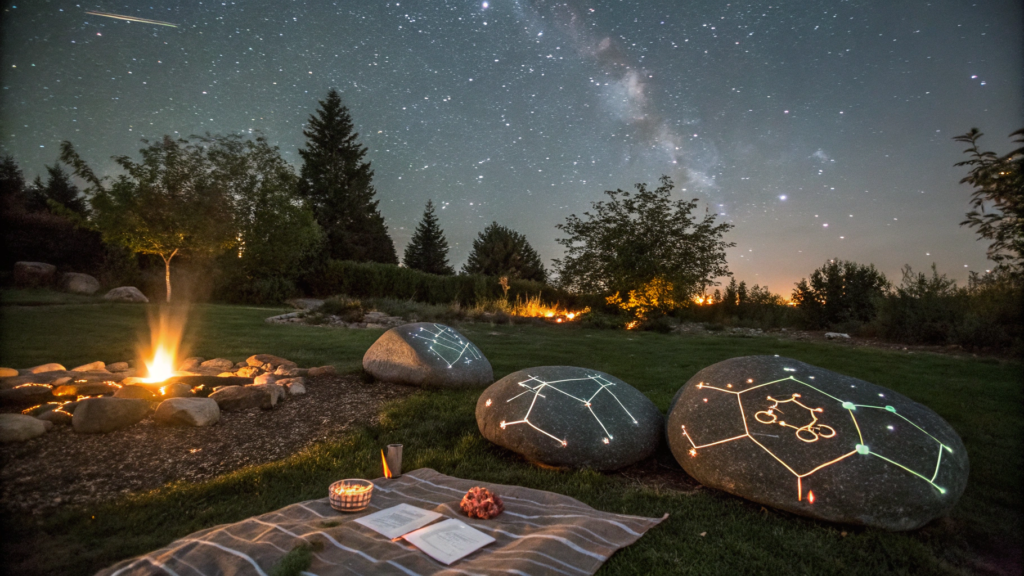
One summer night, we had a little picnic right in our garden. It was warm, quiet, and the sky above us was just unreal — the Milky Way, the North Star, constellations Lindy and I have known since we were kids.
Later that night, sitting by the fire, I thought: why not bring the stars down to the ground?
That’s how we ended up with glow-in-the-dark constellation rocks. Simple. But so striking — especially at night.
What you’ll need:
- Flat or rounded rocks, about 3–5 inches (7–12 cm)
- Glow-in-the-dark paint — we use FolkArt Glow Acrylic, it glows for up to 4 hours
- Black acrylic paint — to create a dark background
- A fine brush or a toothpick — perfect for making tiny star dots
- Clear outdoor sealant — helps the design last through weather
How we do it:
- Paint the entire rock black. This is your “night sky” — the base that will make the stars pop.
- Add star dots using glow-in-the-dark paint. Each dot is a star. A toothpick works surprisingly well for precision.
- Choose a real constellation — like Cassiopeia, Orion, or the Pleiades. Use a photo for reference.
- Sketch and connect the stars with a thin line if you want. We sometimes leave them unconnected for a scattered sky feel.
- Let everything dry overnight. Seriously — don’t poke it. Let the glow paint cure fully.
- Seal the rock with clear coat. Apply two layers, 30 minutes apart. The design will hold up against rain, heat, and foot traffic.
We’ve placed our constellation rocks along the path between the garden and the porch.
During the day, they’re nearly invisible. But once dusk hits and you’re walking out to grab something — they come alive.
Little glowing Pleiades, Cassiopeia, Corona Borealis… And more than once, I’ve caught myself just standing there, quietly searching for the Big Dipper on the ground.
Tips:
- Don’t know what constellations look like? Google them and draw them with a pencil before painting.
- It’s a hit with kids — they love finding “their” star cluster or making up their own.
- Create a whole galaxy by painting a bunch of rocks — we’ve scattered them all over the shady side of our yard.
Glow-in-the-dark constellation rocks aren’t just fun — they add something unexpected.
One quiet step on a glowing stone, and suddenly, your garden feels like it’s breathing with the night sky.
13. Mosaic-Style Pebble Mandala for Patios

If you’re craving something bright and calming at the same time — try a mosaic-style pebble mandala.
We have one now right on the patio, near the old garden chair. It turned out not just pretty, but surprisingly… addictive.
I started laying it out without much of a plan. Just dumped a bucket of colorful pebbles, crouched down — and it felt like someone flipped on my “meditation mode.” Half an hour later I had the center. Then a ring. Then another. And I didn’t want to leave — just keep going.
What you’ll need:
- Small flat pebbles, 0.5–2 inches (1–5 cm) in size, in various colors
- Outdoor adhesive (or cement if you want the mandala to be permanent)
- Metal ring or wooden frame — optional, for shaping
- Sealant or clear coat, if it will be exposed to the weather
How we do it:
- Choose the location. Works best on a flat surface — by the porch, patio, or deck.
- Clear the area. Pull weeds, remove rocks, level out the base — dirt or stone.
- Find your center. That’s where it all begins. We sometimes place one large stone in the middle — like a focus point.
- Start building the pattern. Ring by ring, color by color. There’s no right or wrong here. Just go with what feels good.
- Glue as you go. You can dot adhesive or spread it underneath — depends how permanent you want it.
- Let it dry. Usually takes a full day. Then seal it if your patio is uncovered.
Our mandala turned out about 18 inches (45 cm) wide. Not huge, but you see it right away when you step out for coffee.
And every single time I walk past it, I catch myself staring for just a second. Nothing fancy. But it’s beautiful. And made with our own hands.
Tip from experience:
If you want to see how your mandala will look after rain — wet the pebbles before laying them. When damp, the colors pop: gray turns slate, beige looks warmer, greens and reds come alive.
Now we toss our pebbles in a bucket of water first — and build straight from there. Makes choosing colors so much easier.
14. Painted Rock Cactus Garden
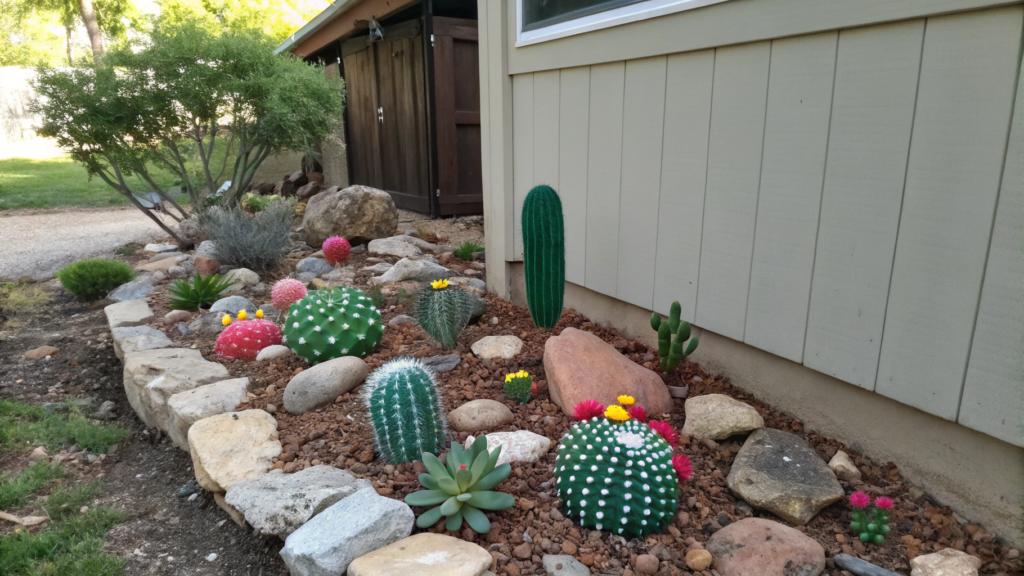
This is probably one of the most fun projects we’ve ever done.
It all started with a dry, shady corner near the shed where nothing would grow. Everything wilted. The soil felt like dust.
I half-joked that maybe we should plant cactuses there — only not real ones. Rock ones.
And within a day, our first cactus rock garden had “sprouted.”
The idea is simple: paint rocks to look like cactuses and arrange them into a little scene. No watering. No prickles. But it still looks like a tiny succulent patch.
What you’ll need:
- Smooth, elongated rocks in different sizes
- Green acrylic paint (multiple shades work best)
- White paint or marker for the needles and patterns
- Medium and fine brushes
- Outdoor-use sealant
- Optional: flat basket, ceramic pot, or shallow container
How we do it:
- Pick your rocks. The best ones are oval, chubby, and smooth — they naturally look like cactus shapes.
- Paint them green. Start with a base coat. Then add a lighter or darker shade on top to create some dimension.
- Add the details. Use white to draw spines, stripes, or dots. We mix it up — lines, zigzags, spots — the more variety, the better.
- Arrange your cactus garden. We usually place them in a basket with sand or gravel, sometimes mixing in one or two real succulents for contrast.
- Secure them if needed. If it’s going outside, you can glue them in place so they don’t tip over from wind (or a cat).
- Seal with matte clear coat. We prefer matte so the rocks don’t end up looking like plastic.
Tip. Add a few mini stones at the base of the “cactuses” — like little offshoots.
We always do that, and it makes the whole setup feel more natural. You can even stick a sign in there that says “No water needed!” — our guests always laugh when they see it.
Now we have these “pots” on the porch, on the greenhouse steps… They need zero maintenance, and yet they look like you’ve got a personal succulent garden.
Just one without the thorns.
15. Animal Footprint Stones for Garden Paths

When we built our first garden path, something just felt… off. It was practical, neat, gravel-lined, everything by the book. But honestly? It felt a little too perfect.
So one day, we decided to “mess it up.” Add a little playfulness. That’s when we laid down our first animal footprint stones.
At first, it was just a fun project for the kid. But somehow, that path stopped being just a shortcut between garden beds — and became a mini adventure trail.
What you’ll need:
- Flat round or square stones (6–10 inches / 15–25 cm)
- Outdoor acrylic paint — we use FolkArt Outdoor Acrylic
- Black or dark brown paint for the footprints
- Sponge brush or stiff bristle brush
- DIY stencils (cardboard, plastic folders — anything works)
- Clear fixative spray — Rust-Oleum Clear Enamel holds up great
How we do it:
- Paint the base color. We go for something earthy — tan, brown, warm gray — so it blends into the path naturally.
- Place the stencil. We made ours by cutting animal tracks out of old plastic folders. So far we’ve got: cat, dog, chicken, duck, raccoon — even a moose.
- Dab with a sponge. Instead of using a brush, we dab paint on with a sponge or stiff brush. It gives the footprint texture — like the animal just stepped in mud.
- Add small details. Claws, scratches, double prints — if you want it to look more real.
- Let it dry and seal with spray. Especially important if the stones will be set into gravel or soil.
Tip. If you want the prints to feel more natural, don’t lay them in a perfect line.
Leave uneven gaps, vary the angle — like the animal was walking and changing pace.
And if the path winds a little instead of going straight? Even better. Looks like something just ran right through the garden.
16. Mandala Rock Art for Garden Centerpiece

We made our first rock mandala totally by accident. It was a hot Sunday, and we just didn’t feel like going anywhere.
I dumped a bucket of small stones on the table near the porch, grabbed a couple of brushes — and started painting a circle. Then another. And before I knew it, I’d forgotten about my phone, the pot on the stove, even my garden gloves — still lying on the steps.
Now that mandala is the centerpiece of our garden. It sits in a round patch between the flowers, and every season its surroundings change: tulips in spring, zinnias in summer, sunflowers in the fall. But the mandala stays at the heart of it all.
What you’ll need:
- Flat stones, 2–4 inches (5–10 cm)
- Outdoor acrylic paints — we like FolkArt Outdoor Acrylic
- Thin brushes for detail work
- A palette of 3–4 colors — we love ochre, white, deep blue, and turquoise
- Rust-Oleum Clear Enamel Spray for sealing
- A circular base — an old flowerpot lid or a wooden round works great
How we do it:
- Sort the stones. Look for ones with similar thickness, but different shapes — rounds, teardrops, ovals. The variety gives your layout rhythm.
- Find the center. Usually, we place the most noticeable stone here — you can paint a symbol or a focal point on it.
- Paint the base. We start with a light background — gray, sand, or white — to make the colors pop.
- Build the pattern. Work outward from the center. First ring — dots. Second — teardrops. Third — spirals or diamonds. Don’t overthink symmetry — it finds you once you’re in the flow.
- Add color accents. We usually pick one bold contrast color — like turquoise against ochre and white. It gives depth.
- Air dry. Preferably in the shade, so the paint won’t crack in the sun.
- Seal with clear spray. Two coats, 30–40 minutes apart. Don’t skip it — this mandala will be in full sun.
Tip. If you want your mandala to truly feel like the garden’s heart, surround it with plants.
We once planted a ring of marigolds and silver wormwood around ours — and that’s when it came alive. The stones started to look like jewels in a green frame.
Now, whenever someone asks where the center of our garden is, we just point to the mandala.
It’s not loud. Not flashy. But everyone who sees it pauses for a few seconds — and slowly walks around it. And maybe that is the whole point.
17. Ladybug Painted Rocks

If there’s one thing in our garden that always gets the same reaction, it’s the ladybugs.
Everyone who spots one on a rock or peeking out from the grass immediately says, “Oh my gosh, how cute!”
And that’s exactly what makes ladybug painted rocks perfect for any garden.
These little beetles… they’re everywhere: by the roses, near the steps, between the lettuce and spinach, at the edge of the raised bed.
Small, round, red — and somehow alive, even though they’re just painted stones.
What you’ll need:
- Small rounded rocks (2–3 inches / 5–8 cm)
- Red, black, and white acrylic paints — we like Apple Barrel Acrylic Paint Set
- Thin brush or marker for details
- Matte outdoor sealant (Rust-Oleum Clear Enamel works great)
How we do it:
- Pick the rocks. We go for small, rounded ones — slightly flattened, easy to hold in your palm. Sometimes we find them right on the path to the woods. One had a tiny chip on the side, and he became the “old grandpa” of our ladybug crew.
- Paint the base. Cover the whole stone in bright red acrylic. One coat is usually too light. The second makes it rich, like fresh strawberries.
- Add the head. A simple black half-circle on the narrow end of the rock. It’s the ladybug’s “face,” and it suddenly brings the whole thing to life.
- Draw the center line. We take a thin brush and carefully split the “back” in half. This one detail turns it from “a painted red rock” into a bug with personality.
- Add the dots. You can do a bunch, or just a couple. Don’t aim for perfect symmetry. We like when one ladybug has two spots, another five, and one has none at all. They each have their own character.
- Paint the eyes. White circles, tiny black pupils — and now it’s looking right at you. Sometimes up, sometimes sideways.
- Let it dry, then seal. We use a matte finish so it doesn’t look like a plastic toy. Two coats, with a short break in between.
Tip. To make sure your ladybugs stand out, place them near muted tones like gray rocks, mulch, or wood borders.
We also like to hide them in fun places: in a flowerpot, on the porch, behind a stump.
Even adults find themselves smiling when they spot one by surprise.
Last year we lined up a full “family” of 12 ladybugs along the path. In the morning, there were only 9. Three had “run away.”
Turned out our son had taken them inside and tucked them under his pillow — just because they were “nice.” Guess that’s our version of quality assurance.
18. DIY Rock Snake Path

Sometimes a garden just needs something playful.
Not more beauty. Not more symmetry. But something goofy, cheerful, a little childlike.
And if you’re craving that kind of joy — a rock snake is exactly what you need.
Our first one slithered out near the basil bed. Then another showed up near the sandbox.
Now these snakes are everywhere on our property: behind the shed, along the terrace, even one curled up by the compost pile — and stayed there.
It’s the perfect project: low cost, great for families, no need to mimic nature or obsess over form. Just fun and color.
What you’ll need:
- Dozens of rocks in different sizes (3 to 7 inches / 8–18 cm)
- Acrylic paints — bright ones! (We love Apple Barrel Acrylic Paint Set)
- Medium and fine brushes
- Black and white markers or paint for details
- Outdoor sealant
- Optional: googly eyes, tongue made from fabric or twine
How we do it:
- Gather the rocks. We walk down to the stream and grab anything that looks like a segment — small, medium, large. The first rock is the “head,” so go a little bigger.
- Pick your colors. We go full rainbow: blue, green, orange — like candy. Or do a monochrome snake: shades of teal, all in green, whatever fits your vibe.
- Paint by segments. Each rock is a body piece. Sometimes we add dots, waves, stripes — but keep it fun, not chaotic.
- Add the face. Eyes, a smile, maybe even eyelashes. One of ours has fangs and guards the greenhouse.
- Lay it out on the ground. Place the rocks like a snake crawling through grass. Don’t go in a straight line — curves and wiggles make it come alive.
- Seal with varnish. Especially if it’ll stay outdoors. We like Rust-Oleum Clear Enamel — holds up really well.
Tip. Want your snake to feel real? Make it bend around a raised bed, hug a tree, or peek out from behind the house.
And definitely add a tongue — we dip a scrap of twine in red paint and glue it under the “mouth.” Tiny detail, big personality!
We even once held a neighbor competition: Who could build the longest snake?
A little girl won with 74 stones. And now her snake still lives in their yard — one of many slithering along the block. Not planned. But so, so fun.
19. Colorful Pebble Art for Garden Mulch
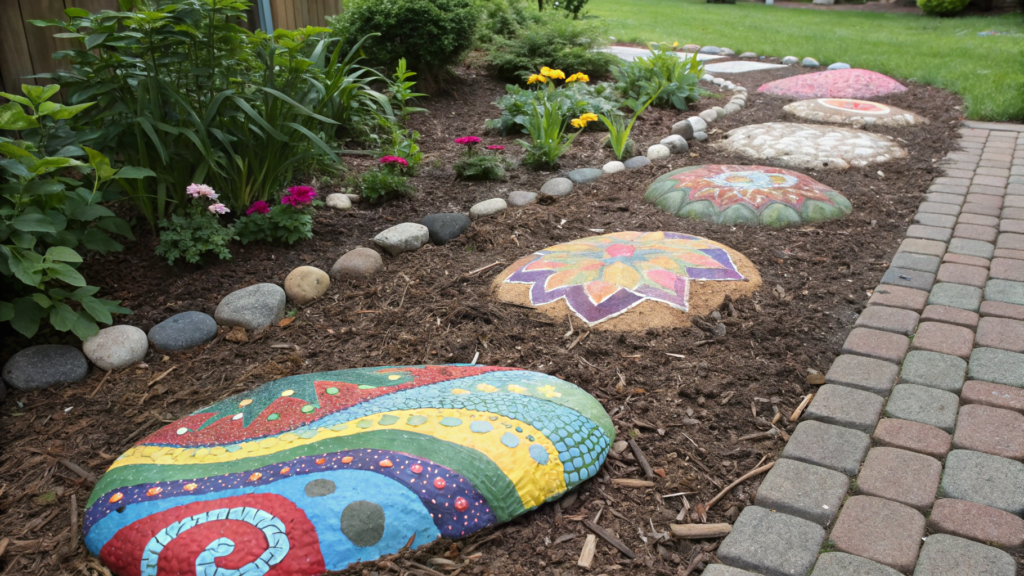
One day while refreshing our garden mulch, I stared at that brown layer and thought: “Why does it all look the same?”
Sure, mulch is practical — holds moisture, blocks weeds — but visually? Just a backdrop.
We wanted color. Something with energy. So we tried swapping mulch for bright, patterned pebble zones — waves, puddles, even abstract art. Not for symmetry. Not for rules. Just play.
What you’ll need:
- Small pebbles (0.5–2 inches / 1–5 cm) — natural, white, or colored
- Acrylic paint that sticks to stone (FolkArt Outdoor Acrylic Paint is great)
- One big brush + a few smaller ones
- Plastic trays or a tarp — for drying
- Clear varnish (optional, for longer-lasting color)
How we do it:
- Wash and sort. We batch our pebbles — by size and color. Lay them out in trays or boxes.
- Paint your palette. Choose a color theme (blues and teals? rainbow?) and layer bolds with accents. We use 3–4 main colors and add a pop of contrast.
- Dry outdoors. On a tarp in the shade works best. If it’s humid, a little sun helps — but don’t overdo it or the paint may crack.
- Seal with varnish. Only if you want it to last past one season. We sometimes skip this and just repaint in spring.
- Lay it out. Use the pebbles to form “pools” in mulch — around shrubs, along beds, near paths. Don’t aim for perfection. Slight messiness makes it look natural and full of life.
Tip. If you don’t want your pebbles sinking into the soil or getting in the way — frame them.
We use flat border stones or low wooden edges. It keeps the color contained and the garden looking tidy.
Now we’ve got pops of color in all kinds of places: under bushes, near the apple tree, beside the garden bench.
And the best part? They shine in early spring and late fall when greenery is scarce but color still matters. Bonus — weeds barely stand a chance through these pebbles.
20. Hand-Lettered Garden Stones
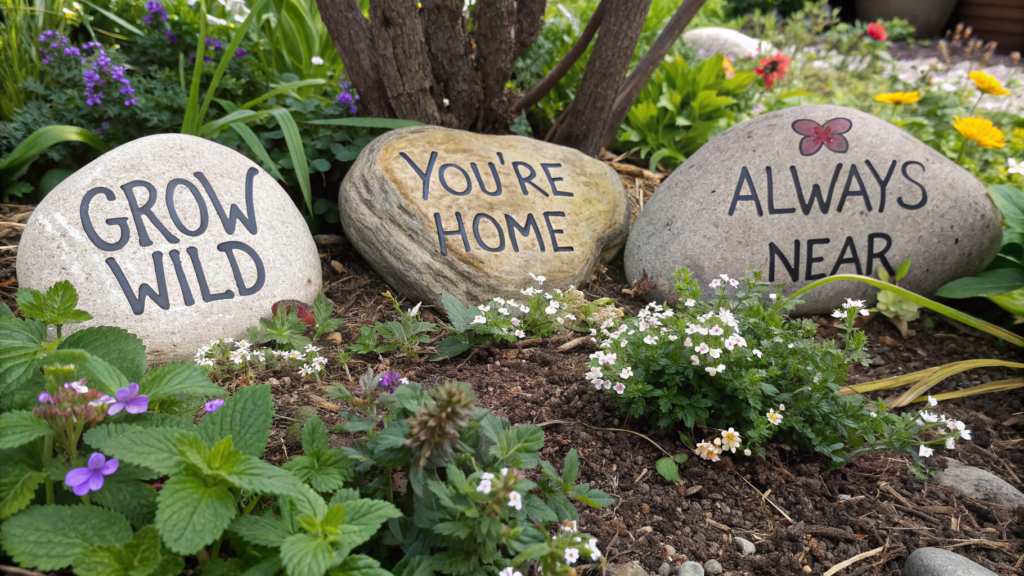
Some words stick in your mind longer than flowers in a bed.
“Grow wild.”
“You’re home.”
“Always near.”
We used to write little notes like that to each other — me and Lindy. Then one day, we started writing them on stones. And it turned out the garden is the perfect place for words.
Hand-lettered garden stones aren’t just a visual detail. They’re a feeling. Something personal. Something that speaks; you want to whisper again — standing near the dill, or walking past the mint.
What you’ll need:
- Flat stones (4–8 inches / 10–20 cm), preferably smooth
- Oil-based permanent marker — we use Sharpie Oil-Based Paint Marker
- White, black, or gold paint — depending on the stone color
- Matte outdoor varnish
- A little inspiration — what do you want to tell yourself and your garden?
How we do it:
- Find a “speaking” stone. Not every rock wants to be written on. We look for the one you want to rest your hand on. Sometimes it just “asks” to be marked.
- Clean and dry. No dust, no moisture — or the marker will slip and the paint won’t stick.
- Choose the words. Sometimes it’s the plant name. Sometimes it’s personal. “I feel calm here.” “Hi, Earth.” “You did it.”
- Write by hand. No stencils. No measuring. Uneven? That’s the point. One time, my “O” tilted sideways — and it looked like a grin. That became my favorite stone.
- Let it dry. Especially with oily paints — don’t rush. Overnight works best.
- Seal with varnish. Just one thin coat. We like it when the text blends into the rock — not shiny, just present.
Tip. One message per stone. Don’t try to cram in too many words. A thought, a phrase — that’s all. If you’ve got more to say — make a series. We place them like stepping stones along a bed or by the stairs. Each one — a step.
One of our very first stones still sits in the lavender patch. It just says: “Wait.” And every time I rush past or feel anxious, it catches my eye — like a quiet reminder: It’s okay. Just wait.
Stories in Stone
We hope you found at least one idea here that feels like yours. Or maybe a bunch.
Some are perfect for kids; are made for a quiet evening with a paintbrush and a cup of tea; you can pull off in an hour, others might become your summer-long project.
We’d be so happy if you told us in the comments which one you liked the most. Or even shared a photo of something you’ve already made.
Lindy and I love reading comments like that — they inspire us just as much as trying a new paint trick on a stone for the first time.So grab a brush, find that one rock — and let a new little story appear in your garden.