An open pergola is great… until the rain starts. Or the blazing sun hits hard. A covered pergola turns your backyard, terrace, or rooftop into a real extension of your living space. And every little detail — from the transparent roof to the flowy curtain panels — works not just for style, but for comfort.
In this article, I’ve gathered ideas to help you plan a stylish and practical covered pergola — whether you’re building it for a wedding, for cozy family dinners, or just want a little privacy from the neighbors up on the rooftop.
We’ll cover how to attach a roof without messing up your home’s exterior, what materials to choose, how to light it up without losing the shade, and what to do about rainwater drainage.
1. Attaching a pergola roof without damaging the house

Pergolas attached to a home can look like they’ve always been there. But no one really wants to drill into the siding of their freshly painted house just to mount a few beams.
Especially when we’re talking about stucco, vinyl siding, or a modern façade — not to mention that any hole you make is a potential leak.
Thankfully, there are ways to build a covered pergola roof without drilling into your house wall. We’ve done it ourselves on an old farmhouse where every hole in the wall was basically a water invitation. So here’s what worked best:
So how do you avoid drilling into your wall?
- Use a post right up next to the wall. Instead of anchoring the pergola directly into your house, you place an extra vertical post just a few inches away from the wall.
The upper beam looks like it’s attached, but it’s actually supported by posts. This method is especially smart if you don’t want to risk your wall’s waterproofing. - Leave a small gap + build a floating roof. If you want your pergola roof to “hover” close to the house but not touch it — leave a 1–2 inch gap.
That’s what we did on our summer kitchen. The roof snuggled up close, but didn’t actually touch the wall. No rain comes in, but the wall stays safe and sound. - Use an aluminum mounting profile. This is super handy if you’re using polycarbonate or metal panels.
You can install a special mounting profile on a wooden beam instead of drilling the wall — then slide the roof panels into it. The Suntuf Polycarbonate Side Ridge is a great option for sloped pergolas. It gives a watertight connection without ever touching the house.
Why is it better not to drill into the wall (if you can help it)?
- Every single hole is a leak risk. Even with sealant.
- You might void your siding or exterior finish warranty — especially in new builds.
- And if your home has modern lines or beautiful natural wood siding… well, let’s not mess with the aesthetics.
Some lessons we learned the hard way:
- If you do end up attaching to the wall, use proper anchor bolts with gaskets — not just screws. They create a waterproof seal between your beam and the wall.
- Don’t skimp on caulk! We use Gorilla Waterproof Caulk & Seal (10 oz / 295 ml).
- Always slope the roof away from the house, so water flows off, not onto the wall.
In the end, you get a pergola that looks like part of the house, but doesn’t cause leaks, siding issues, or warranty problems. Which means you can enjoy your coffee under the cover without worrying about surprise repairs down the line.
2. How to Turn a Covered Pergola into an Open-Air Dining Room

Sometimes all it takes is a roof overhead for a whole new room to appear in your backyard or on your terrace. Not just a shady spot — but a full-on summer dining room, where you can eat, work, host guests, or light some candles for a dinner under the stars.
And a covered pergola is the perfect way to create that space. You just need to style it right.
What do you need to create that “outdoor living room” feel?
1. A large, sturdy dining table.
Nope, plastic won’t cut it. And even a fold-out table is just a temporary fix.
You want a heavy, beautiful table — something made of wood or metal that can anchor the whole space.
We love this Acacia wood dining table for its durability and rich look. It can easily handle rain, sun, and even sudden temperature drops.
2. Hanging lights — but skip the chandelier.
Too much brightness can kill the vibe. Instead, hang low pendant lanterns on a cord or string up some warm LED fairy lights. They’re cozy, atmospheric, and energy efficient. Bonus points if they’re on a timer.
3. Chairs you actually want to sit in.
A lot of outdoor chairs are… punishment. Hard, slippery, and stiff.Instead, go for wicker chairs with cushions or outdoor armchairs with soft padding. You can always swap out the cushions, but comfort is what makes a dining room truly a dining room.
4. Textiles and small details.
A linen tablecloth. A throw draped over a chair. A jar of wildflowers or a few candles.These aren’t must-haves, but they bring your space to life. If you’re worried about rain, use outdoor polyester fabric — it looks great and doesn’t mind getting wet.
A few extra touches that take your pergola dining room to the next level
- Add a big planter with herbs nearby — basil, mint, rosemary. It’s not just pretty, it smells amazing while you eat.
- Install a side curtain panel on one side — it blocks sun and gives the table a sense of intimacy.
- Put a low shelf or rolling cart next to the table — perfect for drinks, plates, or lanterns. It makes hosting way easier.
A covered pergola plus a solid table is all it really takes to create an open-air dining room you’ll want to live in.
And trust me — a simple garden veggie pasta tastes way more magical when you eat it outside, under a warm summer sky.
3. Choosing a Transparent Polycarbonate Roof for Brightness

A transparent polycarbonate roof keeps you dry without blocking out the sunshine. It’s perfect for pergolas that face north or sit under trees — when every bit of sunlight counts.
We first noticed this option when we were searching for something lighter than a solid roof. We didn’t want to turn the yard into a dark storage shed — we wanted something that felt open and airy.
What does polycarbonate give you?
- Lets in up to 90% of sunlight (depending on thickness and finish)
- Blocks UV rays, especially when you choose panels with a protective coating
- Lightweight, so your pergola structure doesn’t need to be extra reinforced
- Resists hail, rain, rot, and time — no need for complicated upkeep
Which type of material should you choose?
- Solid polycarbonate — it looks like glass but is way lighter and stronger
- Twinwall polycarbonate — more affordable, holds heat better, but gives a slightly hazy look
What to pay attention to during installation:
- Install panels with a slope, so rainwater can drain easily
- Use rubber gaskets and washers to keep moisture from sneaking in
- Seal the joint between the pergola roof and the house wall with something like waterproof caulk to protect the siding
If you’re looking for something reliable and easy to use, check out Suntuf Polycarbonate Panels, 6mm, UV Protected, Clear. These are lightweight, UV-protected, and easy to install on sloped or flat structures.
Tip. If you want less heat at noon, go for tinted panels. They don’t block too much light, but they do create a nice soft shade.
A roof like this is a dream setup for an outdoor kitchen, morning coffee zone, or even a little greenhouse with a chill-out space underneath. It’s bright, dry, pretty — and you won’t even need lights on gloomy days.
4. Decorating a Wedding Pergola Using Florals and Fabric

A covered pergola can easily become your perfect wedding arch — even if you’re hosting the event right in your backyard. It already has the shape, the structure — all it needs is a little mood. Want a classic pastel-toned ceremony? Or a boho-chic look with dried flowers and linen? Totally doable.
Just remember: the decor should match the surroundings. If there’s a rose bed nearby, don’t go wild with tropical orchids. Let the decor echo what’s already there.
What can you use?
- Fabric — ideally light and flowy: voile, muslin, organza
- Fresh flowers — roses, hydrangeas, eucalyptus, lavender
- Artificial garlands — for more durability and peace of mind
- Ribbons, tassels, linen — perfect for boho or rustic themes
- Hooks, clips, cords — to keep everything in place
- Floral wire and tape — to secure bouquets and live arrangements
- LED string lights — for that evening magic
How to do it
1. Prep the structure. Make sure the pergola is clean, dry, and stable. If the pergola roof is already installed, you can attach the fabric underneath it — this adds depth and shadows to the whole look.
2. Attach the fabric. Wrap the posts or beams, create soft drapes, or hang curtains. It’s key to secure the fabric in several places — especially if there’s a breeze. Use metal clamps that hold well without tearing the material.
3. Add floral accents. Start with key “anchor” bouquets — on the corners or at the top. If you’re using fresh flowers, keep them in wet floral foam or tubes. You can layer garlands or wreaths on top of the fabric.
4. Blend styles. Don’t be afraid to mix fresh and faux florals, add greenery, dried stems, or even a few sprigs of rosemary — it smells amazing and looks beautiful.
5. Photo check. Before the ceremony, take a few test photos of the pergola. Make sure the whole setup looks dimensional, balanced, and doesn’t disappear into the background.
What not to forget
- Always keep an extra roll of floral wire, clips, and tape with you — better safe than scrambling last minute
- If the fabric is too long, don’t cut it right away. Fold or tie it off — you might want to keep it as a keepsake
- Avoid decor that crumbles or falls apart easily in the wind (like loose petals with no structure)
- Ask a guest or bridesmaid to keep an eye on the setup before the ceremony starts
We decorated our friend’s pergola for her backyard wedding once. It was July, blazing hot, and the fabric felt like it was melting in our hands. But when we finished — that simple wood frame turned into a glowing altar. We added sprigs of lavender and soft fairy lights, and it felt truly magical.
And you know what? The budget was tiny — but the result was stunning.
5. Installing LED Lighting into a Pergola Roof

As the sun sets, it’s the lighting that turns your covered pergola into a truly inviting space. A well-lit pergola roof means you can read at the table, enjoy dinner with friends, or just soak in the evening air — without reaching for your phone flashlight.
And in this game, LEDs win every time.
Why go with LED?
- They’re energy-efficient. Even if you leave them on all night, your electricity bill won’t go crazy.
- They barely get warm. That’s key when dealing with wood and fabric structures.
- They’re super versatile. From tiny spotlights to flexible strip lights you can hide inside beams.
What do you need?
- Waterproof LED strip (look for an IP65 rating or higher)
- Outdoor-rated power supply
- Mounting gear: plastic clips, silicone holders, or self-adhesive backing
- Dimmer or controller, if you want to adjust brightness
How to do it
1. Decide where you need light. Over the dining table, around the edge of the pergola roof, or maybe a “starry night” ceiling with spotlights? It all depends on how you plan to use the space.
2. Run the cable cleanly. Try to follow the beams, tucking wires inside or under slats. No messy dangling cords.
3. Protect the connections. Use sealed connectors, or wrap joints with electrical tape and slide on a silicone sleeve for extra waterproofing.
4. Add a dimmer. You’ll love being able to switch from bright dinner lighting to cozy evening glow.
Safety tips for LED installation
Working with electricity — even outdoors — means staying smart. Especially when your setup includes wooden beams, fabric canopies, and unpredictable weather.
Here’s what matters most:
- Only use waterproof strips and fixtures, rated IP65 or higher. That means they can handle both rain and dust.
- Power should come from a weather-protected outlet with a covered box. No outdoor plug? Call an electrician — don’t DIY this part.
- Wire joins and controllers should be inside sealed outdoor boxes — you can find these at any hardware store.
- Secure all cables properly, so they don’t sag or end up within reach of kids or pets.
- If you’re using multiple LED strips, don’t plug them all into one socket — it could overheat the power supply.
LEDs are a fantastic choice, but even the safest lights need smart setup. Do it right once — and then just hit the switch and enjoy the glow.
6. Building a Covered Pergola on a Rooftop Terrace

A covered pergola on a rooftop isn’t just a hangout spot — it’s a full-on outdoor room under the sky. But from a technical point of view, it’s not the easiest DIY. Especially if you want to avoid damaging the roof’s waterproofing or adding too much weight.
What to check before you start
Before you drill a single screw, check the weight limits of your rooftop. Different buildings and surfaces have very different tolerances. It’s best to play it safe and ask an engineer — or dig into your building’s documentation.
And yep — never drill directly into the membrane! Even one wrong screw can turn your terrace into a ceiling leak nightmare.
What materials work best
- Lightweight aluminum or pressure-treated 2x4s
Weight is the enemy here. Instead of heavy timber, choose dry wood or metal framing. - Ballast-mounted framing (no drilling!)
Use concrete blocks or large planters to hold the structure down. This avoids puncturing the roof and saves you from red tape with your HOA or building management. - Waterproof padding
If you have to rest anything directly on the surface, use thick rubber pads or EPDM sheets to protect the membrane. - Modular or removable roof panels
Polycarbonate, fabric, or even slatted wood — go for something light and easy to remove if a storm hits.
How to build it
- Build the frame off-roof. Make sure every post is standing perfectly straight and the weight is evenly distributed. A flat or gently sloped roof design is ideal — less stress on the surface.
- Use ballast weights at the base. Concrete pavers, weighted planters, or special ballast mounts all work to keep it grounded.
- Add braces or guy wires for wind. Wind is way stronger on rooftops. Your pergola needs to feel anchored and solid — especially if it has a roof.
- Install a lightweight roof. Think polycarbonate sheets, grommeted canvas, or treated slats — anything that won’t become a giant sail in a gust.
Smart rooftop tips
- Fabric canopies work great on tensioned cables — they block sun but reduce stress on the frame.
- Keep it simple — less weight, less risk.
- Think about drainage — even a tiny roof needs a water exit plan.
What about rain?
A pergola roof gives you cover — but also responsibility. Rain shouldn’t pool up or spill down right onto your table.
- Add a slope. Doesn’t matter if it’s fabric or plastic — even a 5–10° pitch helps water move in the right direction.
- Plan drainage. Let runoff flow to the far edge of the terrace, ideally into a drainage zone like a scupper, drain trough, or pipe leading to the edge of the roof.
- Add a rain barrel or container. Want to collect water? Easy — just capture the flow at the edge.
- Fabric needs a slope too. Flat cloth will sag and flood. Always tension it or angle it slightly.
You don’t have to pick just one of these — you can mix and match solutions. The goal: let water out, keep yourself dry.
We used to have nothing but blazing sun and bare tile on our rooftop. Just a sad umbrella that flew away with the first breeze.
Then we added a small pergola with a transparent roof, hung a few curtains, set up a bench — and suddenly it was a room.
Now it’s our favorite place for morning coffee and quiet evenings. Just a simple structure, but it changed everything.
7. Creating a Sloped Pergola Roof to Drain Rainwater

The slope of your covered pergola roof might seem like a “minor” detail — until it rains. Then it suddenly decides whether you stay dry… or end up dealing with water pooling, mold, and rotting wood.
Why a roof slope matters
Because rain needs somewhere to go. Even if you’re using waterproof fabric or clear polycarbonate, water will collect without a proper slope — and that leads to:
- sagging roof panels
- dirty stains and moss buildup
- wood decay or structural damage
What’s the ideal roof slope?
Minimum: 1 inch per foot of roof length (about an 8.3% incline).
So for a 10-foot-long pergola, you need at least a 10-inch height difference between the rear and front beams (about 25 cm).
If you live in a rainy area, go even steeper. Bigger pergola is more slope.
How to build the slope
- Use uneven post heights
For example: rear posts = 8 ft, front posts = 7 ft — simple and effective. - Adjust existing flat roofs
If your pergola is already built, you can add slope using angled rafters or shims under the roof mounts. - Angle the panels themselves
With polycarbonate sheets, it’s common to tilt them directly during installation — so water flows to the back or sides.
Where does the water go?
A sloped pergola roof is only half the job — you also need to plan for drainage, especially on a deck or rooftop.
Here are 3 simple DIY-friendly drainage options:
- Let it run to the far edge. Direct the slope toward a clear corner of your terrace or yard, away from furniture and garden beds.
You can place a decorative rain barrel or stone trough to prevent splashing or tile damage. - Build a gravel strip or drainage trench. On rooftops or paved patios, dig a narrow trench near the roof’s edge, filled with gravel. Water quietly disappears without flooding the surface.
You can even connect it to your home’s rainwater system via a scupper, flexible pipe, or gutter. - Install a mini gutter system. If you already have downspouts nearby, install a gutter under the roofline, just like a porch. Then run a pipe downward — neat and clean.
Tip. Don’t let fabric roofs sag! If your pergola uses fabric covers, watch out for “puddling pockets.” Take them down during winter or rainy seasons — even a small sag can become a soggy disaster.
We once visited a rooftop café during a city tour. The pergola looked basic — just a sloped polycarbonate cover — but in one corner sat a large clay bowl.
Turns out, the café owner used it as a “stylish rain catcher”. Water trickled down one corner, landing in the bowl — no splashes, no mess, no leaks.
And it worked like a charm.
8. Using Curtain Panels in a Covered Pergola for Privacy
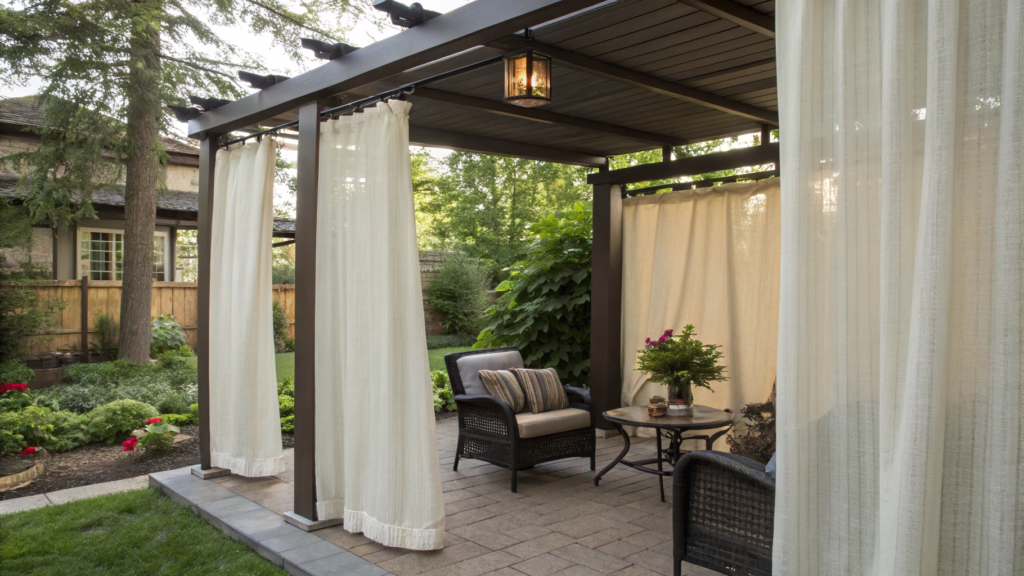
The easiest way to add privacy and atmosphere to your covered pergola? Hang fabric curtains.
You don’t need much — just a couple of panels on one side can completely change the mood.
Suddenly, it’s not a “grill corner” anymore — it’s an outdoor living room where you can read, nap, or sip tea in your bathrobe.
What to Use
- Outdoor curtain panels — look for water-repellent and UV-resistant options
- Curtain rods or stainless-steel cables — stretch them between pergola beams
- Clip rings or grommets — for easy hanging and smooth sliding
- Magnets or bottom clips — to keep curtains from flapping in the wind
How to Do It
- Choose your privacy zones. Usually, that’s one or two sides — the ones facing neighbors or getting strong wind.
- Stretch a rod or cable between beams. A stainless steel cable is best — it holds tension and won’t sag over time.
- Hang your curtain panels. You can use grommet-style panels or hang with clip rings.
Make sure they slide easily — so you can open them in the day, then close them for privacy or shade. - Add magnets at the bottom. Especially helpful if your pergola is open-sided — this keeps the fabric from blowing around or slapping in the wind.
Extra Tips
- Use double panels on corners — they create a curtain-like vibe even when left partially open
- If you’re worried about fading, go with neutral shades like light gray, cream, or dusty green
- For added privacy and texture, hang a woven bamboo screen behind the curtains
Curtains can completely shift the vibe of your pergola — no drilling, no rebuilding.
One day it’s light and breezy, the next it’s cozy and shaded — and it only takes 30 minutes and a few clips.
9. Mounting a Ceiling Fan Inside a Covered Pergola

A ceiling fan in a covered pergola isn’t a luxury — it’s comfort, style, and real functionality.
What You’ll Need
- Outdoor-rated ceiling fan — only these are safe for outdoor use
- Power supply — run from your house or through an outdoor-rated conduit
- Mounting bracket — usually included, but make sure it fits your beam
- Weatherproof box and sealed wire connectors — for safe outdoor wiring
- A licensed electrician (sometimes) — if you don’t plan to run the wiring yourself
How to Install It
- Choose the right fan model. Look for a fan marked “Damp Rated” or “Wet Rated” — only these are built for outdoor use.
- Attach the mounting bracket to a ceiling beam. If your pergola roof is wood-paneled, just locate a structural beam and install it there.
Make sure the beam can support the weight — usually between 12–20 lbs (5–9 kg). - Connect the power. If you’re doing it yourself, use a weatherproof cable and run it through an exterior conduit.
All connections should go inside a sealed junction box to keep moisture out. - Hang the fan and check its balance. It should hang straight and level. Once it’s on, there should be no wobble or vibration.
- Decide how you’ll turn it on. Some fans use remote controls, others have pull cords, like old-school lamps.
A remote is definitely more convenient — especially when you’re mid-burger flip.
Safety Notes
Outdoors means exposure — to moisture, heat, dust, and wind. So:
- Never install indoor fans outside — they’ll break down fast and could be dangerous
- Seal all electrical connections to keep water out
- Ask an electrician if you’re unsure — sometimes one visit saves a lot of stress later
10. Blending a Pergola into a House Façade Using Siding Trim
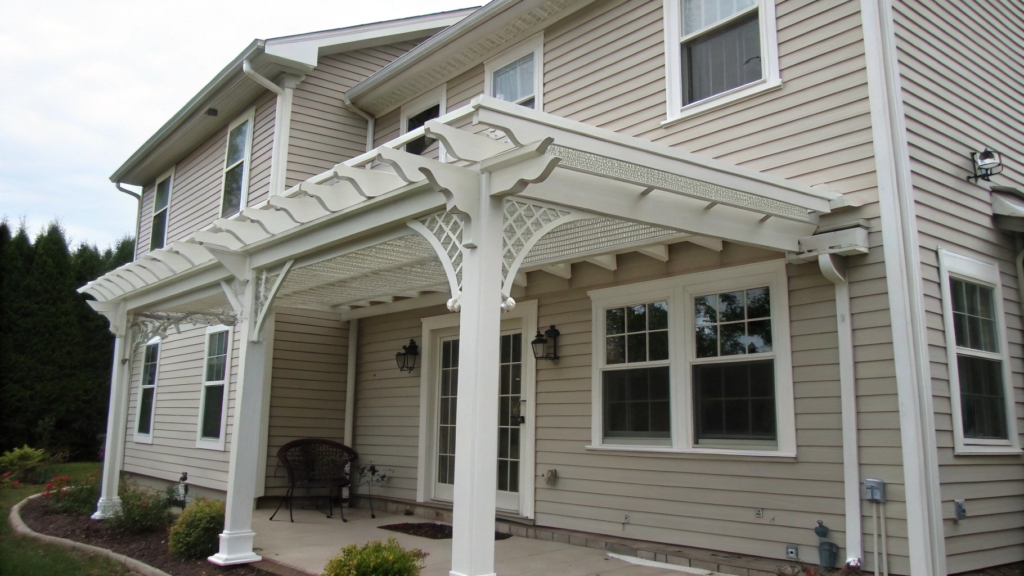
A pergola can look like an afterthought — or like it’s always been there. The difference is in the transition between the pergola and your house, especially if you want it to feel built-in, not just tacked on.
Why This Detail Matters
When your covered pergola is attached directly to the house, the joint line becomes the most visible spot. And if it looks sloppy — it ruins the whole vibe, no matter how pretty your table or flowy curtains are.
But framing that connection with siding trim or decorative molding makes magic happen: it visually merges the structure with the house itself.
How to Do It Right
- Match your house siding. If you have vinyl siding, use matching finishing pieces (like J-trim or end caps).
If it’s wood, build the transition with the same boards — or use painted fascia to mimic the look.
Important. Your trim color should either match exactly or contrast intentionally. Anything in between just looks off. - Cover the beam-to-wall seam. That’s the main eyesore. Whether your pergola beam cuts into the siding or just meets it — always run a trim board along the top edge to hide gaps and give it a clean, finished look.
- Use corner pieces, drip edges, and molding. If there are awkward joins or uneven cuts, use corner profiles to smooth it out.
And if rainwater runs off here, consider a small drip cap to channel it away from the wall. - Paint it all one color — or use contrast for effect. Sometimes a coat of paint is enough.
Other times, contrast works better — like dark pergola trim on a white wall. Classic and sharp.
Pro Tip. Still not sure how to blend the pergola in? Look at your windows and doors.
What kind of trim do they have? How are they framed?
Copy those lines, and your pergola will feel like a natural part of the architecture — not an add-on.
A friend of ours built a pergola right outside his back wall — nothing fancy, just covering an old concrete path.
At first… it looked like something from a hardware store demo. Just a pergola leaned up against the house, visually disconnected.
But the moment he added a white PVC trim where the beam met the wall — it transformed.
Suddenly it looked like it belonged there all along.
What About You?
If even one of these ideas hit home — tell us in the comments! Have you built your own pergola and figured out how to hide those awkward brackets? Or maybe you found the perfect fabric that shrugs off sun and rain?Your stories are more than feedback — they’re inspiration for the next DIYer.
And if you’ve got questions — ask away. I’m here and happy to help.