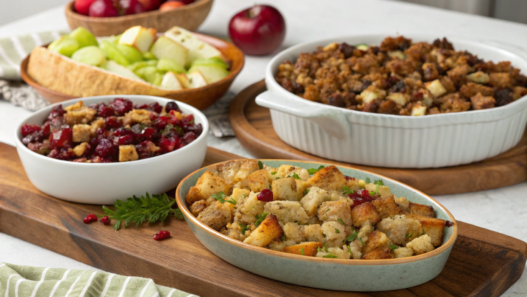
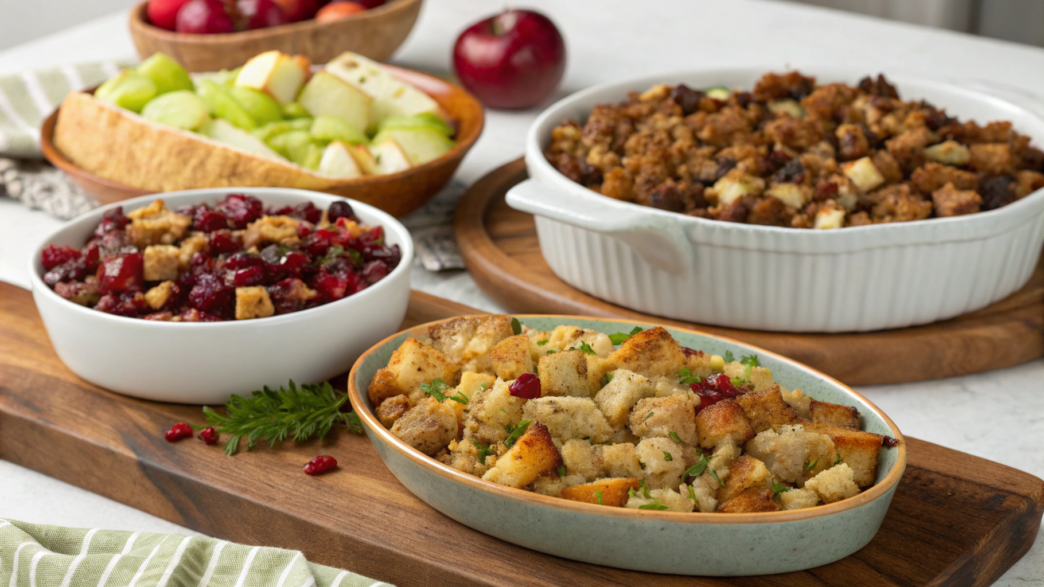
On Thanksgiving, stuffing is always somewhere next to the turkey, and you can keep everything as familiar as possible, but sometimes you just feel like trying something new. Even a small change in ingredients can make a pretty big difference. And I actually like that stuffing is easy to change depending on the dinner.
In this article, I’ve put together 10 stuffing variations for Thanksgiving 2026. And I’m definitely not suggesting you try to make all of them at once. Pick the one that fits your Thanksgiving table best this year, and let’s get started. Ready?
1. Traditional herb stuffing with golden brown perfection
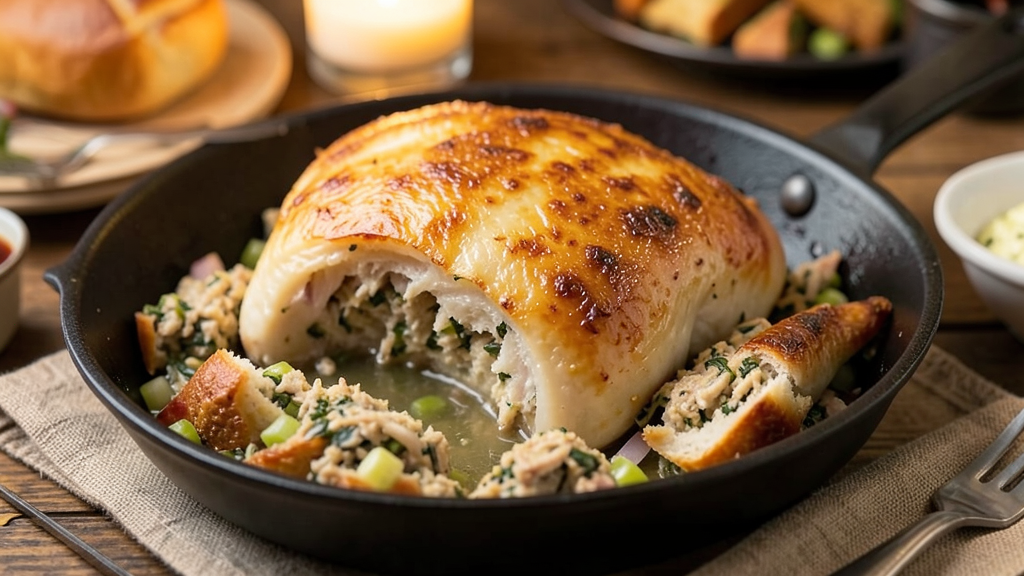
On Thanksgiving, I like to start with the classics. Bread, butter, celery, onion, and fresh herbs give you that familiar flavor that goes perfectly with roast turkey, gravy, and the other dishes on the Thanksgiving table.
There’s already plenty to do in the kitchen that day, so I appreciate recipes that don’t require twenty extra steps. The onion and celery cook in a skillet, the bread soaks up the broth and butter, and the oven does the rest. The top turns golden and slightly crisp, while the bread stays soft inside.
I cook this stuffing separately from the turkey. It makes it easier to control the amount of liquid and get more of those browned pieces around the edges, and then I can put the baking dish right on the table next to the sliced turkey, gravy, and the rest of the Thanksgiving dishes.
Ingredients
For 8–10 servings, you’ll need:
- 1 large loaf of white or country bread, cut into cubes, about 12–14 cups (around 350–400 g).
- ½ cup unsalted butter (113 g), plus a little more for the baking dish.
- 2 medium onions, finely chopped.
- 4 celery stalks, finely chopped.
- 2–2½ cups chicken or turkey broth (480–600 ml).
- 2 large eggs.
- 1 tablespoon fresh sage, finely chopped.
- 1 tablespoon fresh thyme.
- ¼ cup fresh parsley, chopped (around 15 g).
- 1 teaspoon salt, plus more to taste if needed.
- ½ teaspoon freshly ground black pepper.
How to make traditional herb stuffing
- Dry the bread first. Spread the bread cubes on a baking sheet and let them dry out ahead of time, or put them in the oven at 300°F (150°C) for about 20–30 minutes. They should feel dry on the outside, but there’s no need to turn them into dark, hard croutons. Dried bread absorbs the broth better and doesn’t fall apart as soon as you mix everything together.
- Cook the onion and celery. Melt the butter in a large skillet over medium heat. Add the onion and celery and cook for about 6–8 minutes, stirring occasionally. The vegetables should soften. There’s no need to brown them heavily.
- Add the herbs. Add the sage and thyme to the skillet, stir, and cook for about another minute. That’s plenty for fresh herbs. Then add the salt and black pepper.
- Mix everything with the bread. Transfer the dried bread cubes to a large bowl, then add the vegetables with the butter and the parsley. In a separate bowl, lightly beat the eggs with 2 cups of broth (480 ml), then gradually pour the mixture over the bread. Mix gently so the liquid is evenly distributed.
Don’t pour in all the broth at once. Look at the bread. It should be well moistened but not sitting in liquid. If some pieces are still completely dry, add a little more of the remaining broth.
- Bake covered first, then uncovered. Transfer the stuffing to a buttered baking dish and spread it out lightly without packing it down too much. Cover with foil and bake at 350°F (175°C) for about 25–30 minutes. Then remove the foil and bake for another 15–20 minutes, until the top and edges are golden brown.
Let the stuffing rest for 5–10 minutes before serving. This is one of those versions that doesn’t compete with the turkey for attention but complements it really well. Browned bread, butter, sage, and celery give you exactly the kind of flavor many people expect from food made for Thanksgiving.
2. Sausage and apple stuffing for sweet-savory lovers
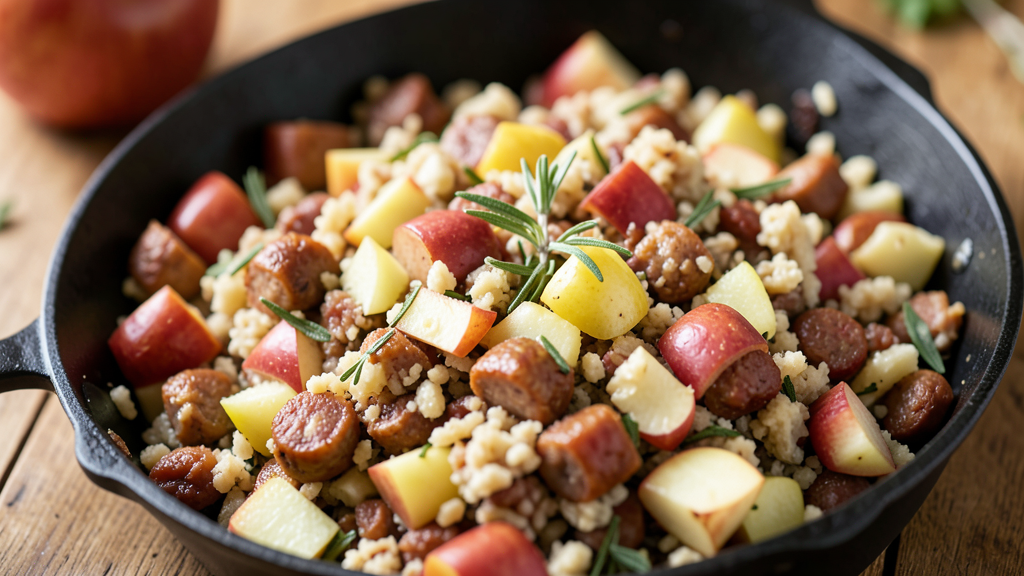
If classic stuffing feels a little too simple, the combination of sausage and apples makes it more interesting right away. The sausage adds richness, the apples bring a little sweetness and freshness, and the sage and thyme tie everything into those familiar Thanksgiving flavors. This stuffing goes really well with roast turkey.
For this stuffing, I use firm apples that won’t turn into mush after a few minutes in the skillet. Granny Smith, Honeycrisp, or Golden Delicious all work well.
Ingredients
For 8–10 servings, you’ll need:
- 1 large loaf of white or country bread, cut into cubes, about 10–12 cups (around 450–550 g).
- 1 pound pork sausage, casings removed (around 450 g).
- 6 tablespoons unsalted butter (85 g), plus a little more for the baking dish.
- 1 large onion, finely chopped.
- 3 celery stalks, cut into small pieces.
- 2 medium apples, cored and cut into cubes.
- 2–2½ cups chicken or turkey broth (480–600 ml).
- 2 large eggs.
- 1 tablespoon fresh sage, finely chopped.
- 1 teaspoon fresh thyme.
- ¼ cup fresh parsley, chopped.
- ½ teaspoon salt, then more to taste.
- ½ teaspoon freshly ground black pepper.
For browning the sausage and vegetables, a heavy cast-iron skillet works well, for example, Lodge Cast Iron Skillet.
How to make sausage and apple stuffing
- Dry the bread. Spread the cubes on a baking sheet and put them in the oven at 300°F (150°C) for about 20–30 minutes. The bread should dry out and firm up slightly, but it shouldn’t get deeply browned.
- Brown the sausage. Add it to a large skillet and cook over medium heat for about 6–8 minutes, breaking it into small pieces with a spatula. The sausage should be fully cooked and nicely browned. Transfer it to a plate.
- Cook the vegetables and apples. Melt the butter in the same skillet. Add the onion and celery and cook for about 5 minutes. Then add the apples, sage, and thyme and cook for another 3–4 minutes. The apples should soften a little but still hold their shape.
- Put the stuffing together. In a large bowl, combine the bread, sausage, vegetables, apples, and parsley. In a separate bowl, whisk the eggs with 2 cups of broth (480 ml), then gradually add the mixture to the bread. Mix gently. If the mixture still feels too dry, add the remaining broth a little at a time.
- Bake until the top is golden. Transfer the stuffing to a buttered baking dish. Cover with foil and bake at 350°F (175°C) for about 30 minutes. Remove the foil and bake for another 20–25 minutes, until the top is nicely browned. This method is also commonly used for classic sausage and apple stuffing.
Let the stuffing rest for about 10 minutes before serving. The bread on top should be nicely browned, while the inside stays soft and moist. Serve it next to the turkey and cranberry sauce, so you get the sweetness of the apples, the savory sausage, and the tart cranberry in the same bite.
3. Vegetarian cornbread stuffing loaded with flavor
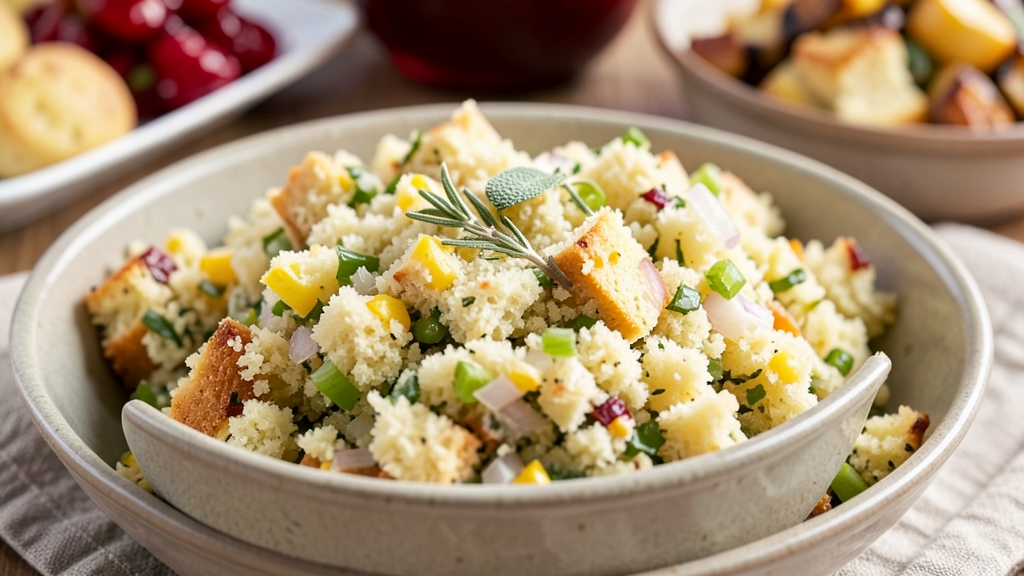
Cornbread changes stuffing quite a bit. It’s softer than regular white bread, crumbles more easily, and has a noticeable corn flavor. Celery, onion, garlic, sage, and thyme go really well with cornbread, while vegetable broth helps keep the stuffing soft and moist.
This stuffing is definitely worth having on the Thanksgiving table if some of your guests don’t eat meat. Cornbread pairs well with sage, celery, and onion, and you can serve it with potatoes, roasted vegetables, and cranberry sauce.
Ingredients
For 8 servings, you’ll need:
- 1 pan of cornbread, about 8–9 cups once cubed or broken into large pieces (around 450–500 g).
- 6 tablespoons unsalted butter (85 g), plus a little more for the baking dish.
- 1 large onion, finely chopped.
- 4 celery stalks, cut into small pieces.
- 2 garlic cloves, minced.
- 2–2½ cups vegetable broth (480–600 ml).
- 2 large eggs.
- 1 tablespoon fresh sage, finely chopped.
- 1 teaspoon fresh thyme.
- ¼ cup fresh parsley, chopped.
- ½ teaspoon salt, then more to taste.
- ½ teaspoon freshly ground black pepper.
How to make vegetarian cornbread stuffing
- Prepare the cornbread. Cut it into roughly 1-inch cubes or break it into large pieces by hand. If the cornbread is very fresh, spread it out on a baking sheet and dry it in the oven at 300°F (150°C) for about 20 minutes. It should lose some moisture without turning into hard croutons.
Cornbread is pretty delicate, so pieces that are too small can easily turn mushy later. In classic recipes, it’s also usually cooled or dried before mixing. - Cook the vegetables. Melt the butter in a large skillet over medium heat. Add the onion and celery and cook for 6–8 minutes, until softened. Then add the garlic, sage, and thyme and cook for about another minute.
I always keep an eye on the celery. If it still has a noticeable crunch, give it another couple of minutes instead of moving everything to the baking dish too soon. - Mix the stuffing. Transfer the cornbread to a large bowl and add the vegetables with the butter and parsley. In a separate bowl, whisk the eggs with some of the vegetable broth, then gradually pour the mixture over the cornbread. Gently mix with a large spoon or spatula, trying not to break the bread up too much.
If the stuffing still feels a little dry, add the remaining broth a little at a time. The bread should be well moistened, but there shouldn’t be any liquid pooling at the bottom of the bowl. - Bake. Transfer everything to a buttered 9 × 13-inch baking dish (23 × 33 cm). Cover with foil and bake at 375°F (190°C) for about 30 minutes. Then remove the foil and bake for another 15–20 minutes, until the edges and top are browned. Let the stuffing rest for 10 minutes after it comes out of the oven. This two-step method helps keep the center moist while letting the top dry out a little.
On Thanksgiving, this stuffing stands on its own, not just as a vegetarian alternative. Lindy usually keeps an eye on the cornbread so it doesn’t get too soggy. She always gets it right, so the result is a soft center, a browned top, and a really tasty combination with cranberry sauce, roasted vegetables, and potatoes.
4. Crockpot stuffing for stress-free cooking
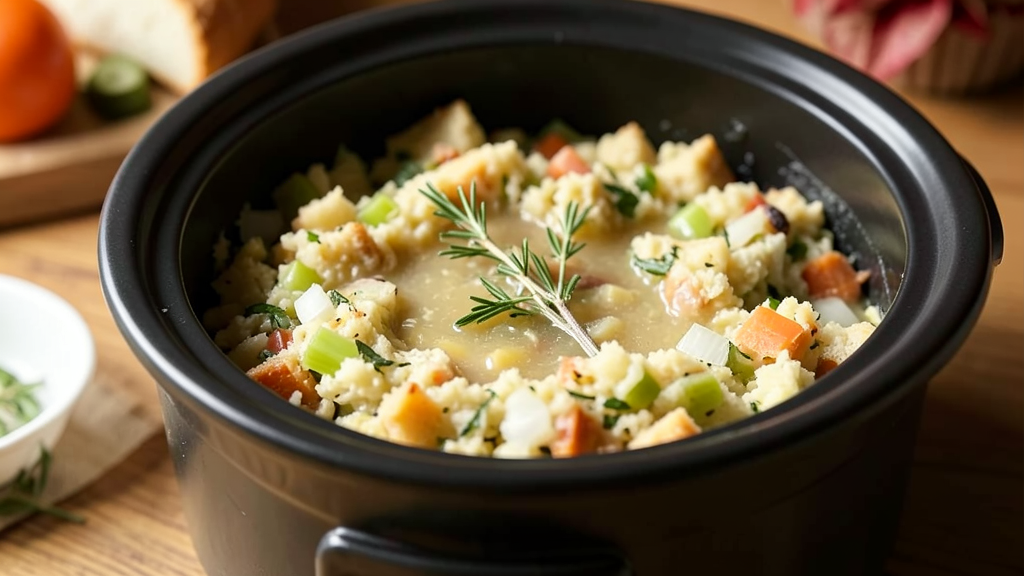
On Thanksgiving, the oven is almost always busy. Turkey, vegetables, pie, sometimes all at once. The crockpot, as usual, comes to the rescue. The stuffing itself stays pretty classic. Bread, onion, celery, butter, sage, and thyme, just cooked without a baking dish and without having to find one more open spot in the oven.
In the crockpot, the center stays soft and soaks up the broth well. For Thanksgiving, it’s a very practical way to make a big batch and keep it hot until it’s time to serve.
Ingredients
For 10–12 servings, you’ll need:
- 1 large loaf of firm white bread or sourdough, cut into cubes, about 10 cups (around 450–500 g).
- 4 tablespoons unsalted butter (57 g).
- 2 medium onions, finely chopped.
- 4 celery stalks, cut into small pieces.
- 3 garlic cloves, minced.
- 2 large eggs.
- 3 cups chicken, turkey, or vegetable broth (around 710 ml).
- ¼ cup fresh sage, finely chopped.
- 1 tablespoon fresh thyme.
- ½ teaspoon salt.
- Freshly ground black pepper to taste.
For this amount, a 6-quart crockpot works well, for example, Crock-Pot 6 Quart Slow Cooker.
How to make stuffing in a crockpot
- Dry the bread well. This is especially important for crockpot stuffing because very little moisture escapes while it cooks. Spread the bread on a baking sheet and dry it in the oven at 225°F (around 105°C), turning it occasionally, until the cubes are dry and crisp. You can also do this the day before and leave the bread until morning. Well-dried bread absorbs the broth better and holds its shape.
- Cook the vegetables. Melt the butter in a large skillet, add the onion, celery, and garlic, and cook for about 8–10 minutes. The vegetables should soften noticeably. Add the sage and thyme during the last couple of minutes. Taste the celery before taking the skillet off the heat. If it’s still too crunchy, give the vegetables a little more time.
- Mix the bread with the vegetables. Transfer the dried bread to a large bowl. Take the skillet off the heat and add the onion, celery, garlic, herbs, and all the butter from the skillet to the bread. In a separate bowl, whisk the eggs with some of the broth, salt, and pepper. Gradually pour this mixture over the bread and mix gently. If some dry pieces remain, add the rest of the broth a little at a time.
- Transfer everything to the crockpot. Lightly grease the insert and add the prepared bread mixture. Spread it out loosely without pressing it down with a spoon. The crockpot shouldn’t be filled more than about two-thirds full.
- Cook the stuffing. Cover the crockpot and cook on high for 1 hour. Then switch to low and cook for another 2–3 hours. Before serving, check the temperature in the center with a thermometer. It should reach 160°F (71°C).
By the evening on Thanksgiving, the kitchen is usually running at full speed. The turkey and gravy are almost ready, and guests are starting to arrive… By then, the stuffing can be transferred to a nice serving dish, topped with fresh parsley, and placed next to the turkey, gravy, and cranberry sauce. Whew, everything’s ready!
5. Southern-style cornbread and sausage dressing
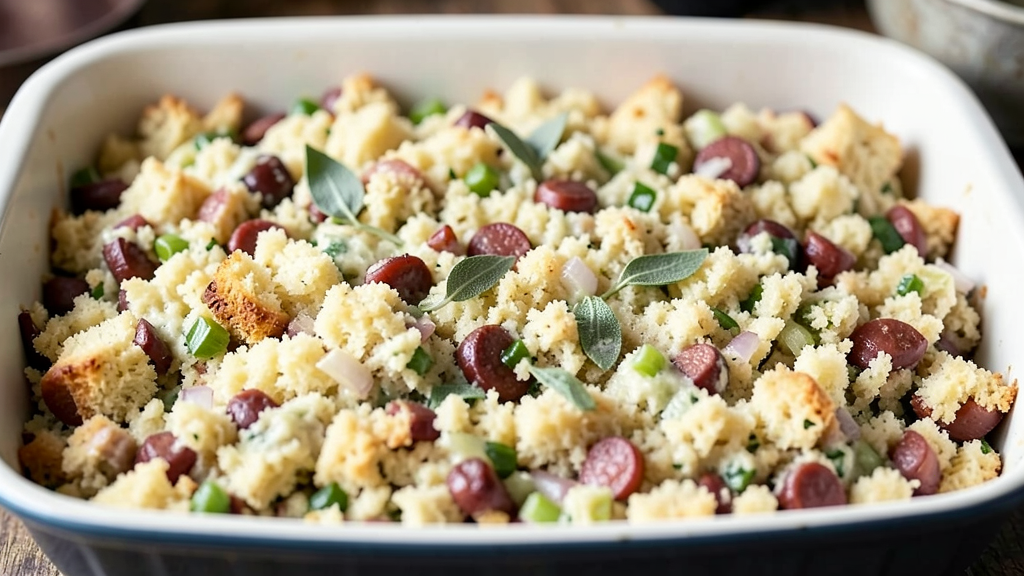
Southern-style dressing is noticeably different from regular bread stuffing. The base is cornbread instead of white bread, so the texture is softer and more crumbly. Add pork sausage, celery, onion, and sage, and you get a dish that feels right at home on Thanksgiving.
And yes, this one is specifically dressing. It’s cooked separately from the turkey, usually in a wide baking dish. For this version, I use unsweetened cornbread, or at least one with very little sugar. A sweeter cornbread takes the whole dish in a very different direction once sausage is added.
Ingredients
For 8–10 servings, you’ll need:
- 1 pan of cornbread, broken into large pieces, about 8 cups (around 450–500 g).
- 1 pound pork sausage (around 450 g), casings removed.
- 4 tablespoons butter (57 g), plus a little more for the baking dish.
- 1 large onion, finely chopped.
- 4 celery stalks, finely chopped.
- 2 garlic cloves, minced.
- 2 large eggs.
- 2½–3 cups chicken or turkey broth (600–710 ml).
- 1 tablespoon fresh sage, finely chopped.
- 1 teaspoon fresh thyme.
- ¼ cup fresh parsley, chopped.
- ½ teaspoon black pepper.
- Salt to taste.
How to make southern cornbread and sausage dressing
- Prepare the cornbread. It’s better to bake it the day before and let it cool completely. Then break it into small, uneven pieces with your hands. Don’t turn it into fine crumbs. Larger pieces hold up better once the broth is added.
- Brown the sausage. Add the sausage to a large skillet and cook over medium heat, breaking it into small pieces with a spatula. Once it’s nicely browned and fully cooked, transfer it to a large bowl. Don’t pour out all the fat from the skillet. Leave a little behind for the vegetables.
- Cook the vegetables. Add the butter, onion, and celery to the same skillet. Cook for about 6–8 minutes, until the vegetables are soft. Then add the garlic, sage, and thyme and cook for about another minute. I usually don’t rush this step. The onion should already be soft and translucent, and the celery shouldn’t still be raw in the middle.
- Put the dressing together. Add the cornbread, cooked vegetables with the butter from the skillet, and parsley to the bowl with the sausage. In a separate bowl, whisk the eggs with some of the broth, then gradually pour the mixture over the cornbread.
Mix gently. If there are still dry spots, add the remaining broth. The mixture should be noticeably moist, but the cornbread should still keep some of its texture. - Bake. Transfer the mixture to a buttered baking dish and spread it out without packing it down too much. Bake at 350°F (175°C) for about 35–45 minutes. By the end, the top should be browned and the edges slightly dry. Let the dressing rest in the baking dish for about 10 minutes before serving.
On Thanksgiving, dressing is served next to the turkey and gravy. You can add it to the plate with the meat, cranberry sauce, and vegetables. If you have a big group of friends and family around the table, making a larger batch definitely won’t hurt — cornbread and sausage make this side pretty filling.
6. Wild rice and cranberry stuffing with autumn flair
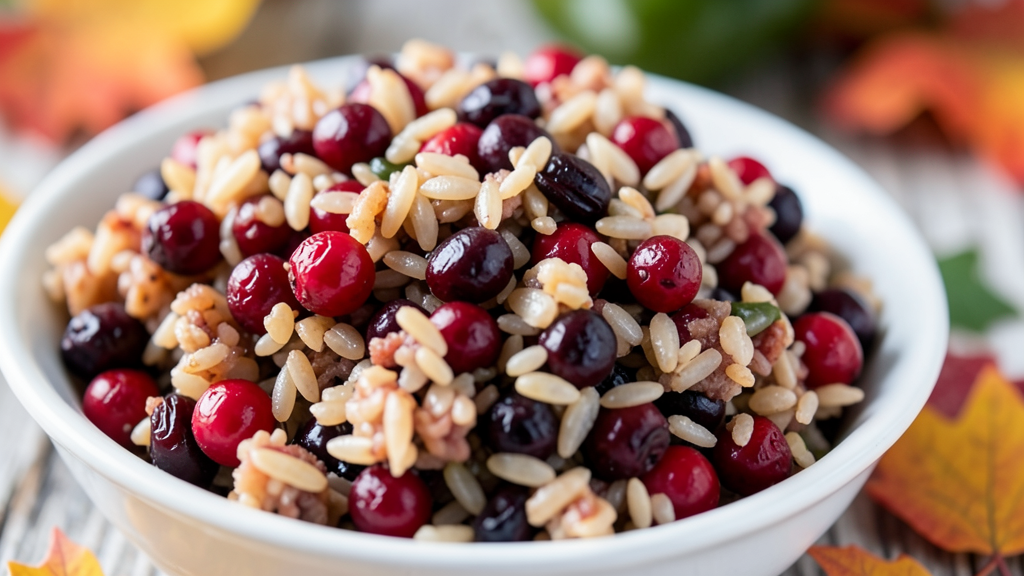
Cranberries have long been tied to fall and Thanksgiving for me, and they pair really well with wild rice. This stuffing is different from classic bread stuffing and brings something new to the table if you’ve already made the usual recipes plenty of times.
You won’t need bread at all for this one. Wild rice is the base, and everything else gets added after it’s cooked.
Ingredients
For 6–8 servings, you’ll need:
- 1½ cups wild rice (around 240 g).
- 4 cups vegetable or chicken broth (around 950 ml).
- 4 tablespoons butter (57 g).
- 1 medium onion, finely chopped.
- 3 celery stalks, finely chopped.
- 1 teaspoon fresh thyme.
- ½ cup dried cranberries (around 65 g).
- ½ cup pecans, roughly chopped.
- ¼ cup fresh parsley, chopped.
- Salt and freshly ground black pepper to taste.
How to make wild rice and cranberry stuffing
- Cook the wild rice. Rinse it well first, then transfer it to a saucepan and pour in the broth. Bring to a boil, reduce the heat, and cover. Wild rice usually takes about 45–60 minutes. By the end, some of the grains will split open. Taste it before taking the pan off the heat. If the grains are still too firm inside, give them a little more time. Drain any remaining liquid.
- Toast the pecans. Add the nuts to a dry skillet and warm them over medium heat for a few minutes, stirring occasionally. As soon as you get a strong nutty smell, take them off the heat. I try not to walk away from the skillet at this point. With pecans, literally a couple of extra minutes can make all the difference.
- Cook the vegetables. Melt the butter in a large skillet, add the onion and celery, and cook for about 8–10 minutes. The onion should become soft and translucent, and the celery should soften noticeably. Add the thyme and cook for about another minute.
- Put the stuffing together. Transfer the cooked rice to a large bowl. Add the vegetables along with the butter from the skillet, the dried cranberries, parsley, and toasted pecans. Mix, then taste before adding salt. If the rice was cooked in fairly salty broth, you may need very little extra salt.
- Heat before serving. Transfer everything to a lightly buttered baking dish, cover with foil, and bake at 350°F (175°C) for about 25–30 minutes. The stuffing should be heated through. Remove the foil after baking and let it rest for a few minutes before serving.
I love Thanksgiving less for any one specific dish and more for the long dinner itself, when nobody at the table is in a rush anymore. You can have friends over, open another bottle of wine, talk for hours, and slowly try a little of everything you made. For a dinner like that, I never mind the time spent cooking, and I always want to make something really good.
7. Mushroom and thyme stuffing for rich depth

Mushroom stuffing has a richer flavor than the classic herb version. Mushrooms, thyme, and butter give it a more pronounced taste that pairs well with turkey, potatoes, and gravy.
On Thanksgiving, you can serve it as the main stuffing alongside the turkey. The mushrooms make the familiar dish a little more interesting, while the recipe still feels recognizable for a holiday dinner.
Ingredients
For 8–10 servings, you’ll need:
- 1 large loaf of white or country bread, cut into cubes, about 10–12 cups (around 450–500 g).
- 1 pound mushrooms (around 450 g), sliced.
- 6 tablespoons unsalted butter (85 g).
- 1 large onion, finely chopped.
- 3 celery stalks, cut into small pieces.
- 2 garlic cloves, minced.
- 2 large eggs.
- 2–2½ cups vegetable or chicken broth (480–600 ml).
- 1 tablespoon fresh thyme.
- ¼ cup fresh parsley, chopped.
- ½ teaspoon salt, then more to taste.
- ½ teaspoon freshly ground black pepper.
How to make mushroom and thyme stuffing
- Dry the bread. Spread the cubes on a baking sheet and put them in the oven at 300°F (150°C) for about 20–30 minutes. The bread should dry out without becoming dark or hard. Then transfer it to a large bowl.
- Brown the mushrooms well. Melt some of the butter in a wide skillet and add the mushrooms. Don’t overcrowd the skillet, or they’ll start steaming instead of browning. Cook over medium to medium-high heat, stirring occasionally, until most of the liquid has evaporated and the edges of the mushrooms are browned. Transfer them to the bowl with the bread.
- Cook the vegetables. Add the remaining butter, onion, and celery to the same skillet. Cook for about 6–8 minutes, until softened. Then add the garlic and thyme and cook for about another minute. Lindy sometimes puts a couple of mushrooms back into the skillet at this point just to taste them with the vegetables and check the salt. By then, it’s already pretty clear how much seasoning the stuffing will need.
- Put the stuffing together. Add the vegetables along with the butter from the skillet to the bread and mushrooms. Add the parsley. In a separate bowl, whisk the eggs with some of the broth, then gradually pour the mixture over the bread. Mix gently. If there are still dry pieces, add the remaining broth a little at a time.
- Bake. Transfer the stuffing to a buttered baking dish and spread it out loosely without pressing it down. Cover with foil and bake at 350°F (175°C) for about 25–30 minutes. Then remove the foil and bake for another 15–20 minutes, until the top is browned. Let the stuffing rest for a few minutes before serving.
I like that Thanksgiving doesn’t have to look exactly the same every year. This time, mushroom stuffing can take the place of the classic version. It’s nice when the food on the holiday table changes a little from year to year.
8. Apple and walnut stuffing with fresh sage

Apples and sage have been part of Thanksgiving recipes for a long time, and they work really well in stuffing too. The apples add a little sweetness, the walnuts bring some crunch, and fresh sage gives the flavor more punch. This stuffing is a great match for turkey at a holiday dinner.
Ingredients
For 8–10 servings, you’ll need:
- 1 large loaf of white or country bread, cut into cubes, about 10–12 cups (around 450–500 g).
- 2 medium apples, cored and cut into cubes.
- ¾ cup walnuts, roughly chopped.
- 6 tablespoons unsalted butter (85 g), plus a little more for the baking dish.
- 1 large onion, finely chopped.
- 3 celery stalks, cut into small pieces.
- 2 large eggs.
- 2–2½ cups chicken or turkey broth (480–600 ml).
- 1½ tablespoons fresh sage, finely chopped.
- ¼ cup fresh parsley, chopped.
- ½ teaspoon salt, then more to taste.
- Freshly ground black pepper to taste.
How to make apple, walnut, and sage stuffing
- Dry the bread. Spread the cubes on a baking sheet and put them in the oven at 300°F (150°C) for about 20–30 minutes. The bread should dry out on the outside without getting too dark. Then transfer it to a large bowl.
- Cook the apples and vegetables. Melt the butter in a large skillet. Add the onion and celery and cook for about 5–6 minutes. Then add the apples and cook for another 4–5 minutes. They should soften a little without falling apart.
Add the fresh sage at the very end and cook for about another minute. - Put the stuffing together. Add everything from the skillet, including the butter, to the bread. Add the parsley and toasted walnuts. In a separate bowl, whisk the eggs with some of the broth, then gradually pour the mixture over the bread. Mix gently. If there are still dry spots, add the remaining broth a little at a time.
- Bake. Transfer the stuffing to a buttered baking dish. Cover with foil and bake at 350°F (175°C) for about 30 minutes. Then remove the foil and bake for another 20–25 minutes, until the top is browned. This helps keep the center soft while making the top a little crispier.
On Thanksgiving, I love that moment when everyone is finally seated, the plates start making their way around the table, and everyone takes a little of everything. That’s when I finally stop checking the clock and relax — everything is ready and everyone is here. The celebration has started.
9. Easy stove top stuffing reinvented
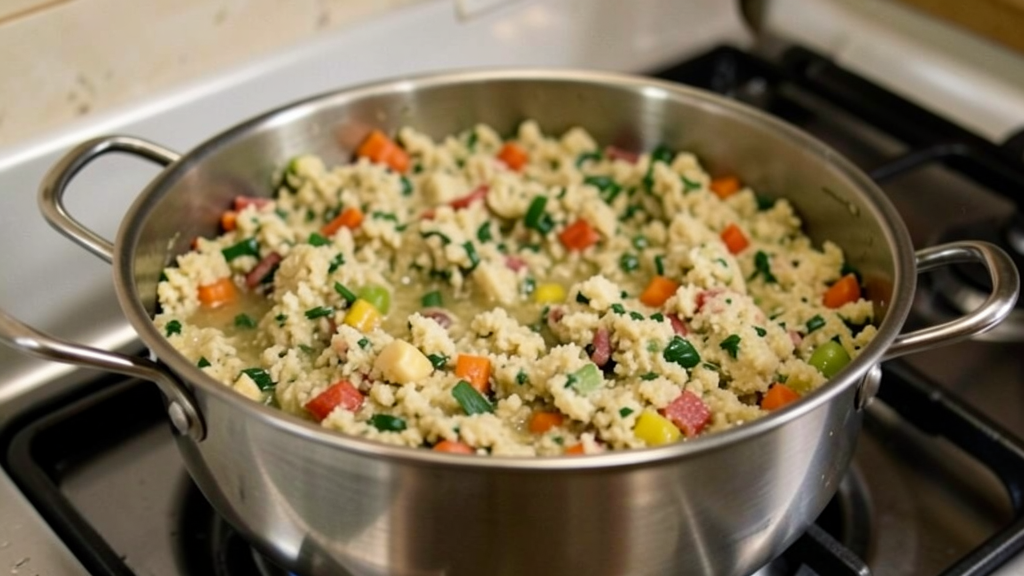
Sometimes there just isn’t room in the oven for one more baking dish, especially when the turkey is already in there. In that case, you can make stuffing right on the stove, and the whole process happens in one large pot.
This way, everything is easy to control as you go. You can see how much broth the bread has absorbed, how soft the vegetables are, and whether the stuffing needs a few more minutes under the lid.
Ingredients
For 6–8 servings, you’ll need:
- 1 large loaf of white or country bread, cut into cubes, about 8–10 cups (around 400–450 g).
- 5 tablespoons unsalted butter (70 g).
- 1 large onion, finely chopped.
- 3 celery stalks, cut into small pieces.
- 2 garlic cloves, minced.
- 2–2½ cups chicken, turkey, or vegetable broth (480–600 ml).
- 1 tablespoon fresh sage, finely chopped.
- 1 teaspoon fresh thyme.
- ¼ cup fresh parsley, chopped.
- ½ teaspoon salt, then more to taste.
- Freshly ground black pepper to taste.
How to make stuffing on the stove
- Prepare the bread ahead of time. Cut the bread into cubes and let them dry out at room temperature for a few hours or overnight. You can also dry the bread in the oven the day before, let it cool completely, and store it until the next day. Another option is to use ready-made unseasoned dried bread cubes for stuffing, and then you won’t need the oven at all.
- Cook the vegetables. Melt the butter in a large pot over medium heat. Add the onion and celery and cook for about 6–8 minutes, until softened. Then add the garlic, sage, and thyme and cook for about another minute.
- Add the bread. Add the dried bread cubes directly to the pot with the vegetables and gently mix so the butter and herbs are distributed through the bread.
- Pour in the broth. Add some of the broth first and stir gently. Cover the pot and leave it over low heat for about 5 minutes. Then uncover it and check the bread. If it still looks noticeably dry, add the remaining broth a little at a time. The stuffing should become soft without turning into a soggy mixture.
- Finish cooking under the lid. Cover the pot again and cook over low heat for another 8–10 minutes. Stir gently a couple of times so the bottom layer doesn’t start sticking. Add the parsley at the very end, taste, and add more salt and pepper if needed.
On Thanksgiving, there’s already plenty happening at the stove, so I leave this stuffing until the very end. It cooks quickly, doesn’t take up oven space, and stays hot until serving. I transfer it to a big serving bowl, put it next to the turkey — and that’s it, time to call everyone to the table.
10. Classic bread stuffing with buttered celery and onions
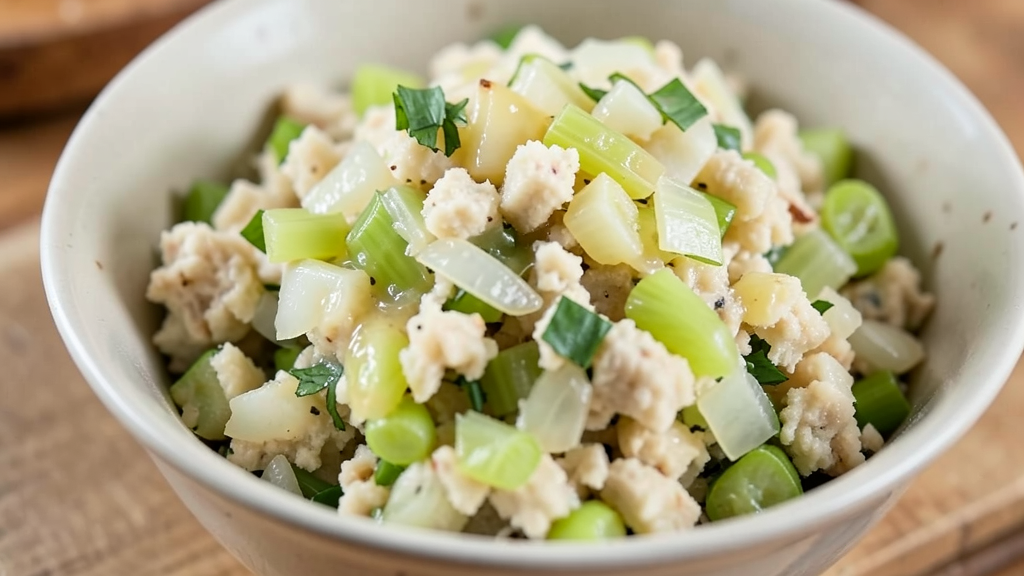
Classic recipes never let you down in the kitchen. Dried bread, plenty of butter, onion, celery, and a few fresh herbs. That’s it. No fruit, nuts, or sausage.
In this version, the onion and celery cook in butter long enough to become soft and soak up the flavor. That keeps the stuffing from turning out dry, even though the ingredient list is pretty simple.
Ingredients
For 8–10 servings, you’ll need:
- 1 large loaf of white or country bread, cut into cubes, about 10–12 cups (around 450–500 g).
- 8 tablespoons unsalted butter (113 g), plus a little more for the baking dish.
- 2 medium onions, finely chopped.
- 4 celery stalks, cut into small pieces.
- 2 large eggs.
- 2–2½ cups chicken or turkey broth (480–600 ml).
- 1 tablespoon fresh sage, finely chopped.
- 1 teaspoon fresh thyme.
- ¼ cup fresh parsley, chopped.
- ½ teaspoon salt, then more to taste.
- Freshly ground black pepper to taste.
How to make classic bread stuffing with onion and celery
- Prepare the bread. Cut it into cubes and dry it well. You can do this ahead of time and leave the bread out overnight at room temperature, or dry it in the oven the day before. Fresh, soft bread absorbs broth too quickly and is more likely to turn into a dense mixture.
- Cook the onion and celery. Melt the butter in a large skillet over medium heat. Add the onion and celery and cook for about 8–10 minutes, stirring occasionally. Don’t rush this step. The onion should turn translucent and the celery should be soft. Add the sage and thyme at the end and cook for about another minute.
- Mix everything with the bread. Transfer the dried bread to a large bowl and add everything from the skillet, including all the butter. I try to stir the bread a few times right away with a large spoon while the butter is still hot, so it coats the cubes instead of settling at the bottom of the bowl.
- Add the eggs and broth. In a separate bowl, whisk the eggs with some of the broth, then gradually pour the mixture over the bread. Mix gently. Then add the remaining broth a little at a time until there are almost no dry cubes left. The stuffing should be moist but still hold its shape.
- Bake. Transfer the stuffing to a buttered baking dish and spread it into an even layer. Cover with foil and bake at 350°F (175°C) for about 30 minutes. Then remove the foil and bake for another 15–20 minutes, until the top is nicely browned. Let the stuffing rest for a few minutes before serving.
On Thanksgiving, there should be a few simple dishes that don’t need any experimenting. The big turkey is already on the table, everyone is sitting down, plates are making their way around, and everyone is taking a little of their favorite dishes. All the people I love are right there with me — the holiday turned out just right!
What are we making this year?
Thanksgiving has never been just about the perfect menu for me. I think more about that moment when the house is already full of people and getting a little noisy. Someone is talking across the table, someone is asking for the turkey, and someone is already looking at dessert. I love those moments.
You can make the stuffing your family has known for years, or choose a mushroom, apple, cornbread, or wild rice version this time. Lindy and I change our holiday dishes little by little too.
Tell me in the comments what kind of stuffing you make for Thanksgiving. Do you stick with a family recipe, or do you try something new every year?